Guns N’ Roses guitarist Slash has a newly discovered snake named after him
Genetics and anatomy revealed a reddish-brown New Guinea snake that scientists had mistaken for another species.

 Edited By: Joshua Shavit

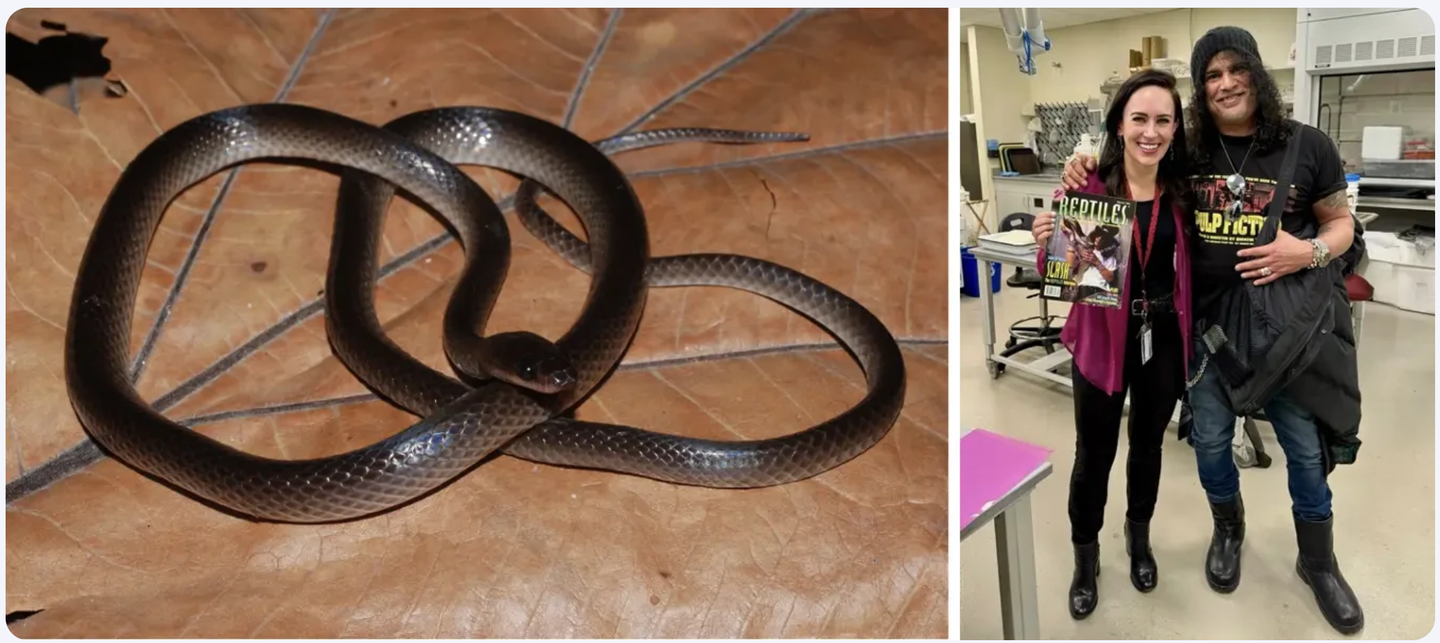
Left: Slash’s groundsnake, Lielaphis slashi, in New Guinea. Photo credit: Chris Austin. Right: Slash and Sara Ruane at the Field Museum, with Sara’s copy of Reptiles Magazine featuring Slash on the cover. (CREDIT: Sara Ruane)
- A newly described groundsnake from Papua New Guinea has been named Lielaphis slashi after Guns N’ Roses guitarist Slash, a lifelong reptile enthusiast.
- Genetic analyses, scale counts, anatomy and habitat modeling showed that the reddish-brown snake represents a species distinct from its closest relatives.
- The discovery raises the known number of Lielaphis species to 20 and highlights how much of New Guinea’s snake diversity remains undocumented as forests face growing pressure.
A reddish-brown snake collected from a New Guinea forest nearly two decades ago has turned out to be something no scientist had formally recognized before. Its new name connects one of the world’s richest tropical ecosystems with one of rock music’s most recognizable guitarists.
The snake is Lielaphis slashi, or Slash’s groundsnake, named for Guns N’ Roses guitarist Saul Hudson, better known as Slash.
The name reflects more than celebrity. Slash has long been a reptile enthusiast and supporter of museums, zoos and natural history.
“As a long time herpephile, I am extremely honored and humbled to have Lielaphis slashi from New Guinea named after me. It is really exciting, I never would have imagined this moment would arrive,” Slash said.
Researchers describe the species in the journal Zootaxa. The work combined genome-wide genetic data, physical measurements and ecological modeling to sort through a difficult group of New Guinea groundsnakes.
A snake collected in the dark
The story began on July 4, 2006, near Utai Village in Papua New Guinea’s Sanduan Province.
Christopher Austin, a professor and curator of herpetology at the Louisiana State University Museum of Natural Science, was conducting fieldwork when he encountered an unfamiliar snake.
“These New Guinea groundsnakes are nocturnal, so the best way to find them is at night. They are typically found just after sunset at the base of large trees where they are looking for something to eat,” Austin said.
Searching for them carries its own risks.
“When working at night in New Guinea you need to be very careful as there are several highly venomous species that look very similar to the non-venomous groundsnakes,” Austin said.
The specimen eventually designated as the holotype, the individual used to formally define the species, was an adult male. It measured 726 millimeters from snout to vent, with a 285-millimeter tail.
different colors, across seven recognized and putative Lielaphis taxa delineated by vertical black lines. (CREDIT: Christopher Austin et al, Zootaxa)
Other specimens came from Utai Village and Kalibobo Point in Madang Province.
At first, their appearance did not make their identity obvious.
The snakes had previously been identified as Lielaphis parvus. But that species is known from Yapen Island in Indonesia, while the newly studied snakes came from mainland New Guinea north of the Central Cordillera.
That mismatch raised questions.
DNA separates an overlooked species
Sara Ruane, the Field Museum’s associate curator of herpetology, began collaborating with Austin after completing her doctorate in 2016.
The researchers examined a broad collection of Lielaphis specimens and tissue samples from museums and field collections.
Their genetic dataset included tissue from 90 Lielaphis snakes. Altogether, sequencing produced 4,870 ultraconserved elements, stretches of DNA useful for comparing evolutionary relationships. The researchers retained 4,137 of those elements in their main dataset.
They also examined mitochondrial DNA and analyzed genetic population structure.
“Using multiple cutting-edge genetic analyses, we found that L. slashi is genetically distinct from other similar snakes in the same genus,” said Tianqi Huang, the study’s first author and a postdoctoral researcher at the Field Museum.
DNA was only part of the evidence.
“The combination of physical characteristics, like differences in numbers of scales when compared with other species, and the genetic evidence is what led us to realize that it is an entirely new species. We also used ecological modeling to show that L. slashi's preferred habitat is different from similar snakes,” Huang said.
The new species has 17 rows of scales around the middle of its body, 165 to 181 ventral scales and 83 to 107 divided scales beneath its tail.
Its back is reddish-brown and lacks a distinct pattern. The underside is white or cream.
Ecological modeling also suggested that Yapen Island, home to true L. parvus, offers poor habitat for the newly recognized lineage. The average modeled habitat suitability there was 0.27, while areas with suitability above 0.70 occurred mainly in eastern lowland mainland New Guinea.
Why Slash became part of the story
For Ruane, the species name connects her scientific career with an interest that began years before she became a herpetologist.
“Guns N’ Roses has been one of my favorite bands since I was in first grade, and by fifth grade, I had already told my teacher that I wanted to be a herpetologist-- a scientist who studies reptiles-- when I grew up,” Ruane said.
A magazine cover left an especially strong impression.
“So when I was twelve years old and got my copy of Reptiles Magazine in the mail and it had a picture of Slash holding his pet reticulated python on the cover, I thought, ‘This guy is so cool.’”
Years later, Ruane revisited that interview.
“I reread his interview, and he talked about how much he loves museums and zoos and natural history, and about how when he was a kid, he’d go outside and look for snakes-- it was all stuff that I really related to, and it made me think that he’d be a great person to name a new species after,” Ruane said.
The species description also notes Slash’s long-running advocacy for snakes and his support for museums and zoos.
A secretive hunter in New Guinea's forests
Scientists still know little about how L. slashi behaves.
“It’s incredibly hard to observe snakes in the wild before they slither away, so our knowledge about L. slashi is limited,” Ruane said.
Its anatomy offers some clues.
“Snakes in this genus often have large teeth in the back of their mouths, which New Guinea groundsnakes may use to grab on to and eat small, slippery-scaled lizards and the eggs of other reptiles; this snake isn't grasping and squeezing its prey like a boa constrictor,” Ruane said.
The species is not considered dangerously venomous to humans.
Known specimens came from largely undisturbed secondary forest north of New Guinea’s Central Cordillera. The documented range includes Sanduan, East Sepik and Madang provinces in Papua New Guinea. The snake may also occur in Indonesia’s Papua Province north of the central mountains.
The Central Cordillera has acted as an important geographic barrier for Lielaphis snakes. Its rise during the late Miocene helped divide habitats across the island.
Before the new description, researchers recognized 19 Lielaphis species. L. slashi brings the total to 20.
The researchers also identified another unusual lineage related to Lielaphis aplini. It differed physically from known populations, but the genetic evidence was not strong enough for the team to recognize it as a separate species. For now, the researchers consider it a possible northern brown form of L. aplini.
Practical implications of the research
Documenting New Guinea’s reptiles carries consequences beyond taxonomy.
“The habitats that Slash’s groundsnake is from are under threat from industries like coffee farming and mining,” Ruane said.
New Guinea has long been recognized for extraordinary biodiversity, yet many of its animals remain poorly studied. Logging, industrial plantations and other land changes add urgency to efforts to document species before habitats are altered.
“That’s part of why describing the species that live there is important. Every species should be recognized in order for us to better understand how ecosystems work, how everything fits into the environment. We can't conserve animals or other living things that we don't know about,” Ruane said.
The new species also shows how museum collections, fieldwork and modern genetic tools can reveal biodiversity that has been overlooked for years.
For Lielaphis, that work is far from finished. The genus includes secretive, ground-dwelling snakes that are difficult to observe and collect. The researchers conclude that additional sampling and higher-resolution genetic analyses will likely clarify more of New Guinea’s still-unresolved snake diversity.
Dig deeper into New Guinea snake diversity and taxonomy
These resources explore New Guinea’s overlooked snake diversity, genomic approaches to reconstructing reptile evolution, museum-based species discovery and the growing pressures on the island’s forests.
Systematics and biogeography of a Sunda-Papuan snake lineage (Natricidae: Tropidonophis Jan 1863)
Using nearly 3,000 nuclear genomic loci, researchers reconstructed the evolution of Sunda-Papuan keelback snakes and linked rapid diversification in New Guinea to the rise of the Central Cordillera, providing important context for how the island’s geology shaped its exceptional snake diversity. (Zoological Journal of the Linnean Society, 2024)
A new species of New Guinea Worm-Eating Snake (Serpentes, Elapidae, Toxicocalamus Boulenger, 1896) from Western Highlands Province, Papua New Guinea
Researchers identified a previously overlooked snake species from a museum specimen collected in 1967, using scale anatomy and micro-CT imaging to distinguish it from related species. The work shows how natural history collections can reveal New Guinea biodiversity decades after specimens were collected. (Zoosystematics and Evolution, 2022)
A striking new species of Papuan groundsnake (Stegonotus: Colubridae) from southern Papua New Guinea, with a dichotomous key to the genus in New Guinea
This research described the groundsnake now known as Lielaphis aplini from Papua New Guinea and documented the physical traits separating it from related snakes. It also provided an identification key for the region’s groundsnakes, making it especially relevant to continuing efforts to resolve Lielaphis diversity. (Zootaxa, 2021)
Forest loss in Indonesian New Guinea (2001–2019): Trends, drivers and outlook
Satellite analysis found that Indonesian New Guinea lost about 750,000 hectares of old-growth forest from 2001 through 2019, with plantations, roads, mining and other development among the drivers. The research also modeled substantial additional forest loss under continued development, underscoring conservation pressures on habitats that may contain undescribed species. (Biological Conservation, 2021)
Cryptic and non-cryptic diversity in New Guinea ground snakes of the genus Stegonotus Duméril, Bibron and Duméril, 1854: a description of four new species (Squamata: Colubridae)
Combining molecular evidence with museum specimens, researchers uncovered four previously unrecognized New Guinea groundsnake species and concluded that diversity within the group had been substantially underestimated. The work laid important groundwork for the genetic and morphological approach now being used to untangle Lielaphis taxonomy. (Journal of Natural History, 2018)
Research findings are available online in the journal Zootaxa.
The original story "Guns N’ Roses guitarist Slash has a newly discovered snake named after him" is published in The Brighter Side of News.
Related Stories
- 80-million-year-old snake fossil rewrites the story of snake evolution
- Snake blood proteins could lead to a more powerful antivenom treatment
- At 23ft and 8 inches, 'The Baroness' is the world’s longest wild snake
Like these kind of feel good stories? Get The Brighter Side of News' newsletter.
Hannah Shavit-Weiner
Medical & Health Writer
Hannah Shavit-Weiner is a Los Angeles–based medical and health journalist for The Brighter Side of News, an online publication focused on uplifting, transformative stories from around the globe. Having published articles on AOL.com, MSN and Yahoo News, Hannah covers a broad spectrum of topics—from medical breakthroughs and health information to animal science. With a talent for making complex science clear and compelling, she connects readers to the advancements shaping a brighter, more hopeful future.