Invisible ultrasound tube can transport solids, liquids, gases through mid-air
An eight-centimeter prototype uses ultrasound to guide liquids, solids and gases along paths that can change electronically.
 University of Helsinki Writer: Juha Merimaa

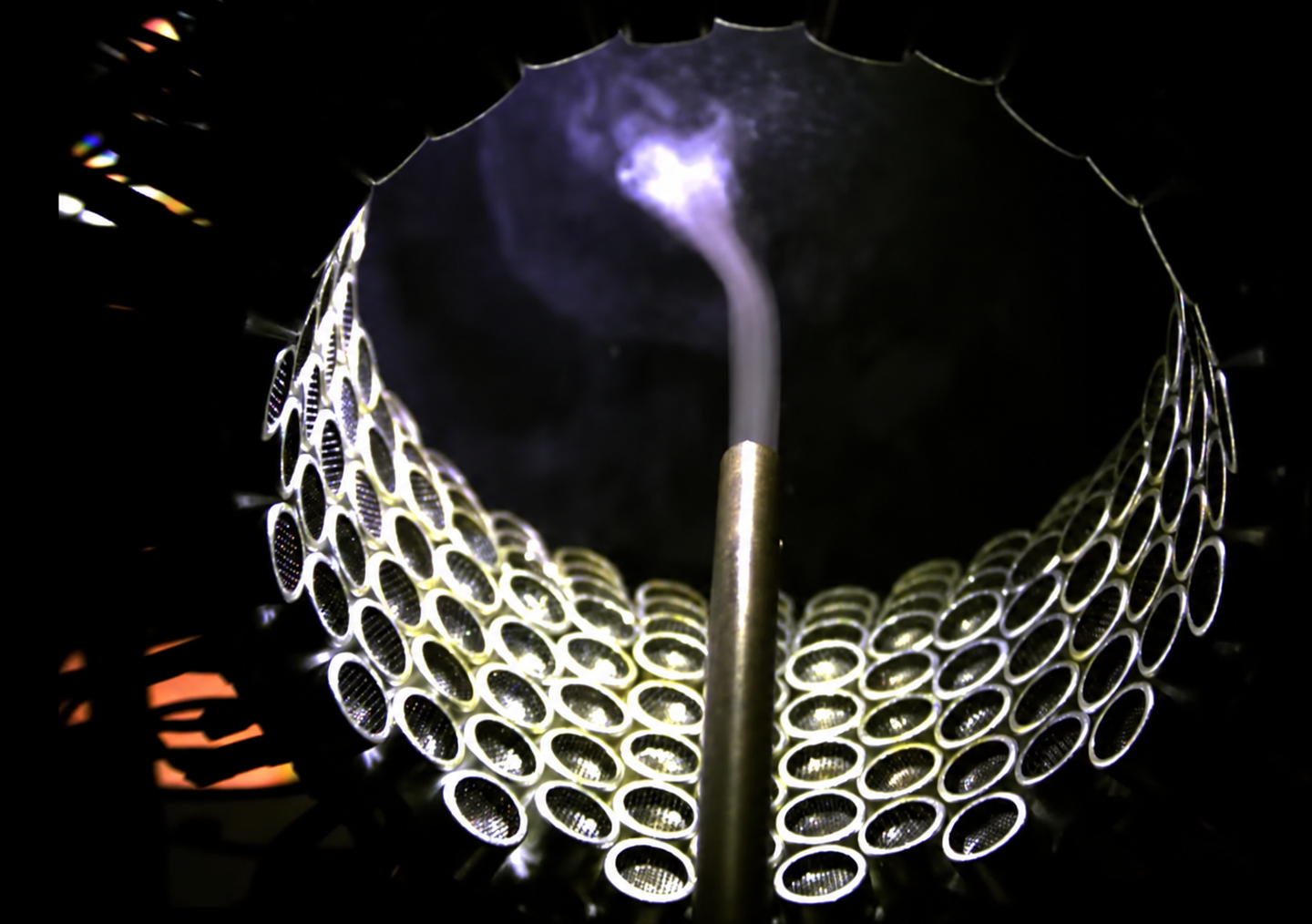
Water mist and gas running through an ultrasound tube emitted by 256 speakers. (CREDIT: University of Helsinki)
- A 256-transducer array creates an invisible acoustic conduit that guides matter without contact with solid walls.
- The experiments demonstrate continuous guidance of solids, liquids, gases and ionized gases along reconfigurable paths.
- The eight-centimeter prototype uses about 50 watts, with longer conduits and industrial applications still to be developed.
A narrow stream of liquid travels horizontally through open air, following a path with no pipe around it. The nearest solid boundary is several centimeters away. Ultrasound supplies the invisible constraint that keeps the stream on course.
The demonstration comes from a University of Helsinki-led collaboration with the Public University of Navarre and the University of Michigan. Their study, published in The Journal of the Acoustical Society of America, describes continuous, contactless guidance of solids, liquids, gases and ionized gases.
The prototype creates an acoustic conduit whose shape can change through electronic control. Its working section measures just eight centimeters, but it offers a different approach to moving materials that foul, damage or become contaminated by conventional tubing.
Building a conduit from sound
The device surrounds its central passage with 256 small ultrasonic transducers, described as miniature speakers. They operate at approximately 40 kilohertz, above the range of human hearing. In the liquid demonstration, the surrounding array sits about five centimeters from the stream.
Those transducers form a phased array. Coordinating their emissions produces a combined acoustic field with a prescribed shape, rather than simply directing all the sound toward one point. The team uses elongated, Bessel-like fields to create the guiding pathway.
Acoustic manipulation works because sound waves can exert forces on matter. Here, the field provides confinement along an extended route, allowing material to keep moving through it. The conduit has no solid inner wall for the transported material to touch.
Calling it a “massless tube” describes that absence of physical walls. The apparatus itself still requires a surrounding structure, electronics and electrical power. Its effect depends on maintaining the sound field.
Moving beyond individual floating objects
Sound-based levitation already allows researchers to suspend and manipulate small objects. Many existing arrangements concentrate on individual particles or small groups, however. Guiding a continuous stream or dispersed material presents a different challenge.
The Helsinki-led team developed field configurations suited to different materials and sizes. The study describes guidance across scales from micrometers to millimeters. It demonstrates transport along three-dimensional paths that can be reconfigured while the apparatus operates.
“Transporting a solid substance, for example, requires a different field configuration than transporting a liquid or a gas,” said postdoctoral researcher Dmitry Nikolaev, who led the project team.
That distinction matters because the achievement is not a single setting that handles every substance identically. The researchers adapt the acoustic field to the material being guided. Changing those settings gives the device flexibility without rebuilding a physical channel.
Redirecting flow without replacing a pipe
Ordinary plumbing fixes a liquid’s route through the placement of walls, bends and junctions. An acoustic conduit instead makes its route depend on how the transducers operate. That opens the possibility of switching destinations electronically.
“By changing how the speakers are controlled, we can reshape and turn the tube as needed,” Nikolaev said.
The team also describes dispensing liquid with single-drop precision. Such control could be useful when a process requires small amounts delivered to a particular location. It could also reduce the need to move or replace tubing between different tasks.
The experiments extend beyond liquid handling. They include guidance of solid material, mist and gases, as well as an electric discharge. An electric discharge involves ionized gas, making it another demonstration of how the acoustic pathway can influence matter.
These results establish a versatile laboratory capability. They do not establish that every corrosive chemical, biological sample or manufacturing feedstock can already be transported successfully. Each application would need operating conditions matched to its material and intended task.
A dirty-pipe problem inspired the idea
Ari Salmi, a University of Helsinki professor of electronics, conceived the approach about four years before the announcement. His laboratory had been developing ultrasound equipment to clean the inner surfaces of pipes. A lunchtime conversation raised a more radical possibility: eliminating the surface where dirt accumulates.
The thought stayed with Salmi. During an evening walk with his dog, he considered whether ultrasound could form the walls instead. Turning that concept into a working device required experimentation to determine how the surrounding emitters should operate.
The resulting system builds on Helsinki’s established ultrasound research. Collaboration with colleagues in Spain and the United States helped turn the idea into a prototype capable of guiding different forms of matter.
For processes troubled by sticky deposits, removing an inner wall could address the source of fouling. Corrosive substances offer another possible use because they can damage ordinary pipes. For sensitive samples, avoiding wall contact could remove one route through which unwanted material enters a process.
An open acoustic pathway does not, by itself, establish a sterile environment. The demonstrated advantage is transport without contact with a solid channel. Any contamination-sensitive application would still need controls appropriate to the surrounding environment.
Eight centimeters is a starting point
The prototype’s short length is an important boundary on the present achievement. Nikolaev suggests arranging similar modules in a row to extend the pathway. That is a proposed route to longer conduits, rather than a demonstration of an operational pipeline of arbitrary length.
Power consumption also matters. The eight-centimeter section draws approximately 50 watts, comparable to an older incandescent light bulb. That figure describes this prototype, not a demonstrated energy advantage over pumps or conventional material-handling equipment.
Although people cannot hear its operating frequency, the acoustic field is intense. Nikolaev compares the sound intensity at its core to nearby continuous gunfire, and the intensity beside the apparatus to a jet engine. Those comparisons concern ultrasonic intensity, rather than a noise that people perceive.
The researchers identify possible applications in containerless laboratory work, controlled reagent delivery and advanced additive manufacturing. Guiding an electrical discharge also suggests a potential role in directing energy. These remain development opportunities beyond the demonstrated transport experiments.
A longer system would need to maintain guidance as material passes between successive modules. Its usefulness would depend on how reliably it delivers material, how much it can transport and what power it requires. Those are different questions from showing that an acoustic conduit can work over a short laboratory distance.
For now, the work shows that an electronically shaped sound field can serve as a reconfigurable conduit. The next question is how that capability performs when adapted to the substances, distances and operating demands of practical systems.
Dig deeper into acoustic levitation and contactless transport
These studies trace advances in using sound to suspend, move and organize matter without conventional containers.
Acoustophoretic contactless transport and handling of matter in air: Demonstrates controlled transport and processing of multiple objects using an acoustic field. (PNAS, 2013)
Holographic acoustic elements for manipulation of levitated objects: Explores shaped acoustic traps that suspend, move and rotate objects. (Nature Communications, 2015)
Automatic contactless injection, transportation, merging, and ejection of droplets with a multifocal point acoustic levitator: Demonstrates automated operations for handling droplets through acoustic levitation. (Review of Scientific Instruments, 2018)
Electrostatics overcome acoustic collapse to assemble, adapt, and activate levitated matter: Combines electrical charging and acoustic levitation to control the arrangement of microscopic particles. (PNAS, 2025)
Midair Single-Sided Acoustic Levitation in High-Pressure Regions of Zero-Order Bessel Beams: Demonstrates a Bessel-beam approach to levitating and translating particles using a single-sided array. (Physical Review Letters, 2026)
Research findings are available online in The Journal of the Acoustical Society of America.
The original story "Invisible ultrasound tube can transport solids, liquids, gases through mid-air" is published in The Brighter Side of News.
Related Stories
- MIT ultrasound wristband revolutionizes AR, VR and robotic movement
- Ultrasound helmet reaches deep into the brain without surgery
- Scientists use ultrasound waves to move objects hands-free
Like these kind of feel good stories? Get The Brighter Side of News' newsletter.
Shy Cohen
Writer