Japan launches MMX to bring home the first samples from a moon of Mars
MMX will survey Mars’ moons, deploy a small rover and collect Phobos material for a planned return to Earth in 2031.

 Editor: Joshua Shavit

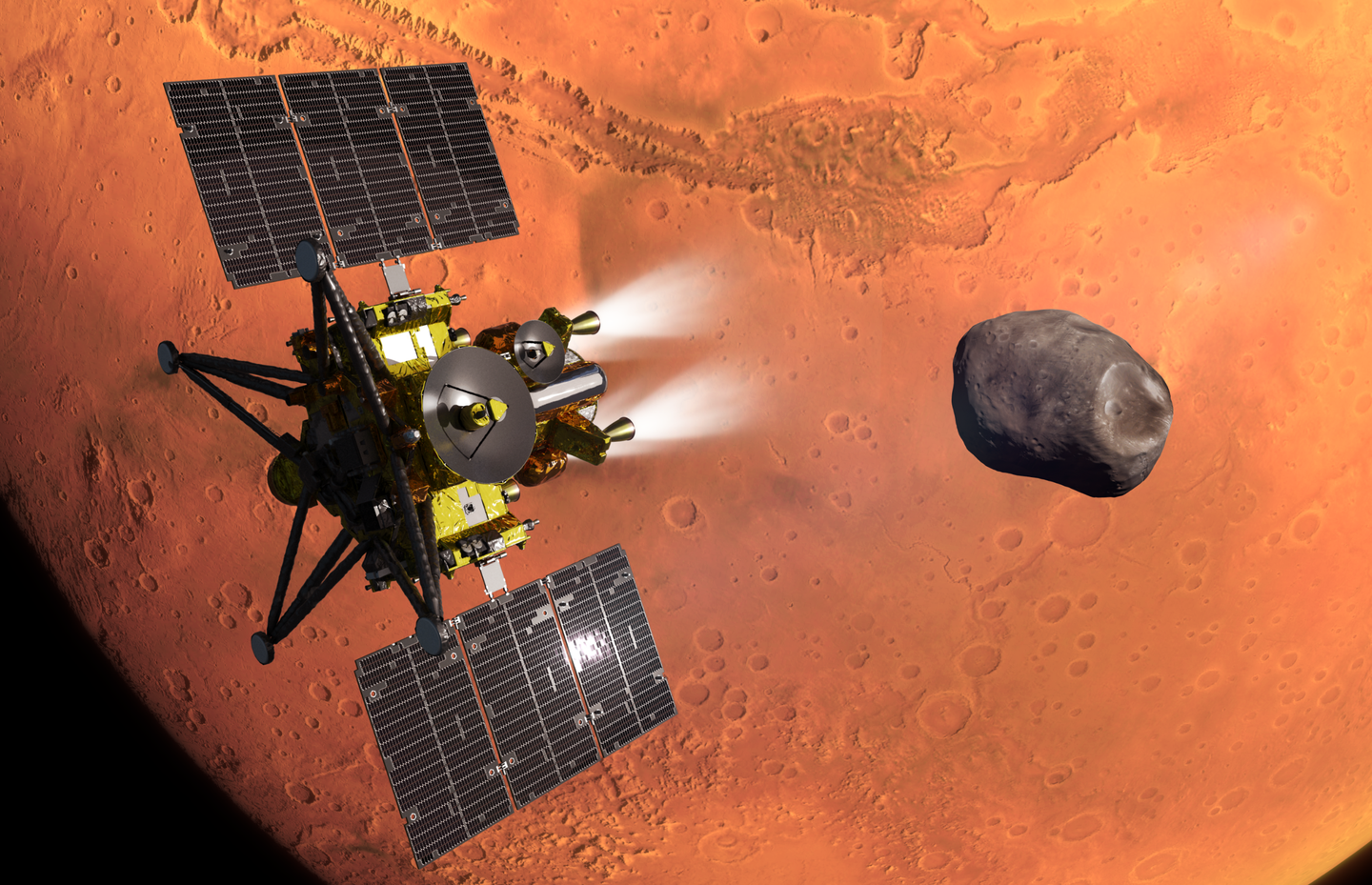
An artist’s concept of JAXA’s MMX spacecraft during its Mars’ orbit insertion. The Martian moon Phobos, which MMX will explore and sample, is in the background. (CREDIT: JAXA)
- Japan has launched MMX toward Mars, aiming to return at least 10 grams of material from Phobos in 2031.
- The mission will test competing explanations for the origins of Phobos and Deimos and investigate the history of the Mars system.
- A French-German rover, two sampling systems and international instruments will support the effort, with Mars arrival expected in August 2027.
A spacecraft headed for Mars is carrying an unusually small shopping list: at least 10 grams of material from Phobos. If Japan’s Martian Moons eXploration mission succeeds, that handful of grains could help resolve how the Red Planet acquired its two moons.
MMX launched aboard an H3 rocket from Tanegashima Space Center on October 20 in Japan, corresponding to October 19 in the United States. Led by the Japan Aerospace Exploration Agency, or JAXA, the mission aims to deliver its samples to Earth in 2031.
The samples would be the first returned from a moon other than Earth’s own. NASA, the European Space Agency, France’s CNES and the German Aerospace Center, DLR, are contributing instruments, technology and operational support. The mission combines remote observations, a small rover and spacecraft landings to investigate a question that telescope images alone have not settled.
Two moons with an uncertain beginning
Phobos and Deimos may be captured asteroids, or they may have formed from debris thrown into orbit after a large impact on Mars. Their origin matters because each possibility records a different chapter in the formation and evolution of rocky planets.
A captured asteroid could preserve evidence about material transported through the early solar system. A moon assembled after an impact could instead contain a mixture that reveals conditions on young Mars and the composition of the object that struck it.
“Having the answer will help illuminate that early era when Earth and the other inner planets may have been acquiring much of their water and organic compounds,” said Tom Statler, NASA’s MMX program executive and program scientist.
Those connections concern the ingredients and environments associated with habitability. MMX is not expected to establish how life began on Earth from a single sample. Its measurements could, however, test ideas about how water-bearing and carbon-containing materials reached terrestrial planets.
Phobos may also contain particles blasted off Mars by later impacts, regardless of how the moon originally formed. Such grains could provide additional information about the planet. Finding and interpreting them would require careful laboratory analysis after the samples return.
Following Phobos around Mars
The spacecraft is expected to reach Mars in August 2027 and spend approximately three years investigating the system. Phobos is the main sampling target, while observations and flybys will also examine Deimos. No landing on Deimos is planned.
MMX will operate in a quasi-satellite orbit near Phobos. Rather than behaving like a conventional satellite orbiting a large planet, it will follow a coordinated path around Mars that keeps it near the small moon. That arrangement supports prolonged observations before any landing.
Its instruments will examine surface shape, composition and other characteristics needed for scientific interpretation and landing-site selection. Studying both moons will allow comparisons that a Phobos sample alone cannot provide. Observations of Mars will also place the moons within their wider planetary environment.
NASA’s Mars-moon Exploration with Gamma rays and Neutrons instrument, called MEGANE, will measure neutrons and gamma rays emitted from Phobos. Those measurements reveal its elemental composition. The instrument was developed by the Johns Hopkins Applied Physics Laboratory.
France’s MIRS infrared spectrometer will investigate mineral composition and observe the Martian atmosphere. Together, the instruments can connect laboratory findings from a few collected grains with measurements across much larger areas. That context will help scientists judge what the samples represent.
A rover scouts extraordinarily weak gravity
Before the main spacecraft lands, it will deploy Idefix, a 25-kilogram rover developed jointly by CNES and DLR. The rover will investigate surface composition, texture and mechanical properties. Its findings will also help prepare the larger spacecraft’s sampling operations.
Gravity on Phobos is extremely weak. ESA estimates that Idefix’s weight there will be equivalent to that of a 15-gram object on Earth, although its mass remains 25 kilograms. Moving without losing contact with the ground therefore presents a very different problem from driving on Mars.
DLR’s planning places deployment around the turn of 2028 and 2029. The spacecraft would release Idefix from approximately 40 meters above the surface. The rover is designed to settle after the fall, right itself and begin a roughly three-month investigation.
Different agency summaries give different levels of detail for subsequent sampling dates. NASA gives an earliest date of December 2028, while ESA’s mission overview places the main spacecraft’s sampling landing in 2030. Both describe sample delivery to Earth in 2031.
Two ways to collect a small treasure
JAXA plans two soft-landing operations to gather material from Phobos. The spacecraft carries complementary sampling systems, allowing it to collect both surface grains and material from below the immediate surface. The total return target is at least 10 grams.
The Japanese coring sampler is designed to collect material from roughly two centimeters deep, according to ESA’s factsheet. NASA’s pneumatic sampler instead uses bursts of high-pressure nitrogen gas to lift loose surface material into a container. Honeybee Robotics developed that mechanism.
The pneumatic sampler is mounted on one of the landing legs and serves as a technology demonstration. Using different collection approaches gives researchers access to material sampled in different ways. It also tests tools that could inform later exploration missions.
NASA plans to receive and curate approximately 15 percent of the returned material at Johnson Space Center’s Astromaterials Lab in Houston. JAXA and its partners will catalogue and allocate the samples for scientific investigations. Careful curation will preserve material for future research as analytical tools improve.
A return journey with decades of scientific potential
MMX is scheduled to leave the Mars system in 2030. Its return capsule would reach Earth in 2031 and land in Australia. The capsule would then travel to Japan for opening, sample extraction and initial cataloguing.
Returning material offers capabilities that spacecraft instruments cannot fully reproduce. Laboratories can use larger, more sensitive equipment and repeat measurements with different methods. Portions preserved today could address questions that scientists have not yet developed the tools to ask.
The mission also tests round-trip transportation, deep-space communications and operations near a low-gravity moon. NASA’s Deep Space Network and ESA’s Estrack network will support communications. These capabilities could inform later robotic missions and eventual human exploration of the Mars system.
Phobos has been discussed as a possible platform for future exploration, including communications relays and scientific monitoring. MMX will investigate conditions relevant to those ideas, rather than establish an operational outpost. Its immediate task is to reach the moon, understand its surface and collect material safely.
Launch begins that effort, but it does not guarantee the sample return. The scientific payoff depends on completing years of navigation, surveying, landing and return operations. Ten grams arriving intact could then become a lasting record of a much larger planetary history.
Dig deeper into Phobos, Deimos and the MMX mission
These resources explain the mission’s scientific foundations, competing moon-formation models and the rover that will scout Phobos.
Martian moons exploration MMX: sample return mission to Phobos elucidating formation processes of habitable planets: Explains the mission’s scientific objectives and sampling strategy, although its original launch and return dates have since changed. (Earth, Planets and Space, 2022)
Origin of Phobos and Deimos Awaiting Direct Exploration: Reviews the evidence and unresolved problems surrounding capture and impact-based explanations for the moons. (Annual Review of Earth and Planetary Sciences, 2024)
Accretion of Phobos and Deimos in an extended debris disc stirred by transient moons: Models how an impact-generated debris disk and temporary larger moons could produce the present satellites. (Nature Geoscience, 2016)
Mixing model of Phobos’ bulk elemental composition for the determination of its origin: Multivariate analysis of MMX/MEGANE data: Investigates how elemental measurements could distinguish different formation scenarios. (Icarus, 2024)
Off to the moons of Mars – MMX mission and Idefix® rover ready for launch: Describes the rover’s deployment, surface investigation and role in preparing spacecraft landings. (German Aerospace Center, 2026)
The original story "Japan launches MMX to bring home the first samples from a moon of Mars" is published in The Brighter Side of News.
Related Stories
- NASA’s Curiosity rover finds a vast field of honeycomb fractures on Mars
- 50 years later, Viking 1’s legacy is powering NASA’s next giant leap on Mars
- NASA’s first nuclear-powered spacecraft is heading to Mars, and its bringing helicopters
Like these kind of feel good stories? Get The Brighter Side of News' newsletter.
Joseph Shavit
Writer, Editor-At-Large and Publisher
Joseph Shavit, based in Los Angeles, is a seasoned science journalist, editor and co-founder of The Brighter Side of News, where he transforms complex discoveries into clear, engaging stories for general readers. With vast experience at major media companies like The Los Angeles Times, Times Mirror and Tribune Publishing, he writes with both authority and curiosity. His writing focuses on space science, planetary science, quantum mechanics, geology. Known for linking breakthroughs to real-world markets, he highlights how research transitions into products and industries that shape daily life.