Japan’s historic MMX mission begins a daring journey to collect the first samples from Mars’ moon Phobos
Japan’s MMX spacecraft is heading toward Mars to collect samples from Phobos, with a rover and two sampling systems helping investigate the moon’s origins.

 Editor: Joseph Shavit

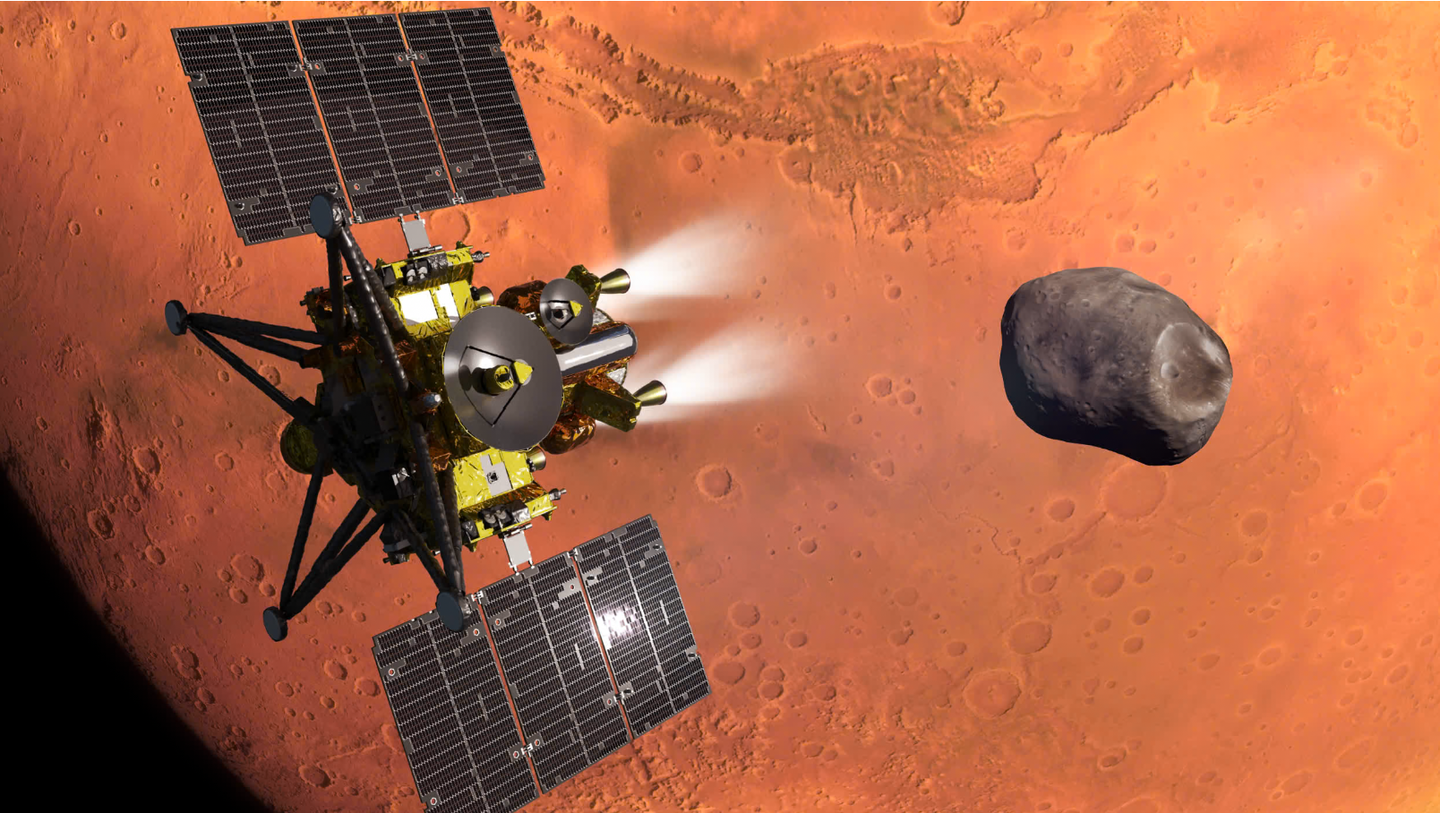
An artist’s impression of JAXA’s MMX spacecraft entering orbit around Mars, with Phobos, the mission’s target for exploration and sample collection, in the background. (CREDIT: JAXA)
- Japan’s MMX spacecraft has launched toward Mars, aiming to return at least 10 grams of material from Phobos in 2031.
- A rover, remote observations and two sampling systems will help investigate how Mars acquired its moons.
- The samples could illuminate planetary history, but years of surveying, landing and return operations remain ahead.
The Japan Aerospace Exploration Agency, or JAXA, launched MMX aboard an H3 rocket from Tanegashima Space Center. Liftoff occurred at 4:41 a.m. on October 20 in Japan, corresponding to October 19 in the United States. The mission combines Japanese spacecraft technology with contributions from NASA, the European Space Agency, France’s CNES and the German Aerospace Center, DLR.
Scientists want more than a close look at an unfamiliar surface. Laboratory studies of returned grains could distinguish between competing explanations for Phobos and Deimos and reveal clues about the wider Mars system. Achieving that goal requires a sequence of operations that has only just begun.
A small moon with a large historical question
Phobos and Deimos could be asteroids that Mars captured, or remnants of debris thrown into orbit by a giant impact. Those possibilities imply different chemical histories. Measuring the moons’ composition could therefore help reconstruct processes that operated while the solar system was taking shape.
A captured asteroid might preserve evidence of materials transported between different regions of the early solar system. An impact-generated moon could instead contain material from young Mars mixed with the body that struck it. Establishing which explanation fits the samples would also improve scientists’ understanding of rocky planetary systems.
“Having the answer will help illuminate that early era when Earth and the other inner planets may have been acquiring much of their water and organic compounds,” said Tom Statler, NASA’s MMX program executive and program scientist. Those connections concern the delivery of ingredients associated with habitability. They do not mean that a Phobos sample will establish how life began on Earth.
The moon may hold another kind of evidence, whatever its origin. Impacts on Mars can launch particles into space, some of which may eventually reach Phobos. Identifying such grains among the returned material could provide information about the planet without requiring MMX to land there.
Surveying before attempting a landing
MMX is expected to arrive at Mars in August 2027 and spend approximately three years investigating the system. Phobos is its primary sampling destination. Observations and flybys will also examine Deimos, but the mission does not plan to land on that smaller moon.
Near Phobos, the spacecraft will follow a quasi-satellite orbit. This is a coordinated path around Mars that keeps MMX close to the moon, rather than a conventional orbit around a large planetary body. Prolonged observations will help scientists map the terrain and identify suitable places to land.
The spacecraft’s measurements will also establish a wider context for the samples. NASA’s MEGANE instrument will measure gamma rays and neutrons from Phobos to investigate elemental composition. Developed by the Johns Hopkins Applied Physics Laboratory, it will help connect a small collection of grains with conditions across the moon.
France’s MIRS infrared spectrometer will investigate mineral composition and observe the Martian atmosphere. Images and other measurements will characterize surface shape and conditions relevant to landing. Together, these observations can help researchers judge whether collected material represents a broader region or a particular local setting.
Learning to drive in extremely weak gravity
Before the main spacecraft lands, it will release Idefix, a rover developed jointly by CNES and DLR. The vehicle has a mass of 25 kilograms. Its weight on Phobos, however, will be equivalent to that of an approximately 15-gram object on Earth, according to ESA.
That distinction creates an unusual engineering problem. The rover must move across the ground while gravity provides only a very weak pull toward the surface. Its behavior during touchdown and driving will help the team understand conditions facing the larger sampling spacecraft.
DLR plans deployment around the turn of 2028 and 2029. Idefix would fall from roughly 40–100 meters above the ground, bounce and settle, then right itself and deploy its solar panels. Its surface investigation is designed to last approximately 100 days.
The rover will examine mechanical, thermal and mineralogical properties of the surface. Those measurements will support scientific interpretation and preparations for the main spacecraft’s landing and sampling operations. They also provide a direct test of robotic mobility on a small moon where conventional driving assumptions do not apply.
Two tools for gathering a tiny cargo
JAXA plans two landing operations to collect material from Phobos. The spacecraft carries complementary systems for gathering loose surface grains and material beneath the immediate surface. The return target is at least 10 grams, rather than a large container of rocks.
A coring sampler will extract subsurface material, while a pneumatic sampler will use bursts of high-pressure nitrogen gas to lift surface grains. The gas-driven device sits on one of the spacecraft’s landing legs. Honeybee Robotics, a Blue Origin company, developed the mechanism as a technology demonstration.
Agency descriptions differ in their level of detail about the sampling schedule. NASA’s revised mission summary gives an earliest sampling date of 2028, while the broader mission plan allows several years of operations before departure. Specific landing dates remain planning milestones rather than completed events.
The mission’s scientific value depends on more than collecting enough material. Measurements taken before and during sampling will help establish where the grains came from and the conditions around them. Once returned, those records will help laboratories interpret chemical differences without losing their geological context.
Bringing the evidence back to Earth
MMX is scheduled to depart the Mars system in 2030 and deliver its return capsule to Earth in 2031. The capsule is intended to land in Australia before transfer to Japan. Specialists would then open it in a dedicated facility, extract the samples and catalogue them for research.
NASA plans to receive and curate approximately 15% of the returned material at Johnson Space Center’s Astromaterials Lab in Houston. Laboratories can apply larger instruments and multiple analytical methods that a spacecraft cannot carry. Preserving portions of the collection would also allow future researchers to study it with improved techniques.
The mission will test round-trip transportation, deep-space navigation and operations near a low-gravity moon. NASA’s Deep Space Network and ESA’s Estrack network will support communications. These capabilities could inform later robotic exploration, while the immediate challenge remains surveying Phobos and collecting material safely.
Launch has put those plans in motion, but it does not guarantee a successful sample return. The spacecraft must still reach Mars, assess its target, land and leave with its cargo intact. If it completes those steps, the next question will be whether the grains resemble captured asteroid material, impact debris or a more complicated history.
Dig deeper into Phobos and the MMX mission
These resources explain the rover, sampling technology and research questions behind the mission.
MMX mission successfully launches – Idefix® rover on its way to Martian moon Phobos
DLR describes the rover’s planned deployment, surface instruments and the challenges of operating in extremely weak gravity. (German Aerospace Center, October 2026)
NASA to Help Unlock Mysteries of Mars’ Moons in Upcoming Mission
NASA details its composition instrument, pneumatic sampler and plans to curate a share of the returned material. (NASA, October 2026)
Analytical protocols for Phobos regolith samples returned by the Martian Moons eXploration (MMX) mission
This paper explains how laboratory measurements could distinguish possible origins and identify material delivered from Mars. (Earth, Planets and Space, June 2021)
Dynamical evidence for Phobos and Deimos as remnants of a disrupted common progenitor
This modeling study explores whether both moons could have developed from a larger body that broke apart. (Nature Astronomy, February 2021)
Transport of impact ejecta from Mars to its moons as a means to reveal Martian history
Simulations investigate how impacts could transfer Martian material to its moons, giving returned grains additional scientific value. (Scientific Reports, December 2019)
The original story "Japan’s historic MMX mission begins a daring journey to collect the first samples from Mars’ moon Phobos" is published in The Brighter Side of News.
Related Stories
- NASA’s Curiosity rover finds a vast field of honeycomb fractures on Mars
- 50 years later, Viking 1’s legacy is powering NASA’s next giant leap on Mars
- NASA’s first nuclear-powered spacecraft is heading to Mars, and its bringing helicopters
Like these kind of feel good stories? Get The Brighter Side of News' newsletter.
Joshua Shavit
Writer and Editor
Joshua Shavit is a NorCal-based science and technology writer with a passion for exploring the breakthroughs shaping the future. As a co-founder of The Brighter Side of News, he focuses on positive and transformative advancements in technology, physics, engineering, robotics, and astronomy. Having published articles on AOL.com, MSN, Yahoo News, and Ground News, Joshua's work highlights the innovators behind the ideas, bringing readers closer to the people driving progress.