JWST finds salt clouds in the atmosphere of a strange Pink Planet
JWST has revealed salt clouds and unusual chemistry in GJ 504 b, one of the coldest worlds ever directly imaged.

 Edited By: Joshua Shavit

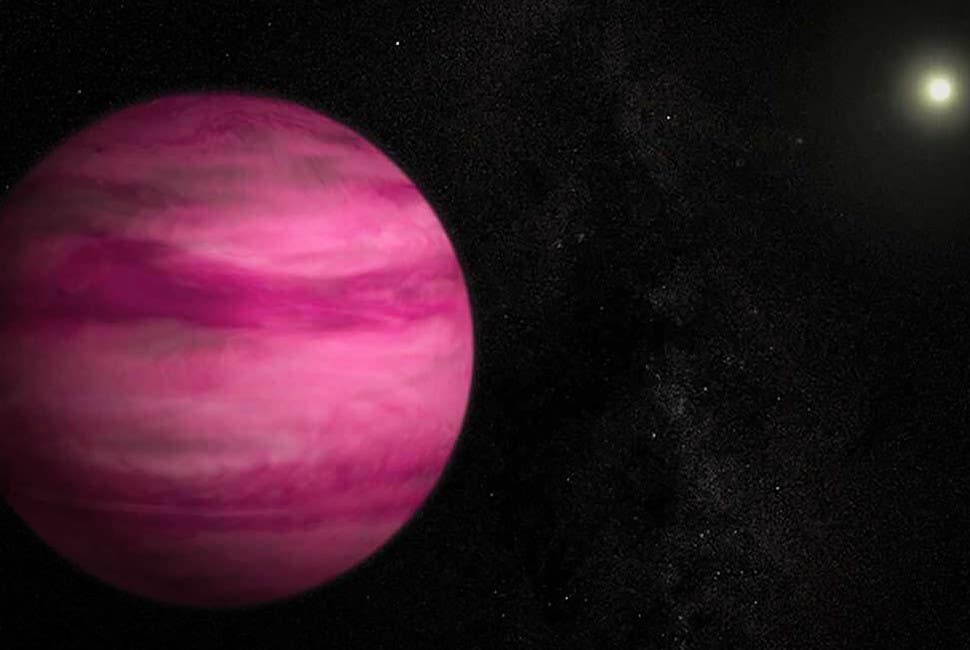
Discovered in 2013, the Pink Planet orbits a sun-like star located 57 light-years from Earth. At roughly 25 times the mass of Jupiter, it sits near the fuzzy boundary between giant planets and brown dwarfs. (CREDIT: NASA/Goddard Space Flight Center)
GJ 504 b has been one of astronomy’s stranger nearby worlds for years, a faint pink companion circling a sunlike star 57 light-years away. It looked unusual, stayed frustratingly out of reach, and raised a deeper question: what kind of object is it, really?
Now the James Webb Space Telescope has given astronomers their clearest look yet, revealing an atmosphere rich with water vapor, methane, carbon dioxide, ammonia and other molecules, along with what appear to be salt clouds high in its sky. The result pulls the so-called Pink Planet into sharper focus, even as it leaves one central mystery unresolved.
Led by Northwestern University’s Aneesh Baburaj, the team used JWST to capture the faint light of GJ 504 b and separate it from the glare of its much brighter host star. The object had resisted that kind of detailed study from the ground for more than a decade.
“The Pink Planet is the coldest companion ever discovered using ground-based instruments,” Baburaj said. “Many teams all around the world performed follow-up observations to study its light, but it was too faint for ground-based instruments. That made it a perfect target for JWST. When we finally obtained its spectrum, it immediately looked interesting. But once we started digging deeper into the data, we realized it was not like anything we have analyzed before.”
A cold outlier finally gives up its light
Discovered in 2013, GJ 504 b orbits a star called GJ 504 A at a distance of about 43 astronomical units, roughly comparable to Pluto’s distance from the sun. It sits near the blurry boundary between giant planets and brown dwarfs, with a mass estimate around 25 times that of Jupiter. Because of that uncertainty, astronomers describe it more cautiously as a planetary-mass companion.
Its temperature is part of what makes it so unusual. Most directly imaged giant exoplanets glow at around 1,000 to 2,000 degrees Fahrenheit. GJ 504 b is far cooler, about 550 degrees Fahrenheit, or 290 degrees Celsius. That places it among the coldest known objects ever directly imaged around another star.
Its age helps explain that chill. Giant planets and similar bodies start out hot and cool over time, and the new analysis points to a system age between about 2.5 billion and 4 billion years. That older age also supports the view that GJ 504 b is much heavier than early estimates once suggested.
“In the past, other astronomers observed the companion for an entire night with some of the biggest telescopes in the world to obtain a spectrum,” Baburaj said. “And they could not see the object. With JWST, our entire observation took around two hours, and we were successful.”
What JWST collected was a spectrum, a spread of light that lets astronomers identify molecules and other atmospheric features. In GJ 504 b’s case, the data showed clear signs of water vapor, methane, carbon dioxide and ammonia, along with more subtle traces including hydrogen sulfide and isotopic forms of carbon monoxide.
The clouds that made the models make sense
At first, the atmosphere models did not behave the way the researchers expected. Simulations without clouds could match the data only by producing strange atmospheric conditions that did not seem physically realistic.
That changed when the team added clouds.
“We ran simulations with clouds, and the results aligned with what we know about cold planets,” Baburaj said. “We tried three different types of clouds, and salt clouds fit best. When we accounted for salt clouds, it subdued the signature of molecules hidden deeper in the companion’s atmosphere. Then, the results became physically possible.”
The best fit came from clouds made of potassium chloride and zinc sulfide, compounds more often associated with salts than with the kinds of ice or silicate clouds discussed for hotter worlds. Researchers had predicted years ago that such clouds could form in cool substellar atmospheres, but this is among the clearest direct evidence yet that they matter.
Those clouds appear to sit around the one-bar level in the atmosphere, blocking light from deeper layers and changing the spectrum JWST received. That matters because without them, the atmosphere looks wrong. With them, the temperature structure and chemistry become much more plausible.
The work also found that GJ 504 b has a metal-rich atmosphere, meaning it contains a higher proportion of elements heavier than hydrogen and helium than expected for a simple star-like object. Carbon and oxygen appear enhanced relative to the host star, while sulfur looks closer to stellar levels. That pattern hints at a planet-like formation history, but the case is still not closed.
Still not quite a planet, still not quite something else
That is where the story gets more complicated. GJ 504 b may have formed in a planetary disk by accreting gas and solids, or it may have formed more like a small failed star. The new observations strengthen the argument that it formed like a planet, but the uncertainties are still large enough that astronomers cannot rule out a brown-dwarf-like origin.
The team estimates a mass near 25 Jupiter masses and says the object likely belongs to an older system, between roughly 2.5 and 6 billion years old. Those numbers favor the heavier, older interpretation of GJ 504 b rather than the much younger and lighter picture proposed in some earlier work.
Even so, the object’s chemistry does not neatly settle the debate. Some abundance measurements remain tangled up with uncertainties in gravity, cloud structure and even the exact composition of the host star itself. The authors say future observations, including work at longer wavelengths and better dynamical mass measurements, may be needed to break those ties.
Still, the detection is important beyond this one object. Salt clouds have long been part of theorists’ picture of cool atmospheres, but directly testing that idea has been difficult because such worlds are dim. GJ 504 b shows JWST can reach into that colder regime.
“This is the first time we’ve found that salt clouds are critical to explaining the spectrum of an object,” Baburaj said. “It’s a good reminder to account for clouds in our models.”
Practical implications of the research
This study pushes atmospheric astronomy into colder territory, showing that JWST can analyze faint worlds that ground-based telescopes struggled to probe.
That opens the door to better studies of old giant planets, planetary-mass companions and cool brown dwarfs whose chemistry may resemble a bridge between hot exoplanets and Jupiter-like atmospheres.
It also gives astronomers a stronger framework for modeling clouds in these objects, which is essential if they want to estimate temperature, composition, age and formation history with confidence.
Research findings are available online in the journal The Astronomical Journal.
The original story "JWST finds salt clouds in the atmosphere of a strange Pink Planet" is published in The Brighter Side of News.
Related Stories
- JWST catches mineral clouds forming and fading on 'hot Jupiter' exoplanet
- Jupiter-like exoplanet helping scientists rethink how solar systems form
- JWST finds a dark, airless exoplanet covered in rock like Mercury
Like these kind of feel good stories? Get The Brighter Side of News' newsletter.
Shy Cohen
Writer