Coconut oil could offer airlines another path toward alternative jet fuel
Coconut oil jet biofuel ran in a small turbojet engine with similar efficiency and lower hydrocarbon emissions.
 OMU Writer: Matthew Coslett

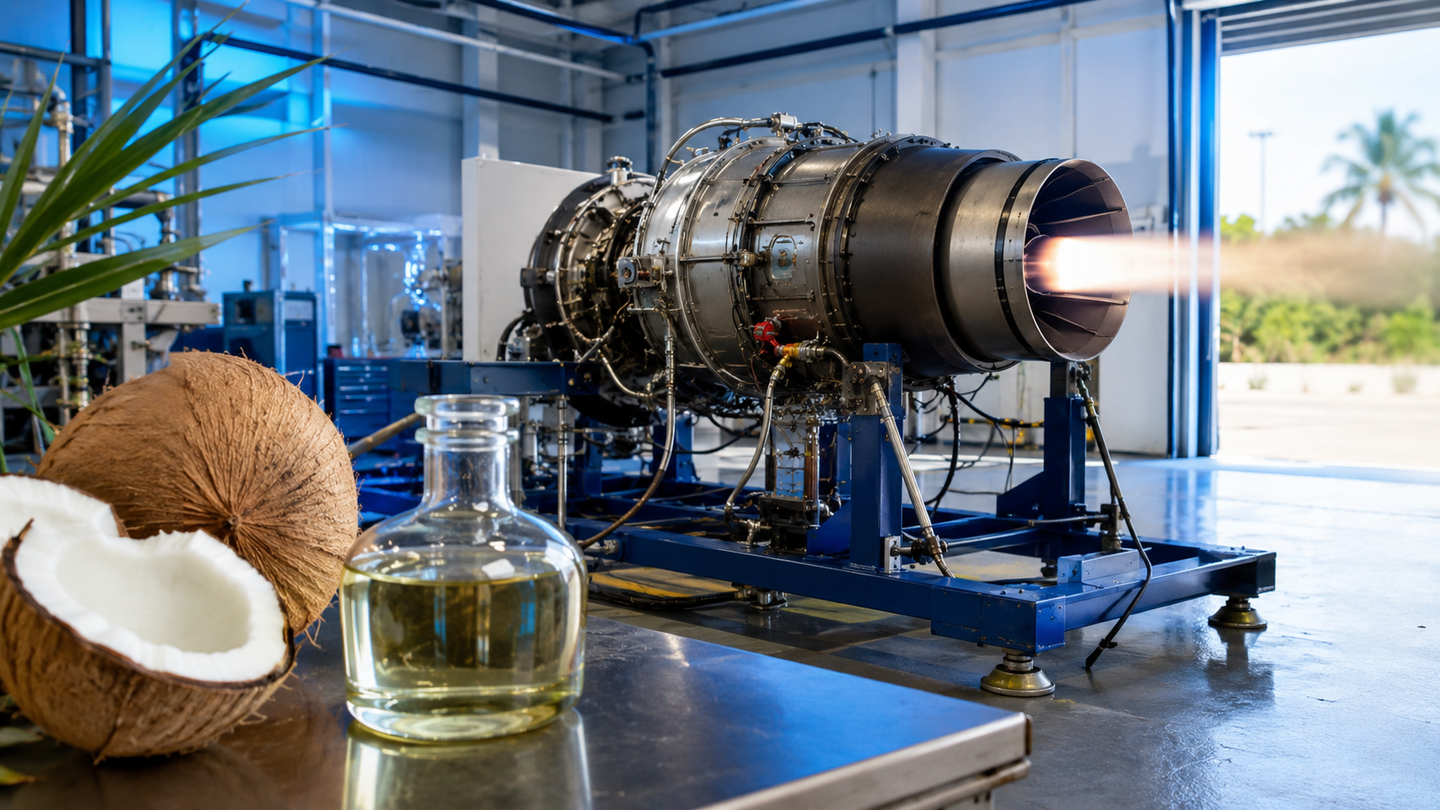
Coconut oil biofuel ran in a turbojet with comparable efficiency while cutting hydrocarbon emissions in blends with Jet A-1. (CREDIT: Shutterstock)
- Coconut oil can be turned into biofuel that runs in a small jet engine when blended with conventional jet fuel.
- The blends kept engine efficiency close to standard Jet A-1 and reduced hydrocarbon emissions, but fuel consumption increased.
- The fuel could be useful in coconut-producing regions, though storage stability, material compatibility and full environmental impacts still need study.
Coconut oil may seem far removed from a jet engine, but its chemistry gives it an unusual advantage. Its fatty acid chains are close in length to the hydrocarbons used in aviation fuel.
A team from Osaka Metropolitan University has now tested coconut oil-based biofuels in a small turbojet engine. The work focused on whether these fuels could be blended with Jet A-1, a conventional aviation fuel, without reducing engine performance.
The researchers made two biofuels from coconut oil. One, called FAME, used methanol. The other, called FAEE, used ethanol. Both were produced through a co-solvent method that combines coconut oil extracts with acetone and alcohol.
The method works under ambient temperature and pressure. That could reduce energy consumption during production while helping preserve fuel purity.
A cleaner fuel search with strict demands
Airlines and consumers have become increasingly concerned about carbon, nitrogen and hydrocarbon emissions. Biofuels have drawn attention as one possible greener alternative.
Aviation fuel has a difficult job. It must deliver high energy in a compact form. It also has to work safely in existing engines across demanding conditions.
Coconut oil stands out because its fatty acid chain lengths are similar to the hydrocarbon chain lengths needed for jet fuel. That means it could require less processing than some other plant oils before use in aviation fuel blends.
The Osaka Metropolitan University team tested different blend ratios of FAME and FAEE with Jet A-1. Their goal was to find a balance among fuel consumption, thermal efficiency and exhaust gas emissions.
The researchers used a small turbojet engine for the trials. That allowed them to compare performance and emissions under controlled conditions.
Efficiency held steady, fuel use rose
The tests showed a trade-off. As the biofuel blending ratio increased, fuel consumption also increased.
The likely reason was the difference in heating value between the biofuels and Jet A-1. Heating value describes how much energy a fuel releases when burned. If a fuel releases less energy per unit, an engine may need more of it to produce the same output.
Even so, thermal efficiency remained comparable to Jet A-1. Thermal efficiency measures how well an engine turns fuel energy into useful work.
That result matters because a potential biofuel cannot simply burn. It must run in current engine systems without major loss of performance.
“The experiments showed that our fuel blend can operate in existing gas turbine engines without major loss of efficiency or engine performance, and without increasing emissions,” Dr. Huynh Phuong Uyen Nguyen of the Graduate School of Sustainable System Sciences summarized.
The study did not show that coconut biofuel can fully replace conventional jet fuel. The tested fuels were blends with Jet A-1. The researchers also identified fuel consumption as a target for improvement.
Exhaust results showed a mixed picture
The biofuel blends reduced hydrocarbon emissions. Hydrocarbons in exhaust can come from unburned or partly burned fuel.
That decrease is one of the stronger practical signs from the engine trials. It suggests that adding coconut oil-derived fuel can change the exhaust profile in a favorable way for at least one pollutant category.
The team also found no significant changes in carbon dioxide or nitric oxide emissions. Those pollutants are central to the carbon and nitrogen footprints of airlines.
The result does not mean the fuel has no climate or environmental impact. Carbon dioxide from combustion is only one part of the full picture. Production, transport and storage also matter.
That is why the researchers plan to assess environmental impacts through life cycle assessment. Such an analysis would examine the broader footprint of producing and using the fuel.
A fuel source in discarded coconuts
The findings could be especially relevant for Asian countries, including those in Southeast Asia. The region grows large numbers of coconuts and also faces fuel-security concerns.
About 30 percent of harvested coconuts in Southeast Asia are discarded because they do not meet commercial standards. That discarded material could become a feedstock for biofuel production.
Using rejected coconuts would avoid relying only on higher-value commercial products. It could also create a local resource for countries at risk of fuel shock.
The study’s production method may also fit that regional context. Because the co-solvent method operates under ambient temperature and pressure, it may need less energy than more intensive processing routes.
Still, scaling from laboratory and engine testing to practical aviation use would require further development. Fuel quality must remain stable over time. It must also be compatible with engine materials and storage systems.
Beyond blends toward future engines
The research team sees several next steps. One is improving fuel consumption performance. Another is establishing technologies for operating engines on 100 percent biofuel.
“In the future, we want to improve fuel consumption performance and establish technologies for operating engines on 100% biofuel,” Dr. Ogawa said.
That is an ambitious target. The current work supports blended use, not full replacement. But the engine results provide a starting point for further testing.
Ogawa also pointed to practical barriers beyond engine operation.
“Looking ahead, we also want to advance the practical application of this fuel by improving its long-term storage stability, material compatibility, and environmental impacts through life cycle assessment.”
Those issues are not minor. Aviation fuels must remain safe and reliable from production through storage, transport and use. A fuel that performs well in an engine test still needs to meet broader durability and safety demands.
Practical implications of the research
The study gives aviation fuel researchers a clearer look at coconut oil-derived biofuel under real engine conditions. It shows that FAME and FAEE blends can run in an existing gas turbine engine without major efficiency loss or emission increases.
That could help guide future work on biofuels made from discarded coconut material, especially in regions where coconuts are abundant and fuel supply risks matter. The reduced hydrocarbon emissions also give researchers a specific performance benefit to investigate further.
The main practical challenge is improving fuel consumption while proving long-term stability, compatibility and environmental value. If those issues can be addressed, coconut oil-based fuels could become one more option in the broader search for lower-impact aviation fuel.
Dig deeper into sustainable aviation fuel and jet engine emissions
These resources examine coconut-derived turbine fuels, sustainable aviation fuel performance, life-cycle emissions and the technical challenges involved in replacing conventional jet fuel.
Development and turbine engine testing of coconut oil-based biojet fuel: Researchers produced high-purity coconut oil ethyl esters and tested blends containing 10% to 30% renewable fuel in a small gas turbine. Engine operation remained stable, although specific fuel consumption increased as the coconut-derived fraction rose. (Fuel Processing Technology, 2025)
Overview of combustion and emission characteristics of sustainable aviation fuels and standard JET A-1 fuel: This review compares the physical properties, combustion behavior and emissions of sustainable aviation fuels with conventional Jet A-1. It also examines the technical requirements and remaining challenges for increasing SAF blending levels in aircraft engines. (Fuel, 2025)
The Prospects and Challenges of Sustainable Aviation Fuels (SAFs) for Clean Combustion in Gas Turbine Engines: A Review: This review evaluates SAF combustion, emissions, engine operability and compatibility with existing turbine components. It highlights the engineering challenges that become increasingly important as aviation moves toward higher SAF concentrations. (Energy & Fuels, 2026)
Sustainable aviation fuel from waste cooking Oil: Pathways, Catalysts, and Prospects: This review examines technologies for converting waste oils into aviation fuel, particularly hydroprocessed esters and fatty acids and catalytic hydrothermolysis. It provides broader context for using discarded lipid feedstocks as alternatives to petroleum-derived jet fuel. (Fuel, 2026)
Sustainable aviation fuel pathways: Emissions, costs and uncertainty: This meta-analysis compares greenhouse gas emissions, costs and uncertainty across several major SAF production pathways. It shows why combustion tests alone cannot establish a fuel’s environmental benefits and why full life-cycle assessment remains essential. (Resources, Conservation and Recycling, 2025)
Research findings are available online in the journal Fuel.
The original story "Coconut oil could offer airlines another path toward alternative jet fuel" is published in The Brighter Side of News.
Related Stories
- New discoveries in synthetic DNA could lead to modified genes and new biofuels
- Methane-eating microbes turn greenhouse gas into fuel, food, and bioplastics
- Start-up company produces butter from carbon dioxide instead of animal fat
Like these kind of feel good stories? Get The Brighter Side of News' newsletter.
Joshua Shavit
Writer and Editor
Joshua Shavit is a NorCal-based science and technology writer with a passion for exploring the breakthroughs shaping the future. As a co-founder of The Brighter Side of News, he focuses on positive and transformative advancements in technology, physics, engineering, robotics, and astronomy. Having published articles on AOL.com, MSN, Yahoo News, and Ground News, Joshua's work highlights the innovators behind the ideas, bringing readers closer to the people driving progress.