JWST reveals how a supermassive black hole keeps feeding itself
A glowing filament appears to carry cooled gas directly into the disk surrounding a supermassive black hole.

 Edited By: Joshua Shavit

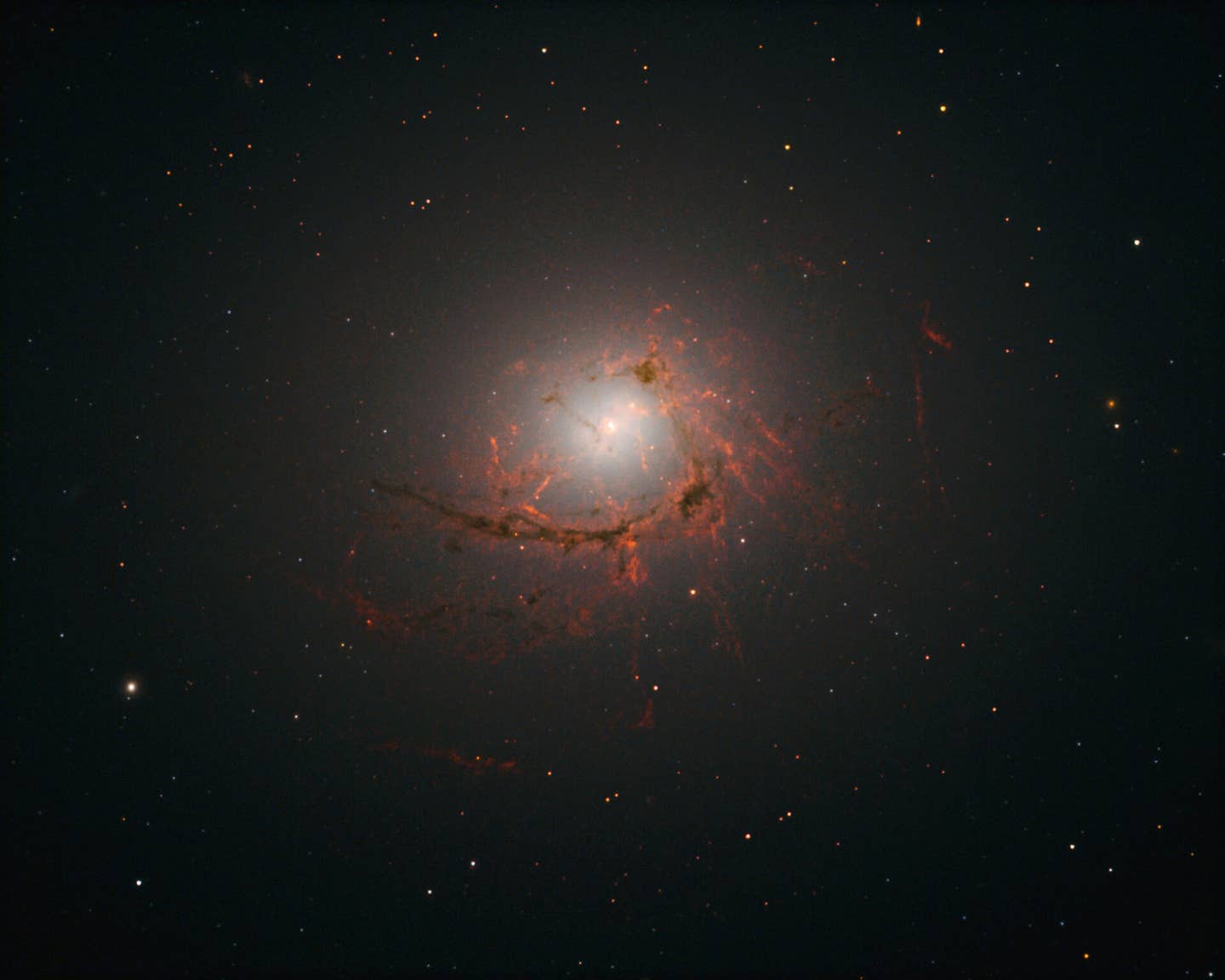
An image of elliptical galaxy NGC4696 located at the center of the Centaurus Cluster taken by the Hubble Space Telescope. This image shows dusty filaments surrounding the center of the galaxy. (CREDIT: NASA, ESA/Hubble, A. Fabian
Supermassive black holes can heat the gas around them so fiercely that their own food supply should disappear. New James Webb Space Telescope images now show how that fuel returns, tracing a filament directly into a rotating disk around one black hole.
The observations focus on NGC 4696, the central galaxy of the Centaurus Cluster, about 145 million light-years from Earth. An international team led by the Université de Montréal, with contributions from Michigan State University, reported the results in The Astrophysical Journal Letters.
“JWST observations are offering us thousands of new facts and measurements, and I can report it’s a lot to absorb,” said Megan Donahue, an MSU University Distinguished Professor of physics and astronomy. “We are all working together to solve the astrophysics questions about how these black holes get their fuel and how they interact with their host galaxy.”
Nearly every large galaxy contains a supermassive black hole millions or billions of times more massive than the sun. When one actively consumes surrounding material, it becomes an active galactic nucleus, or AGN.
An AGN can launch powerful jets that heat nearby gas, slow star formation and reshape the host galaxy. That creates a long-standing puzzle. If the jets heat the surrounding atmosphere, why does the black hole not starve?
A filament reaches the feeding disk
The leading explanation is that some of the hot gas cools again. It condenses into narrow filaments, loses angular momentum and falls toward the center.
Until now, astronomers lacked a clear spatial view connecting those large filaments to the small disk that feeds the black hole.
The team used JWST’s Near-Infrared Spectrograph, or NIRSpec, for 7.7 hours. The instrument mapped warm ionized gas across the inner region of NGC 4696 at a scale fine enough to distinguish features about 30 light-years wide.
Earlier Hubble images had shown an S-shaped swirl near the galaxy’s center. Hubble revealed its shape but not how the gas moved.
JWST changed that. The new velocity maps show that the swirl is a rotating circumnuclear disk roughly 800 light-years across. Gas moves through it at speeds reaching about 600 kilometers per second.
The disk is physically connected to a filament extending westward into the galaxy. The gas velocities match where the filament meets the disk, supporting the conclusion that material is flowing inward.
The filament is about 105 parsecs wide and at least 350 parsecs long, though it probably extends beyond JWST’s field of view. Gas near the connection point also appears more turbulent than gas farther away.
The black hole closes its own loop
The observations support a self-regulating cycle. Jets from the central black hole inject energy into the surrounding hot atmosphere. Some gas later cools, becomes unstable and collapses into long filaments.
Magnetic forces may then help the gas shed angular momentum. That allows the material to move inward instead of remaining in orbit farther from the center.
The gas gathers into a rotating disk around the black hole. That disk supplies fresh material, allowing the black hole to power new jets and restart the cycle.
“It’s been really exciting to participate in this project,” said MSU physics and astronomy professor Mark Voit. “Calculations done by our Michigan State group predict that magnetic fields should help feed the universe’s biggest black holes by channeling cool gas toward them, and it’s amazing to see that happening in these JWST images.”
The team tested this picture with three-dimensional magnetohydrodynamic simulations tailored to NGC 4696. These models included cooling gas, turbulence, gravity and magnetic fields.
The simulated atmosphere produced narrow filaments that carried gas toward a central disk. Their structure and motion closely resembled the JWST observations.
In the simulations, magnetic tension stretched and strengthened fields behind falling gas. Those magnetic tethers removed angular momentum, helping the filaments descend toward the galaxy’s center.
A disk shaped by changing inflow
The simulations also showed that the disk can grow, shrink and change orientation as filaments arrive from different directions. That motion may help explain why the galaxy’s jets point in different directions at different scales.
On large scales, the radio jets in NGC 4696 run roughly east to west. Closer to the black hole, they appear closer to a north-south direction.
The circumnuclear disk lies mostly east to west, roughly perpendicular to the smaller-scale jet. Continued inflow could make the disk wobble and shift the jet axis over time.
That movement could spread heating more evenly through the cluster’s core instead of concentrating it along one fixed line.
The Centaurus Cluster also contains large-scale gas sloshing linked to interactions between two subclusters. Those motions may further redirect filaments and influence how gas reaches the central black hole.
The observations do not yet provide a complete inventory of every gas phase. This analysis focused on the Pa-alpha emission line, which traces warm ionized gas around 10,000 kelvins.
JWST also detected molecular hydrogen lines from colder material. Future work will examine those measurements in detail and test how the warmer and colder layers fit together inside the disk.
Practical implications of the research
The images provide direct evidence linking gas cooling across a galaxy cluster to black hole feeding near the center. That connection has long been predicted but remained difficult to observe spatially.
The results give astronomers a stronger way to test models of AGN feedback, magnetic accretion and galaxy growth. They also suggest that hot-gas Bondi accretion may not dominate in systems like NGC 4696.
More observations of other cluster galaxies can show whether filament-fed disks are common or unusual. Comparing weaker and stronger AGN may also reveal when rotating disks survive and when powerful feedback disrupts them.
By following gas from large filaments into a compact disk, JWST has supplied the clearest view yet of how a supermassive black hole can heat its surroundings without cutting off the fuel that keeps it active.
Research findings are available online in the journal The Astrophysical Journal Letters.
The original story "JWST reveals how a supermassive black hole keeps feeding itself" is published in The Brighter Side of News.
Related Stories
- Strange gravitational waves may reveal dark matter near merging black holes
- Collapsing stars could form gravastars instead of black holes
- The Universe is creating black holes in many different ways
Like these kind of feel good stories? Get The Brighter Side of News' newsletter.
Joseph Shavit
Writer, Editor-At-Large and Publisher
Joseph Shavit, based in Los Angeles, is a seasoned science journalist, editor and co-founder of The Brighter Side of News, where he transforms complex discoveries into clear, engaging stories for general readers. With vast experience at major media companies like The Los Angeles Times, Times Mirror and Tribune Publishing, he writes with both authority and curiosity. His writing focuses on space science, planetary science, quantum mechanics, geology. Known for linking breakthroughs to real-world markets, he highlights how research transitions into products and industries that shape daily life.