PAC-MAN capsules use turbulence to selectively capture and release particles
Hollow capsules harness turbulence to sort particles across scales, suggesting filtration uses while medical applications remain untested.
 NYU Writer: Rachel Harrison

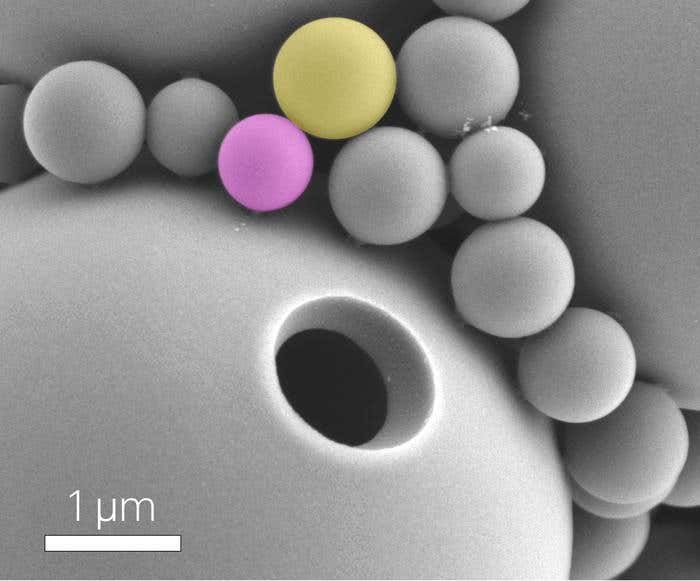
Single-opening capsules selectively collect or release particles in moving liquid, with different mechanisms operating from centimeter to microscopic scales. (CREDIT: Chong/Sacanna Lab, NYU)
Hollow capsules can collect particles from swirling water even when smaller particles that could easily fit through their openings remain outside. The surprising behavior turns an apparently simple container into a selective collector. It also suggests a different approach to water filtration: shaping how particles encounter moving liquid rather than merely blocking them with small pores.
The work, published in Science, comes from teams at New York University and the University of Chicago. Chemist Stefano Sacanna and physicist William Irvine co-led the research. Its proposed uses include environmental cleanup and drug delivery, although the experiments establish particle transport rather than a finished technology.
A quiet pocket inside moving water
Turbulence consists of irregular fluid motions containing swirls, called eddies, at different scales. Those motions usually spread material through a liquid, making controlled transport difficult. The researchers instead created capsules whose walls shelter an interior region from much of the surrounding turbulent flow.
Each shell has one opening, which limits the scales of fluid motion that can reach inside. The result is a relatively calm pocket surrounded by stronger fluctuations. This contrast changes how particles enter and leave, adding a form of selectivity distinct from ordinary filter pores.
In an initial experiment, the team placed a printed shelter inside liquid stirred by two counter-rotating paddles. Laser illumination revealed the movement of fluorescent particles approximately 120 micrometers across. Outside, particles followed energetic, irregular paths; inside, motion remained much weaker, apart from intermittent activity near the opening.
Dye experiments measured how quickly material exchanged between the sheltered interior and surrounding liquid. Changing viscosity, a fluid’s resistance to flow, shifted the characteristic exchange time from roughly three seconds to 125 seconds. That demonstrated how changing the accessible fluid motions can strongly alter transport without closing the opening.
Why the capsules resemble PAC-MAN
The next experiments used hollow spherical shelters surrounded by test particles. Depending on the relationship between particle size and opening geometry, shells either accumulated particles or largely excluded them. The researchers named the collecting behavior the PAC-MAN effect, comparing it with the game character swallowing dots, an unusual visual model for particle capture.
This is not simply a sieve separating particles too large to fit through a hole. Some particles that fit easily remain outside, while particles that barely fit accumulate inside. The distinction matters when considering future filtration systems, because passage through an opening does not by itself predict collection.
Particles can travel in both directions. What determines the eventual concentration is the balance between their entry and exit rates. A capsule can therefore collect material even without a sustained, one-way flow of liquid through its opening.
The team describes that concentration contrast using a PAC-MAN number, the concentration inside divided by the concentration outside. Values above one indicate accumulation; values below one indicate exclusion. This measure captures where particles end up, rather than implying that every particle entering a shell remains permanently trapped.
One design spans very different scales
The researchers tested the principle across centimeter, submillimeter-to-millimeter and microscopic systems. Chicago investigators printed the larger structures, while Sacanna’s laboratory synthesized microscopic polymer capsules around five micrometers across. The range shows that geometry can organize transport in widely different settings, a useful consideration for filter design.
At the centimeter scale, openings from 2.08 to 2.27 millimeters interacted with particles measuring 1.99 millimeters. An opening change smaller than 10 percent could switch shells from collecting particles to rejecting them. Such sensitivity illustrates how closely dimensions can govern particle separation.
Opening diameter was not the only useful control. Adjusting shell thickness also changed transport, showing that the entrance acts as a three-dimensional passage rather than a line drawn on a surface. Its geometry affects the fluid motions and particle trajectories involved in crossing that passage.
The details of the transport changed with scale. Larger particles could temporarily lodge in an opening, and collisions helped move them inward. Particles already inside could struggle to escape through a tight fit, allowing unequal entry and exit rates to build up their concentration.
For smaller particles, intermittent fluid currents played a greater role. Intermediate-scale tests also revealed density-based selection: shells could collect lighter particles preferentially over otherwise similar particles. The shared outcome therefore does not mean that every capsule uses an identical microscopic mechanism.
One intermediate-scale setup used capsules roughly 300 micrometers across, with 75-micrometer openings and particles around 50 micrometers wide. Other density-selection tests compared particles at 1.00 and 1.08 grams per cubic centimeter. These controlled comparisons help separate the influence of particle properties from the simple question of whether a particle fits.
Small capsules add thermal and electrical effects
Microscopic shelters measuring approximately 5.36 micrometers across, with openings around one micrometer wide, collected particles about 860 nanometers in diameter. Their internal concentrations reached at least ten times those outside. These dimensions place the process in a size range relevant to research on delivery particles, without demonstrating transport inside a living body.
Mixtures containing 780- and 980-nanometer particles revealed selective collection of one size by individual capsules. At this scale, Brownian motion, the random movement caused by thermal collisions, helps particles cross the entrance. Fluid motion brings them toward the opening, linking larger-scale transport with processes important to microscopic carriers.
Electrical interactions between particles and capsule surfaces also influence capture and escape. Changing salt concentration changes those interactions and can accelerate release. Geometry remains central, but describing the entire system as independent of chemistry would obscure the importance of solution conditions at the smallest scale.
Capture and release also unfold on different timescales. A high final concentration says little by itself about how quickly a shell fills or empties. Designing a useful collector would require measuring both its selectivity and the time needed to move a practical amount of material.
Long-duration observations showed that capsules could retain particles for months under suitable conditions. That result concerns experimental cargo and specific liquids, not demonstrated storage of active medicines. It supports studying controlled release while leaving questions about biological compatibility and useful release schedules unresolved.
Using turbulence still requires energy
The shells exploit energy in the surrounding moving liquid; they do not create energy or eliminate its cost. Laboratory stirring and shaking supplied that motion. An eventual system might use existing environmental flows, but evaluating its efficiency would require accounting for how the turbulence arises and how collection operates, including in water-cleaning devices.
Medical applications would require a separate demonstration that capsules work under the intended conditions inside the body. Selective collection in a shaken laboratory sample does not establish navigation to diseased tissue, safe treatment or effective dosing. Those questions remain central across approaches to targeted delivery.
For environmental use, investigators would likewise need to test real mixtures, collect the loaded capsules and determine whether performance remains reliable. Size- or density-based selection also differs from identifying a contaminant by its chemical identity. The demonstrated result is more specific: a sheltered pocket and a carefully shaped opening can turn surrounding fluctuations into selective particle transport.
Dig deeper into particle sorting and fluid motion
These resources explain related ways that geometry, flow and particle properties influence separation.
- Manta rays feed using ricochet separation, a novel nonclogging filtration mechanism: Physical models and simulations examine how manta-ray filters separate particles smaller than their pores, offering a biological comparison beyond simple sieving. (Science Advances, September 2018)
- Lock and key colloids: Sacanna, Irvine and colleagues demonstrate shape-based recognition between microscopic particles, providing background on how geometry can organize colloidal behavior. (Nature, March 2010)
- Continuous inertial focusing, ordering, and separation of particles in microchannels: This study uses inertia in laminar microchannel flows to organize particles, illustrating a different mechanism from turbulence shelters. (Proceedings of the National Academy of Sciences, November 2007)
- Continuous particle separation through deterministic lateral displacement: An asymmetric obstacle array sorts particles by size in laminar flow, offering a foundational comparison for geometry-driven separation. (Science, May 2004)
- Preferential concentration of particles by turbulence: This review examines why turbulence can produce uneven particle concentrations rather than uniform mixing, providing context for harnessing fluid fluctuations. (International Journal of Multiphase Flow, August 1994)
Research findings are available online in the journal Science.
The original story "PAC-MAN capsules use turbulence to selectively capture and release particles" is published in The Brighter Side of News.
Related Stories
- New physics explains how odor changes on its journey through the air
- New AI-powered armband uses gestures to control robots in real time
- First-ever floating titanium looks to transform marine construction
Like these kind of feel good stories? Get The Brighter Side of News' newsletter.
Joseph Shavit
Writer, Editor-At-Large and Publisher
Joseph Shavit, based in Los Angeles, is a seasoned science journalist, editor and co-founder of The Brighter Side of News, where he transforms complex discoveries into clear, engaging stories for general readers. With vast experience at major media companies like The Los Angeles Times, Times Mirror and Tribune Publishing, he writes with both authority and curiosity. His writing focuses on space science, planetary science, quantum mechanics, geology. Known for linking breakthroughs to real-world markets, he highlights how research transitions into products and industries that shape daily life.