Lunar samples reveal the violent history of the Moon’s largest impact basin
Chang’e-6 lunar samples reveal how ancient collisions shaped the Moon’s largest impact basin over billions of years.
 The University of Hong Kong Writer: Philip Kwong

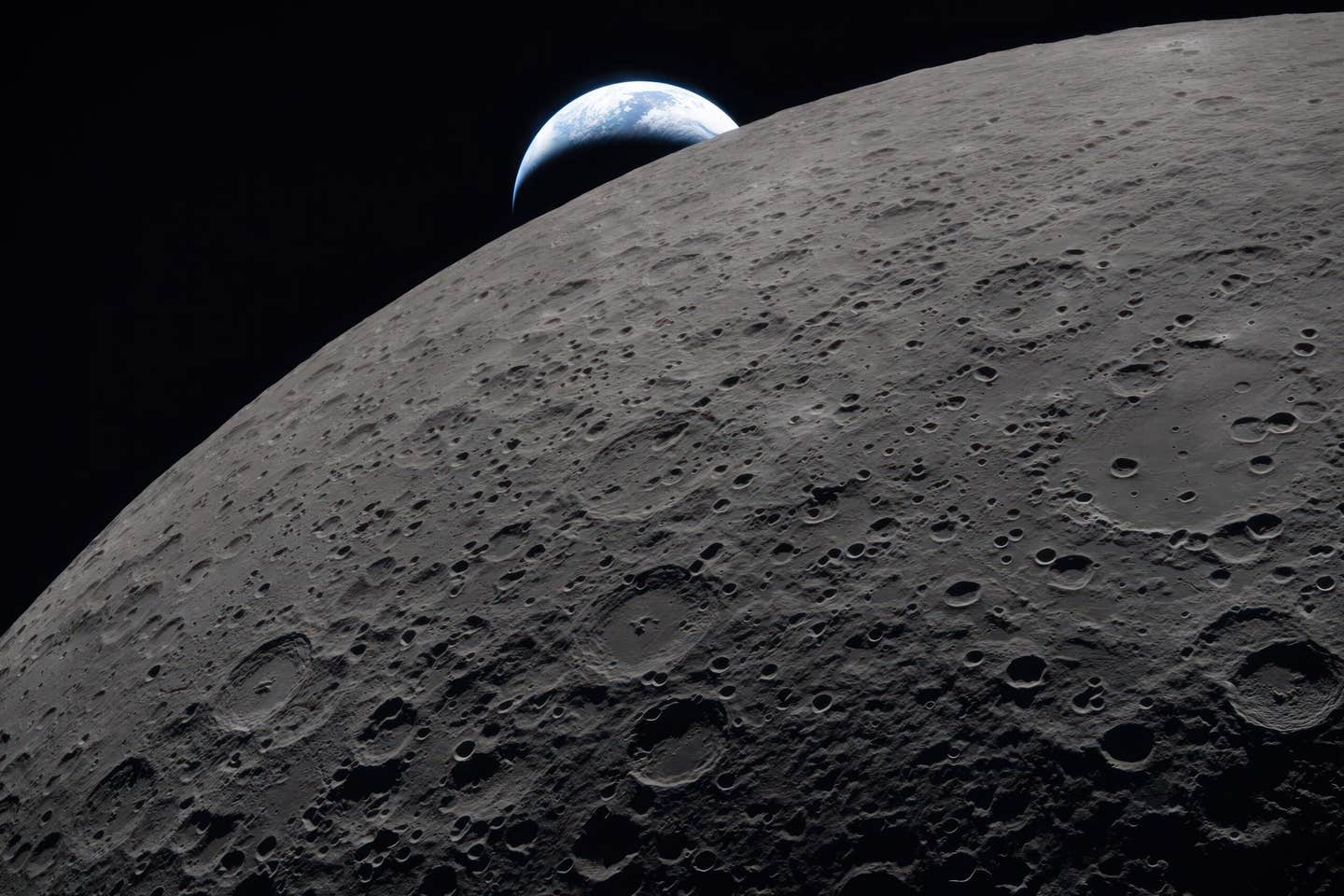
Lunar samples and surface measurements from China’s Chang’e-4 and Chang’e-6 missions reveal two distinct origins for magnesium-rich rocks and suggest the Moon’s largest impact basin formed approximately 4.34 billion years ago. (CREDIT: Shutterstock)
Tiny fragments of rock collected from the Moon’s far side are helping scientists reconstruct a collision that occurred approximately 4.34 billion years ago. The impact created the South Pole–Aitken (SPA) basin, a depression spanning approximately 2,050 by 2,400 kilometers and reaching depths of nearly 12 kilometers.
An international team led by geologists at The University of Hong Kong (HKU) has identified two groups of magnesium-rich rocks that appear to have formed through different geological processes. Their discoveries help explain how the original collision and subsequent impacts transformed the lunar interior and scattered ancient materials across its surface.
Published in Science Advances, the study was led by Guochun Zhao, the Mok Sau-King Professor at HKU, and first author Yuqi Qian. The team combined returned lunar samples, surface measurements, satellite observations and computer models to reconstruct the basin’s complicated history.
Two missions explore the Moon’s far side
The Moon’s two hemispheres look remarkably different. Broad volcanic plains dominate much of the near side, while heavily cratered terrain covers the far side. Understanding the geological history of the SPA basin could help explain how these contrasting landscapes developed.
China’s Chang’e-4 mission opened a new chapter in lunar exploration when it landed inside the 186-kilometer-wide Von Kármán crater in January 2019. Its Yutu-2 rover examines surface materials using instruments that identify minerals through the wavelengths of light they reflect.
Chang’e-6 followed in 2024, landing in the southern portion of the Apollo basin within northeastern SPA. The spacecraft returned approximately 1,935.3 grams of lunar soil, giving scientists their first opportunity to examine material collected directly from the Moon’s far side in Earth-based laboratories.
Both spacecraft landed on ancient volcanic deposits. However, billions of years of bombardment had scattered rock fragments from surrounding regions across those landing sites. Identifying where these fragments originally formed became central to reconstructing the basin’s evolution.
Following the trail of scattered rocks
An impact does more than create a depression. It also launches fragmented and sometimes molten rock across the surrounding landscape. Scientists call this displaced material ejecta, and even relatively recent lunar impacts demonstrate how widely a collision can redistribute surface material.
The researchers examined a catalog containing more than one million lunar craters. They identified 67 that formed after the volcanic deposits at the Chang’e-6 landing site, approximately 2.83 billion years ago, and could have delivered substantial quantities of debris.
Their models estimated that local volcanic deposits contributed between 54% and 61.3% of the landing site’s soil. Materials originating outside those deposits accounted for another 38.4% to 45.7%.
Mapping impact craters helped the team identify Chaffee S crater as a particularly important contributor. Its impact deposited an estimated 15 centimeters of debris at the Chang’e-6 landing site, potentially accounting for 16.1% to 18.2% of the local soil.
Chang’e-4 encountered a different mixture. The collision that created the 73.1-kilometer-wide Finsen crater approximately 3.1 billion years ago deposited an estimated 4.6 meters of material near the rover, covering volcanic deposits that date back approximately 3.6 billion years.
Millions of particles offer chemical clues
The team examined a one-gram lunar sample allocated to HKU by the China National Space Administration. Although that quantity sounds small, previous investigations of Chang’e-6 samples have demonstrated how much geological information microscopic particles can preserve.
The researchers analyzed 1,092 relatively large rock fragments and 2,935,175 microscopic soil particles. Calcium-rich pyroxene and plagioclase accounted for approximately 37% and 30.3% of the examined material, respectively.
Other minerals included ilmenite at 3.8% and olivine at 1.6%. Chemical analysis also revealed average concentrations of 2.3% titanium dioxide, 19.9% aluminum oxide and 15.4% iron oxide by weight.
These measurements matter because mineral composition reflects the conditions under which rocks form. Just as impact chemistry can reveal changes caused by collisions, magnesium concentrations can help scientists distinguish materials with different geological histories.
The team estimated that magnesium-rich noritic materials accounted for approximately 35% to 45% of the Chang’e-6 soil. Norite is a rock composed primarily of plagioclase and pyroxene. Less than 5% of the soil likely originated from feldspar-rich lunar highlands.
The most revealing distinction involved two groups of minerals with different magnesium concentrations. Their compositions and geographic origins pointed toward separate formation processes.
Two origins for magnesium-rich rocks
The original SPA collision released enough energy to melt enormous quantities of lunar material. Simulations suggest that it may have reached more than 80 kilometers beneath the surface, potentially excavating portions of the lunar mantle.
As the resulting melt sheet cooled, minerals crystallized at different temperatures and separated into layers. This process, called differentiation, appears to have produced moderately magnesium-rich norites beneath an upper layer of basaltic rock.
Subsequent collisions exposed some of these norites at the central peaks of large craters. The Finsen impact then carried fragments toward Von Kármán crater, where Chang’e-4 could examine them billions of years later.
The highly magnesium-rich materials collected by Chang’e-6 appear to have a different origin. Rather than crystallizing directly from the impact melt sheet, they likely formed through magnesium-suite magmatism, a process involving the movement and cooling of magma within the lunar crust.
Earlier investigations of buried magma demonstrate how orbital measurements can help identify volcanic formations beneath the surface. Previous gravity studies of the Apollo basin identified 14 underground magmatic structures with a combined length exceeding 2,200 kilometers and an estimated volume of 12,000 cubic kilometers.
The Apollo impact may have excavated material from depths of approximately 30 kilometers, exposing magnesium-rich rocks along its western peak ring. The later Chaffee S collision likely transported some of those rocks to the Chang’e-6 landing site.
Putting ancient lunar collisions in order
Determining when these events occurred requires distinguishing the age of a rock from the age of the collision that moved or altered it. Radioactive dating helps establish these timelines, while evidence of ancient volcanic activity provides additional geological context.
Some magnesium-rich fragments recorded ages of approximately 4.34 billion years. Other norites and impact-melt materials yielded ages closer to 4.245 billion years, which Qian and his colleagues associate with the formation of the Apollo basin.
This interpretation differs from earlier research that placed the original SPA collision approximately 4.25 billion years ago. Establishing which geological event each sample records remains essential to resolving that disagreement.
Another group of samples recorded ages of approximately 3.87 billion years, potentially marking the Orientale impact. Models suggest that the Orientale and Imbrium collisions deposited approximately 29.3 and 22.5 meters of debris, respectively, near the Chang’e-6 region.
The Moon’s subsequent geological evolution, including its gradual interior cooling, added further complexity to this ancient landscape. Future exploration through Chang’e-7, Artemis and the proposed Endurance rover could help researchers examine materials beyond the two existing landing sites.
For now, the combined evidence offers a clearer sequence of events connecting ancient magma, massive collisions and the rocks scattered across the Moon today. Testing that sequence will require samples from other parts of the basin, particularly locations where deeply buried material may have survived.
Dig deeper into the Moon’s impact history
These five studies offer additional insights into lunar collisions, volcanic activity and the geological evolution of the South Pole–Aitken basin.
- Crust–mantle architecture of the Moon’s South Pole–Aitken basin from Chang’e-6 samples: Combines lunar rock analysis and thermodynamic modeling to investigate how the enormous SPA impact reorganized the Moon’s crust and mantle. (Communications Earth & Environment, November 2025)
- Impact-induced mixing generated the stratified soils of the Lunar South Pole Aitken Basin: Investigates how repeated collisions transported, fragmented and mixed geological materials around the Chang’e-6 landing site. (Communications Earth & Environment, July 2025)
- South Pole–Aitken massive impact 4.25 billion years ago revealed by Chang'e-6 samples: Examines the mineral composition and radioactive ages of lunar norites, proposing an alternative timeline for the formation of the SPA basin. (National Science Review, March 2025)
- Lunar farside volcanism 2.8 billion years ago from Chang’e-6 basalts: Identifies evidence of volcanic episodes approximately 4.2 billion and 2.8 billion years ago, revealing the extended volcanic history of the Moon’s far side. (Nature, November 2024)
- A sample of the Moon's far side retrieved by Chang'e-6 contains 2.83-billion-year-old basalt: Uses isotope measurements to establish the age of volcanic material and investigate the chemical composition of its mantle source. (Science, November 2024)
Research findings are available online in the journal Science Advances.
The original story "Lunar samples reveal the violent history of the Moon’s largest impact basin" is published in The Brighter Side of News.
Related Stories
- Laser-printed LEGO-like bricks offer a new way to build on the Moon
- Earth’s gravitational pull could explain the Moon’s long volcanic history
- Japan’s historic MMX mission begins a daring journey to collect the first samples from Mars’ moon Phobos
Like these kind of feel good stories? Get The Brighter Side of News' newsletter.
Joseph Shavit
Writer, Editor-At-Large and Publisher
Joseph Shavit, based in Los Angeles, is a seasoned science journalist, editor and co-founder of The Brighter Side of News, where he transforms complex discoveries into clear, engaging stories for general readers. With vast experience at major media companies like The Los Angeles Times, Times Mirror and Tribune Publishing, he writes with both authority and curiosity. His writing focuses on space science, planetary science, quantum mechanics, geology. Known for linking breakthroughs to real-world markets, he highlights how research transitions into products and industries that shape daily life.