New discovery raises questions about the existence of the Milky Way’s Norma arm
The Milky Way’s Norma arm may be a star-forming shock front, revealing new clues about the galaxy’s central bar.
 University of Sydney Writer: Marcus Strom

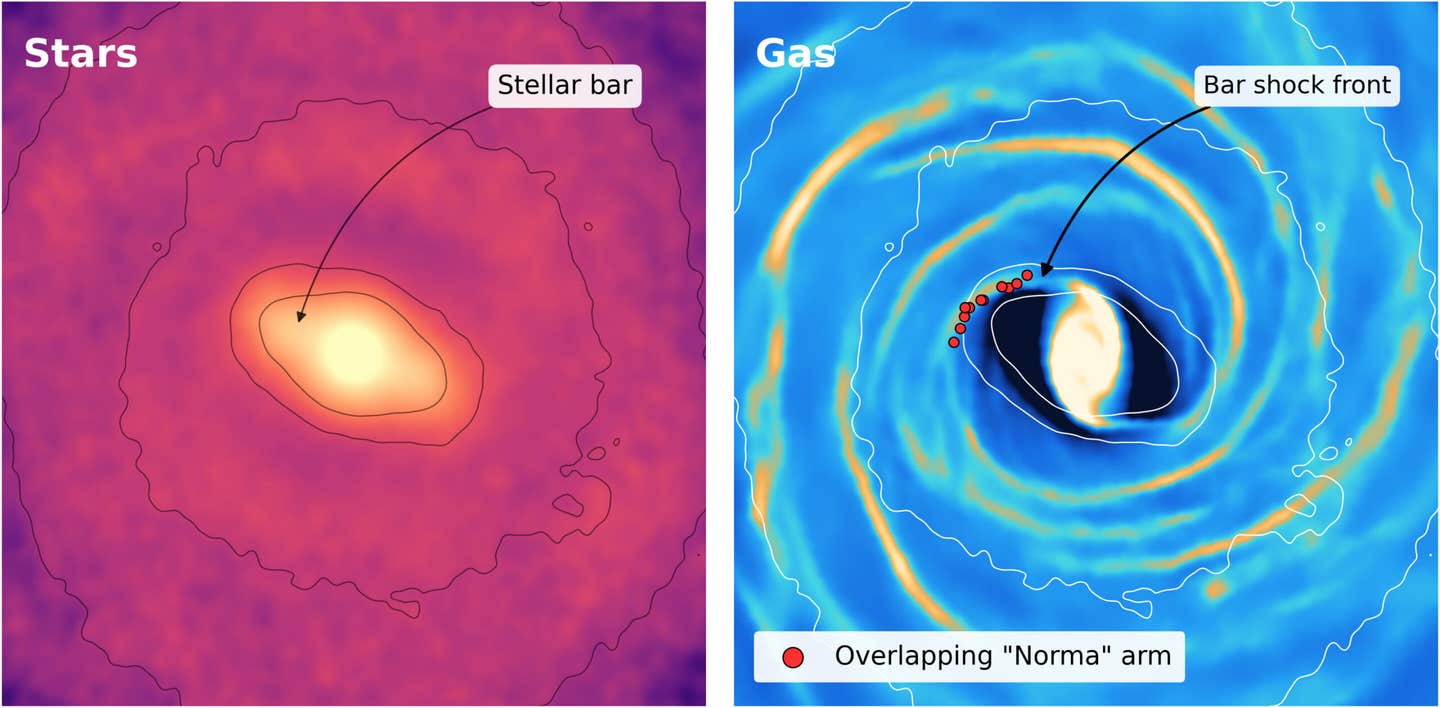
Graphics illustrate where the Milky Way’s Norma spiral arm overlaps with a shock front created by the galaxy’s central bar. In this region, gas becomes compressed as it encounters the shock front, creating conditions that can trigger the formation of new stars. (CREDIT: Hillary Davis)
- Young stellar nurseries assigned to the Milky Way’s Norma arm may instead trace a shock front along its central bar.
- Galaxy simulations match the locations and gas-velocity patterns of masers associated with massive young stars.
- The interpretation suggests unusual star formation along the bar, but does not establish the fate of the entire Norma spiral arm.
A stretch of the Milky Way long mapped as a spiral arm may actually mark a shock front where new stars form. The proposed change concerns part of the Norma arm near the Galaxy’s center. It would place those stellar nurseries along the leading edge of the Galactic bar, an elongated concentration of stars that steers surrounding gas.
Hillary Davis, who recently completed her doctorate at the University of Sydney, led the research. Published in Nature Astronomy, the study compares galaxy simulations with microwave signals from young stellar regions. Their alignment suggests that star formation continues in a setting where many nearby galaxies struggle to produce stars.
Why the central bar matters
The Milky Way’s bar rotates within the galaxy, exerting gravitational forces that redirect gas. Those flows can encounter shocks, abrupt changes that compress material into dense lanes along the bar’s leading edges. Understanding these motions matters because the bar helps shape the Galaxy’s central structures, rather than simply occupying space between its arms.
Compression can create conditions that favor star formation, but dense gas alone does not guarantee new stars. Strong shocks and turbulence can also disrupt the process. Observations of other galaxies show that substantial gas reservoirs can coexist with relatively little star formation, making the behavior of the Milky Way’s bar especially interesting.
Nearby barred galaxies commonly show weak star formation along these dust lanes, although exceptions exist. Davis and her colleagues argue that the Milky Way belongs among those exceptions. Their evidence comes from identifying where very young stellar regions sit relative to the gas structures predicted by simulations.
The difference between compression and disruption is central to the interpretation. A shock can gather gas, while the motions it creates can also resist collapse. Identifying young stellar regions along the lane therefore tests what actually happens there, rather than assuming that every dense feature must produce stars.
Microwave markers offer a different map
Astronomers cannot step outside the Milky Way to inspect its outline. Dust blocks parts of the view, while structures at different distances overlap along the same direction. Those difficulties complicate efforts to map the Milky Way and decide which visible features belong together.
The team used masers, naturally occurring sources of amplified microwave emission, as markers of massive young stellar regions. A maser works on a principle similar to a laser, but at microwave wavelengths. Measurements from the BeSSeL Survey and Japan’s VERA project had previously helped assign these regions to Norma, linking them to the Galaxy’s broader spiral structure.
The new interpretation changes that assignment. Rather than tracing a separate spiral arm, the observed markers may follow a curved dust lane generated by the bar. The distinction matters because the same stellar nurseries would then reveal activity within the bar’s shock front, changing both the map and its physical explanation.
Simulations connect positions with gas motions
To test that idea, the researchers examined a simulated galaxy containing a stellar disk, central bulge, dark matter halo and gas disk. The model followed gravity, gas heating and cooling, star formation, chemical enrichment and stellar feedback. Such simulations let astronomers explore how galaxies evolve while tracking positions that real observations cannot reveal directly.
The calculation covered approximately 4.3 billion years, with a finest spatial resolution of 74 parsecs. The team focused on a stage 3.95 billion years into the run, when a developed bar and dense gas lanes appeared. This model represents large-scale flows, rather than resolving every detail inside individual stellar nurseries.
A key test involved the kinematic distance method, which estimates distance from gas velocity while assuming circular motion. The bar disrupts that assumption, so the researchers compared estimated distances with known simulated positions. They isolated regions with errors below 2 percent, including zones that approximately followed a bar shock front.
The team also identified a secondary peak in diagrams of gas velocity against viewing direction. In the simulation, that feature marked where a dust lane crossed a geometric reference called the tangent-point circle. A second model, designed to resemble NGC 4303, reproduced the connection, supporting its usefulness beyond one simulated galaxy.
The two comparisons serve different purposes. The simulated distance errors reveal where a familiar mapping method happens to work well. The velocity peak then offers a recognizable feature to seek in observations. Neither result alone identifies a stellar nursery, which is why the maser comparison remains essential.
A longer bar comes into focus
The researchers then scaled and rotated the simulated gas distribution to align its shock front with the Norma masers. They compared both positions and line-of-sight velocities, strengthening the case beyond a resemblance on a map. The resulting geometry adds to evidence that the central bar has a substantial reach.
Their estimate places the bar’s long half-axis at approximately 4.3 ± 0.2 kiloparsecs, or about 14,000 light-years. That measures the distance from the center to one end, rather than the full length. The short half-axis measures about 2.3 ± 0.2 kiloparsecs, helping define the bar’s elongated shape within the galactic disk.
The preferred orientation is 20 degrees relative to the Sun–Galactic center line, with uncertainty extending two degrees lower and five higher. The inferred pattern speed is no more than roughly 40 kilometers per second per kiloparsec. This describes how quickly the bar’s overall pattern turns, rather than the speed of every star within it.
These results favor a relatively long, slowly rotating bar. However, the fit relies partly on visual alignment and rescaling a model galaxy. The quoted uncertainties do not capture every difference between methods for measuring bar length, so they should not imply that competing estimates have become irrelevant.
What the stellar nurseries establish
The masers trace very young regions associated with massive stars, making their locations informative about recent births. If those markers belong to the dust lane, star formation is not fully suppressed there. That would distinguish the Milky Way from many barred galaxies without making it unique among star-forming systems.
The finding does not prove that every structure labeled Norma disappears from the map. It reinterprets the observed segment near the bar and raises questions about connections farther out. It also leaves open why this particular shock environment supports stars when similar barred galaxies often show less activity.
The distinction also changes how astronomers explain the region’s gas motions. A spiral-arm interpretation and a bar-driven shock interpretation assign the same markers to different dynamical structures. Testing which picture fits requires agreement across multiple observations, not simply a curve that resembles the distribution of young stars.
The next challenge is to test the proposed association with more observations of positions and gas motions. For now, the study offers a coherent explanation linking a disputed Galactic feature to a physical process. A region once assigned to a spiral arm may instead show where the rotating bar compresses gas into new stellar birthplaces.
Dig deeper into the Milky Way’s bar and stellar nurseries
These resources explain the observations and galactic structures behind the proposed reinterpretation.
- NGC 1433 (MIRI Image): Webb’s infrared view provides an external comparison for the gas and dust structures surrounding a barred galaxy’s center. (NASA, February 2023)
- NASA’s Webb Reveals Intricate Networks of Gas and Dust in Nearby Galaxies: This official observing report explains how infrared imaging reveals material associated with star formation in nearby galaxies. (NASA, February 2023)
- Trigonometric Parallaxes of High-mass Star-forming Regions: Our View of the Milky Way: Reid and colleagues compile maser distances and motions used to trace Galactic structure, including the Norma region reconsidered here. (The Astrophysical Journal, November 2019)
- The Galaxy in Context: Structural, Kinematic, and Integrated Properties: This review surveys the Milky Way’s major components and the uncertainties involved in measuring their structure and motion. (Annual Review of Astronomy and Astrophysics, September 2016)
- Trigonometric Parallaxes of High Mass Star Forming Regions: The Structure and Kinematics of the Milky Way: An earlier maser survey establishes the distance-measurement approach behind modern maps of the Galaxy’s star-forming regions. (The Astrophysical Journal, March 2014)
Research findings are available online in the journal Nature Astronomy.
The original story "New discovery raises questions about the existence of the Milky Way’s Norma arm" is published in The Brighter Side of News.
Related Stories
- A cosmic giant 5,000 times the Milky Way’s mass emerges from the early Universe
- Milky Way’s fastest star revolves around the central black hole at 15,500 miles per second
- Astronomers discover a lost galaxy buried in the Milky Way’s ancient star clusters
Like these kind of feel good stories? Get The Brighter Side of News' newsletter.
Joseph Shavit
Writer, Editor-At-Large and Publisher
Joseph Shavit, based in Los Angeles, is a seasoned science journalist, editor and co-founder of The Brighter Side of News, where he transforms complex discoveries into clear, engaging stories for general readers. With vast experience at major media companies like The Los Angeles Times, Times Mirror and Tribune Publishing, he writes with both authority and curiosity. His writing focuses on space science, planetary science, quantum mechanics, geology. Known for linking breakthroughs to real-world markets, he highlights how research transitions into products and industries that shape daily life.