Space radiation changes gene activity in brain immune cells differently by gender
Simulated space radiation altered mouse brain immune cells without detected behavioral deficits; long-term effects remain unclear.
 University of Rochester Writer: Kelsie Smith Hayduk

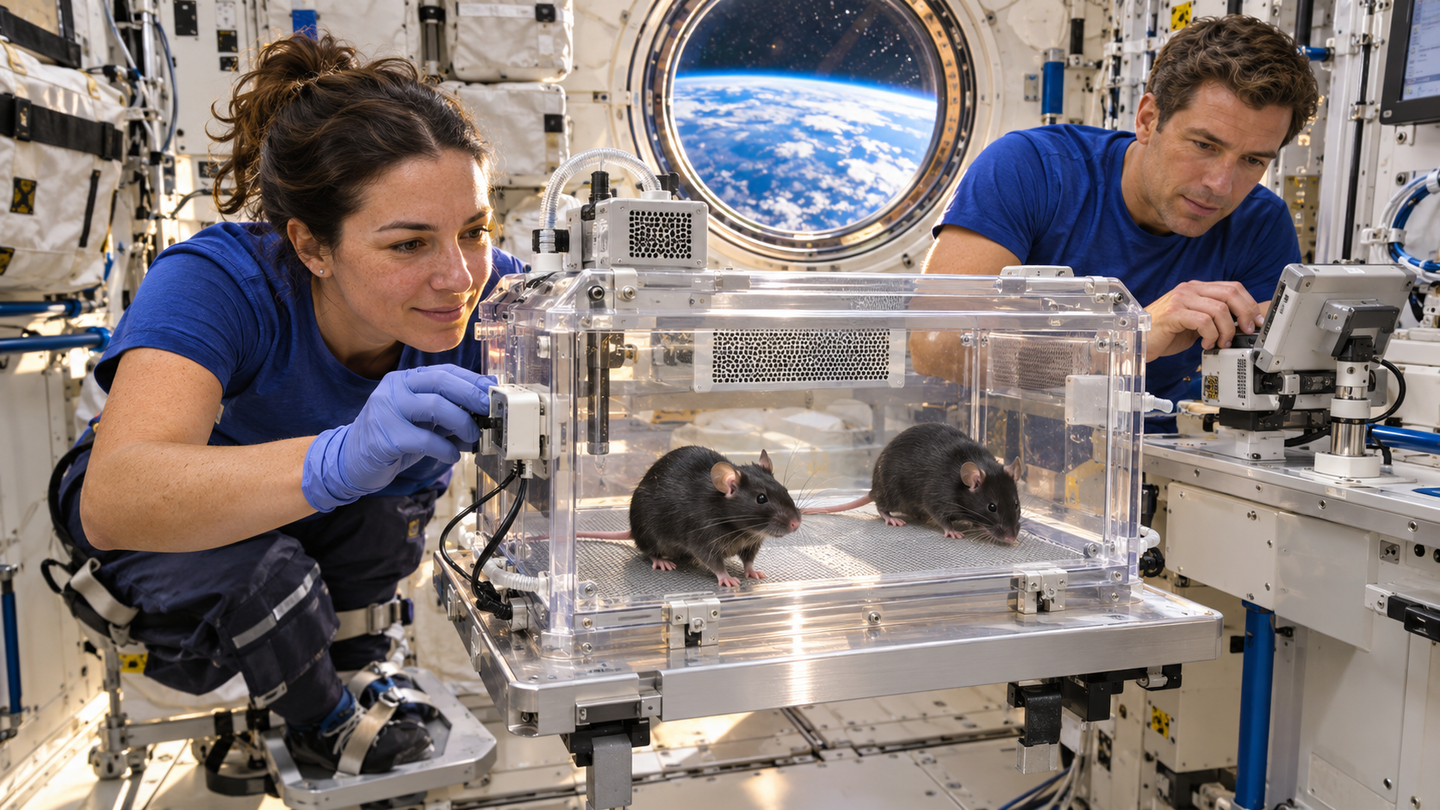
Male and female mice showed distinct microglial gene responses after simulated cosmic radiation, without detected behavioral impairment at the tested interval. (CREDIT: Shutterstock)
Brain immune cells changed their molecular activity weeks after simulated cosmic radiation exposure, even though behavioral tests detected no radiation-related impairment. Male and female mice showed different responses, suggesting that biological sex matters when investigating the neurological risks of space radiation. Whether those cellular changes help, harm or temporarily adjust brain function remains unresolved.
Neuroscience graduate student Mark Osabutey led the project in M. Kerry O’Banion’s laboratory at the University of Rochester. The findings appeared in Scientific Reports. They offer a closer look at microglia, the brain immune cells that help maintain tissue and respond to injury.
Recreating one part of deep-space exposure
Galactic cosmic radiation consists of energetic particles traveling through space. Earth’s atmosphere and magnetic field provide protection, but journeys beyond that shielding raise concerns about astronaut health. Understanding the brain’s response matters because crews must preserve judgment, memory and reliable performance during demanding missions.
The researchers studied 35 six-month-old mice, including 15 males and 20 females. Animals received either simulated radiation or a sham procedure without irradiation. Experiments took place at the NASA Space Radiation Laboratory at Brookhaven National Laboratory, using particle accelerators to reproduce selected components of the cosmic radiation environment.
The five-ion exposure combined protons, helium, oxygen, silicon and iron, delivering 100 centigray over approximately 27–32 minutes. A centigray measures absorbed radiation energy per unit mass. The dose exceeded the roughly 30–40 centigray estimate cited for a three-year Mars round trip, helping investigators detect biological effects.
That comparison has an essential limit: astronauts would accumulate radiation gradually, rather than receive this dose within minutes. The experiment therefore tests a particular exposure scenario, not a complete Mars mission. Differences in dose rate, particle mixture and exposure duration could change how brain cells respond.
Behavioral tests leave an important qualification
Between days 48 and 51 after exposure, the team tested movement and exploration, object recognition and contextual fear learning. The last test measures whether animals remember an environment associated with an unpleasant experience. Together, these tasks sampled several aspects of brain function, rather than every ability relevant to a space mission.
The tests revealed no statistically significant radiation-related differences in the measured behaviors. However, none of the groups clearly distinguished familiar from unfamiliar objects. That weak performance limits what the object-recognition task can establish about preserved memory, even though exposed animals did not differ significantly from controls.
The distinction prevents an overly reassuring interpretation. Failure to detect a difference does not prove the groups functioned identically, and an inconclusive memory test cannot establish intact recognition. The results describe the tasks and observation period studied, rather than demonstrating that radiation leaves cognition unaffected.
The tissue analysis therefore addressed a separate question from the behavioral tests. It asked whether cells had changed their internal activity, not whether the animals had developed a specific disability. Keeping these outcomes separate helps avoid treating a molecular response as either proof of injury or proof of protection.
Thousands of cells reveal subtler responses
On day 53, the researchers collected microglia from the hippocampus and overlying cortex. The hippocampus supports learning and memory, making it relevant to concerns about radiation-related cognitive effects. Examining microglia allowed the team to look for responses that behavioral testing might miss.
Single-cell RNA sequencing measures gene activity in individual cells. After quality checks removed lower-quality cells, the analysis retained 15,976 of 16,550 cells from 12 mice. Each combination of sex and treatment contributed three animals, allowing comparisons of cellular responses within each sex and providing a detailed view of brain biology.
The analysis identified 11 cell groups, with biological sex accounting for much of the variation. About 93.1 percent of analyzed cells belonged to groups retaining a maintenance-oriented microglial identity. Markers associated with routine microglial function remained prominent, while broad inflammatory and disease-associated gene patterns did not emerge.
Those findings challenge a simple expectation that radiation must leave microglia in a broadly inflamed state. They do not rule out an earlier inflammatory response that resolved before tissue collection. Nor can this single observation establish whether later inflammation or other consequences might develop.
Male and female cells adjust differently
Comparing exposed males with unexposed males identified 43 genes with altered activity: 35 increased and eight decreased. Genes including Fkbp5, Ddit4 and Adrb1 contributed to stress-related and metabolic patterns. Other changes involved protein-folding machinery, suggesting adjustments in how these cells manage cellular stress.
Female microglia showed 82 altered genes, with 29 increasing and 53 decreasing. Reductions affected several immune-signaling pathways, including systems associated with inflammatory responses. The pattern suggests broader dampening of signaling, rather than the widespread activation often discussed in studies of immune function.
The number of altered genes does not measure the amount of injury. More changes in female cells cannot establish greater damage, just as stress-related activity in males does not prove successful protection. The researchers interpret these patterns as distinct cellular responses whose functional consequences still require testing.
Gene activity describes how much RNA a cell produces from particular genes. It does not directly measure every protein or establish how well a cell performs its job. Patterns across related genes can suggest an underlying process, but testing that explanation requires additional experiments that measure or alter the process itself.
Both sexes shared increased activity of Fkbp5, a gene involved in regulating responses to stress hormones. Microscopy independently supported the finding by detecting more FKBP5 protein within microglia. This agreement between gene and protein measurements strengthens the evidence for a shared response despite the broader differences between sexes.
A stress signal to investigate further
In the dentate gyrus, part of the hippocampus, the measured proportion of microglial volume containing FKBP5 rose from 9.4 to 12.2 percent. In the cortex, it increased from 15.0 to 19.4 percent. These measurements describe protein-associated staining within brain cells, rather than an equivalent percentage increase in the number of cells.
The team has not established whether FKBP5 helps cells tolerate radiation or contributes to later problems. It also has not tested an FKBP5-directed treatment. Identifying this signal provides a research target, while developing protective strategies for deep-space missions remains a future goal.
The cellular analysis involved only three mice per sex-treatment group, despite its thousands of individual cell measurements. It also focused on microglia, leaving interactions with neurons, other support cells and blood vessels incompletely addressed. Human microglia may respond differently, and actual spaceflight adds microgravity and other stressors.
The timing also matters for interpreting the absence of broad inflammation. A sample taken 53 days after exposure provides a snapshot of that stage. It cannot reconstruct every earlier response or forecast the cells’ later condition.
The next step is to track responses across additional times, doses and exposure schedules, then test what FKBP5 actually does. The study makes one point clearer: measurable molecular changes can coexist with no detected behavioral impairment. Their meaning for long-term brain health depends on what happens beyond this experimental window.
Dig deeper into space radiation and brain immunity
These resources explore microglial responses, radiation simulation and the challenge of combining spaceflight stressors.
- Microglial activation in spaceflight and microgravity: potential risk of cognitive dysfunction and poor neural health: This review examines how radiation, altered gravity and stress may affect microglia, placing the new single-exposure findings in a broader context. (Frontiers in Cellular Neuroscience, February 2024)
- Combined space stressors induce independent behavioral deficits predicted by early peripheral blood monocytes: Mouse experiments combine simulated radiation with housing conditions modeling other mission stressors, illustrating why radiation alone cannot represent spaceflight. (Scientific Reports, January 2023)
- Microglia: Ally and Enemy in Deep Space: This review considers microglia, sex differences and cognitive outcomes across space-radiation experiments, including possible approaches to protection. (Neuroscience & Biobehavioral Reviews, July 2021)
- NASA’s first ground-based Galactic Cosmic Ray Simulator: Enabling a new era in space radiobiology research: The technical report explains how mixed-ion beams approximate aspects of deep-space radiation and why dose rate remains an experimental challenge. (PLOS Biology, May 2020)
- Temporary microglia-depletion after cosmic radiation modifies phagocytic activity and prevents cognitive deficits: This mouse study tests microglial manipulation after a different radiation exposure, providing experimental context without establishing a treatment for astronauts. (Scientific Reports, May 2018)
Research findings are available online in the journal Scientific Reports.
The original story "Space radiation changes gene activity in brain immune cells differently by gender" is published in The Brighter Side of News.
Related Stories
- Humans may not have the heart for space travel to Mars
- Scientists develop laser-powered graphene propulsion for next-generation space travel
- Scientists design the ‘perfect’ meal to feed long-term space travelers
Like these kind of feel good stories? Get The Brighter Side of News' newsletter.
Joseph Shavit
Writer, Editor-At-Large and Publisher
Joseph Shavit, based in Los Angeles, is a seasoned science journalist, editor and co-founder of The Brighter Side of News, where he transforms complex discoveries into clear, engaging stories for general readers. With vast experience at major media companies like The Los Angeles Times, Times Mirror and Tribune Publishing, he writes with both authority and curiosity. His writing focuses on space science, planetary science, quantum mechanics, geology. Known for linking breakthroughs to real-world markets, he highlights how research transitions into products and industries that shape daily life.