Saturn’s moon Enceladus offers new clues in the search for alien life
Cassini data suggest large ocean droplets freeze, chemically separate and shatter before Enceladus launches their fragments into space.
 UC Riverside Writer: Iqbal Pittalwala

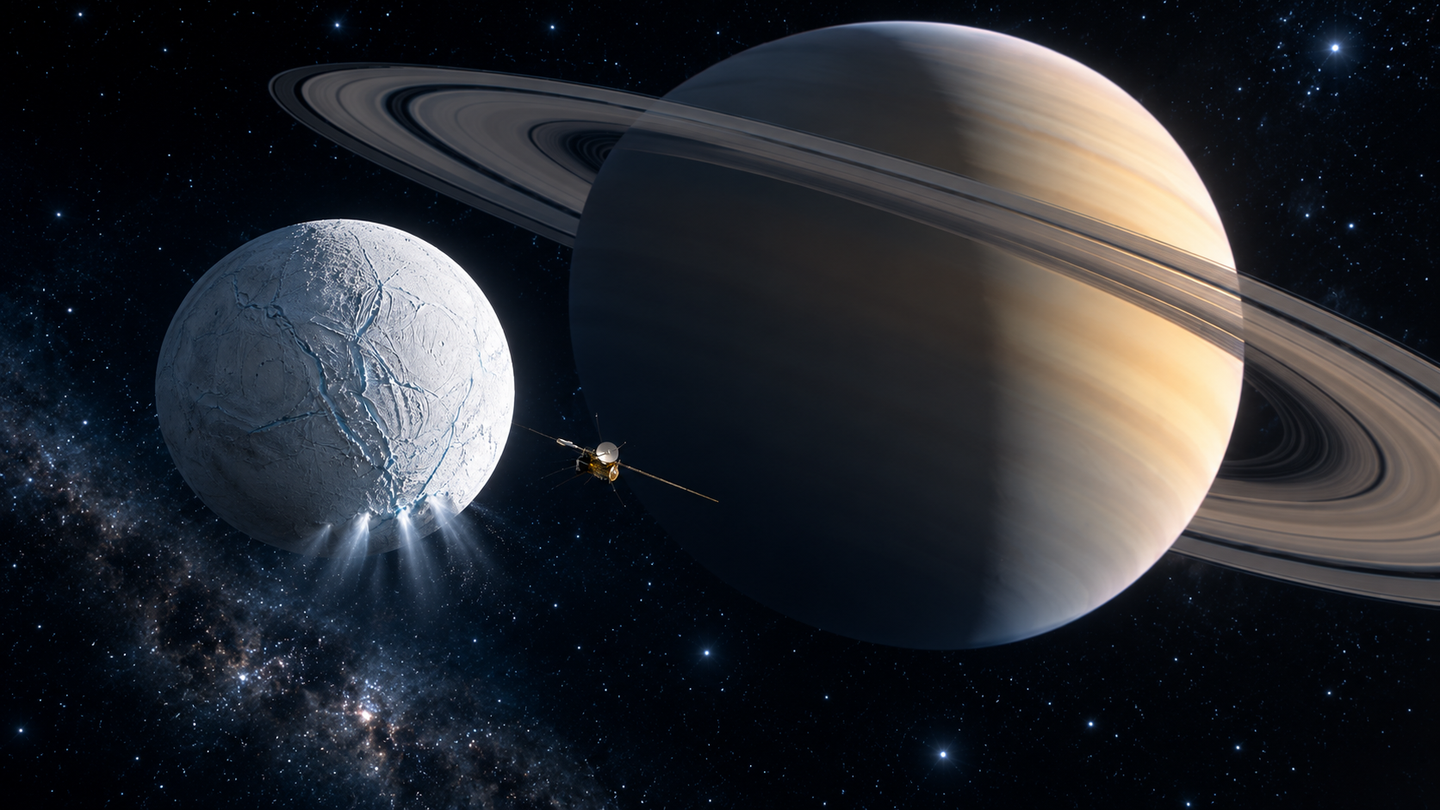
Enceladus may sort and concentrate ocean chemicals into individual ice grains, potentially making rare biosignatures easier to detect. (CREDIT: Shutterstock)
- Cassini measurements of 961 salt-rich ice grains show that salts from Enceladus’s ocean often become separated into chemically distinct particles rather than remaining evenly mixed.
- Laboratory experiments indicate that relatively large ocean droplets can freeze slowly inside Enceladus’s vents, allowing chlorides, carbonates, phosphates and potassium salts to segregate before the frozen droplets shatter.
- The same physical process could concentrate rare organic molecules or possible biosignatures into individual ice grains, strengthening the case for future missions that analyze large numbers of particles one at a time.
Saturn’s moon Enceladus may be doing part of the laboratory work for scientists searching for extraterrestrial life.
A new analysis suggests that droplets sprayed from its hidden ocean can separate dissolved chemicals as they freeze, concentrating different compounds into different microscopic regions. Those frozen droplets may then smash apart inside cracks in the ice, producing chemically distinct grains that erupt into space.
The process means an individual grain may contain a much higher concentration of a particular substance than the ocean itself. If organic molecules or biological material behave similarly, traces of life could become concentrated into a small number of particles that future spacecraft could analyze directly.
The study, published in Science Advances, combined measurements from NASA’s Cassini mission with laboratory freezing experiments, thermodynamic calculations and models of conditions inside Enceladus’s icy vents.
“We show that each grain is not necessarily a tiny scoop of the ocean,” said Fabian Klenner of the University of California, Riverside. Instead, a grain may be a fragment of a much larger droplet whose chemistry changed during freezing.
Cassini found surprisingly different grains
Enceladus contains a global saltwater ocean beneath its ice shell and above a rocky core. Near the south pole, fractures vent water vapor and ice into space, creating an enormous plume that supplies material to Saturn’s E ring.
Cassini repeatedly sampled those particles with its Cosmic Dust Analyzer. Earlier work divided the grains into several broad chemical groups, including nearly pure water ice, organic-rich particles and salt-rich Type 3 grains derived from ocean spray.
The new study examined 961 individual Type 3 spectra, generally produced by particles about 0.4 to 4 micrometers across.
Scientists expected these grains to reflect variations around a common ocean composition. Instead, the particles proved remarkably different from one another.
Some were dominated by sodium chloride, while others contained carbonates, phosphates or potassium-rich salts. Chloride and carbonate signatures almost never appeared together. Only about 1.4% of the 858 regularly classified sodium-rich spectra contained both.
Phosphate-rich grains likewise lacked detectable chloride or carbonate. Potassium behaved differently again, appearing mainly with chloride.
Such sharp chemical separation is difficult to explain if each particle simply froze instantaneously from a tiny droplet of well-mixed ocean water.
Larger droplets provide an explanation
The researchers proposed a different starting point.
Gas bubbles rising through Enceladus’s ocean could burst at the water surface and spray droplets tens or hundreds of micrometers across. These droplets would be much larger than the particles Cassini eventually encountered.
To test what happens next, the team created alkaline saltwater resembling estimates of Enceladus’s ocean composition. They froze droplets of different sizes under cooling rates ranging from extremely rapid freezing to just a few degrees per minute.
Large droplets that froze slowly developed clear chemical segregation.
Different salts precipitated at different stages. Thermodynamic modeling showed that sodium phosphates could appear first, followed by carbonates as temperatures dropped. Sodium and potassium chlorides crystallized much later, when most of the water had already frozen.
That sequence naturally creates chemically different regions inside a single droplet.
Droplets cooled faster than roughly 20 kelvins per minute remained much more uniform. Strong segregation therefore requires enough time for ice formation and salt precipitation to progress before the droplet freezes completely.
Enceladus’s vents may provide the right conditions
Slow freezing might sound difficult inside a plume that ultimately blasts material into space at high speed. Conditions deep inside the fractures, however, may provide exactly that opportunity.
Near the ocean, water vapor initially travels relatively slowly through warm channels. As it rises, temperatures decrease gradually along the icy walls.
The researchers modeled droplets traveling through this environment and found that they should rapidly adjust to the local gas temperature. Rather than experiencing one abrupt freeze, they could cool progressively as they move upward.
Modeled cooling rates remained below about 20 kelvins per minute through much of the lower vent. That matches the regime where laboratory droplets developed strong salt segregation.
Only higher in the vent does the vapor accelerate dramatically. Gas eventually reaches hundreds of meters per second, while some models permit even higher local velocities near the surface.
By then, much of the chemical sorting may already have occurred.
Frozen droplets may shatter against the walls
The next step is fragmentation.
Particles traveling through twisting, narrow fractures cannot perfectly follow accelerating gas. Collisions with the icy walls become increasingly likely as their speeds rise.
Experiments with ice indicate that particles tens of micrometers across can fragment during high-speed impacts. A large, compositionally segregated frozen droplet could therefore break into many much smaller pieces.
One fragment might contain mostly sodium chloride. Another could inherit a carbonate-rich region, while another carries potassium salts or phosphate.
Cassini would then encounter these fragments as apparently separate chemical populations, even though all originated from droplets drawn from broadly similar ocean water.
“Enceladus actually does a lot of the work for us in preparing samples for analysis that usually take a lot of effort in chemical labs on Earth,” study leader Frank Postberg said.
The finding changes how plume samples should be read
The mechanism has an important consequence for future life-detection missions.
Combining hundreds of grains into one average measurement could hide the most interesting chemistry. Rare compounds concentrated in only a handful of particles would be diluted by the much larger population of ordinary grains.
Analyzing individual grains preserves those extremes.
This may be particularly important for organic molecules. Cassini has already detected complex organic material in Enceladus ice, and more recent analysis of freshly ejected plume grains revealed additional classes of organic compounds.
The new study does not demonstrate that biological molecules are present or that they will segregate exactly like salts. It instead argues that freezing-driven separation should affect a broad range of dissolved ocean constituents, potentially including organics.
“Molecular signatures of life, if present, may be concentrated in only a few grains,” Klenner said. A future spacecraft would therefore need to examine enough individual particles to find the rare ones carrying the strongest chemical clues.
Enceladus remains unproven as an inhabited world. But its unusual plumbing may give scientists an extraordinary advantage: an underground ocean that launches naturally separated, concentrated samples directly into space.
Dig deeper into Enceladus and its hidden ocean
These studies provide directly relevant context on the organic chemistry, nutrients and hydrothermal conditions that make Enceladus a major target in the search for life.
Detection of organic compounds in freshly ejected ice grains from Enceladus’s ocean: Fresh plume grains revealed esters, alkenes, ethers and tentative nitrogen- and oxygen-bearing compounds that appear to originate within Enceladus. (Nature Astronomy, 2025)
Detection of phosphates originating from Enceladus’s ocean: Cassini ice grains revealed abundant sodium phosphates, showing that a biologically important element is readily available in the subsurface ocean. (Nature, 2023)
Macromolecular organic compounds from the depths of Enceladus: Ice grains containing complex organic material above 200 atomic mass units demonstrated that Enceladus can concentrate large carbon-rich molecules. (Nature, 2018)
Molecular hydrogen in the Enceladus plume: Evidence for hydrothermal processes: Detection of molecular hydrogen provided evidence for ongoing water-rock reactions capable of supplying chemical energy to potential microbes. (Science, 2017)
Ongoing hydrothermal activities within Enceladus: Silica nanoparticles in Saturn’s system pointed to active high-temperature water-rock interactions deep inside Enceladus. (Nature, 2015)
Research findings are available online in the journal Science Advances.
The original story "Saturn's moon Enceladus offers new clues in the search for alien life" is published in The Brighter Side of News.
Related Stories
- Saturn’s icy moon Enceladus may make alien life easier to find than scientists thought
- Supercomputers unlock secrets of Enceladus’ icy plumes and hidden ocean
- Key building block for life found at Saturn’s moon Enceladus
Like these kind of feel good stories? Get The Brighter Side of News' newsletter.
Joseph Shavit
Writer, Editor-At-Large and Publisher
Joseph Shavit, based in Los Angeles, is a seasoned science journalist, editor and co-founder of The Brighter Side of News, where he transforms complex discoveries into clear, engaging stories for general readers. With vast experience at major media companies like The Los Angeles Times, Times Mirror and Tribune Publishing, he writes with both authority and curiosity. His writing focuses on space science, planetary science, quantum mechanics, geology. Known for linking breakthroughs to real-world markets, he highlights how research transitions into products and industries that shape daily life.