CERN physicists recreate matter from the early universe using ‘Little Big Bangs’
Oxygen and neon collisions at CERN produced collective particle flow tied to the earliest matter and the internal shape of nuclei.
 University of Copenhagen Writer: Maria Hornbek

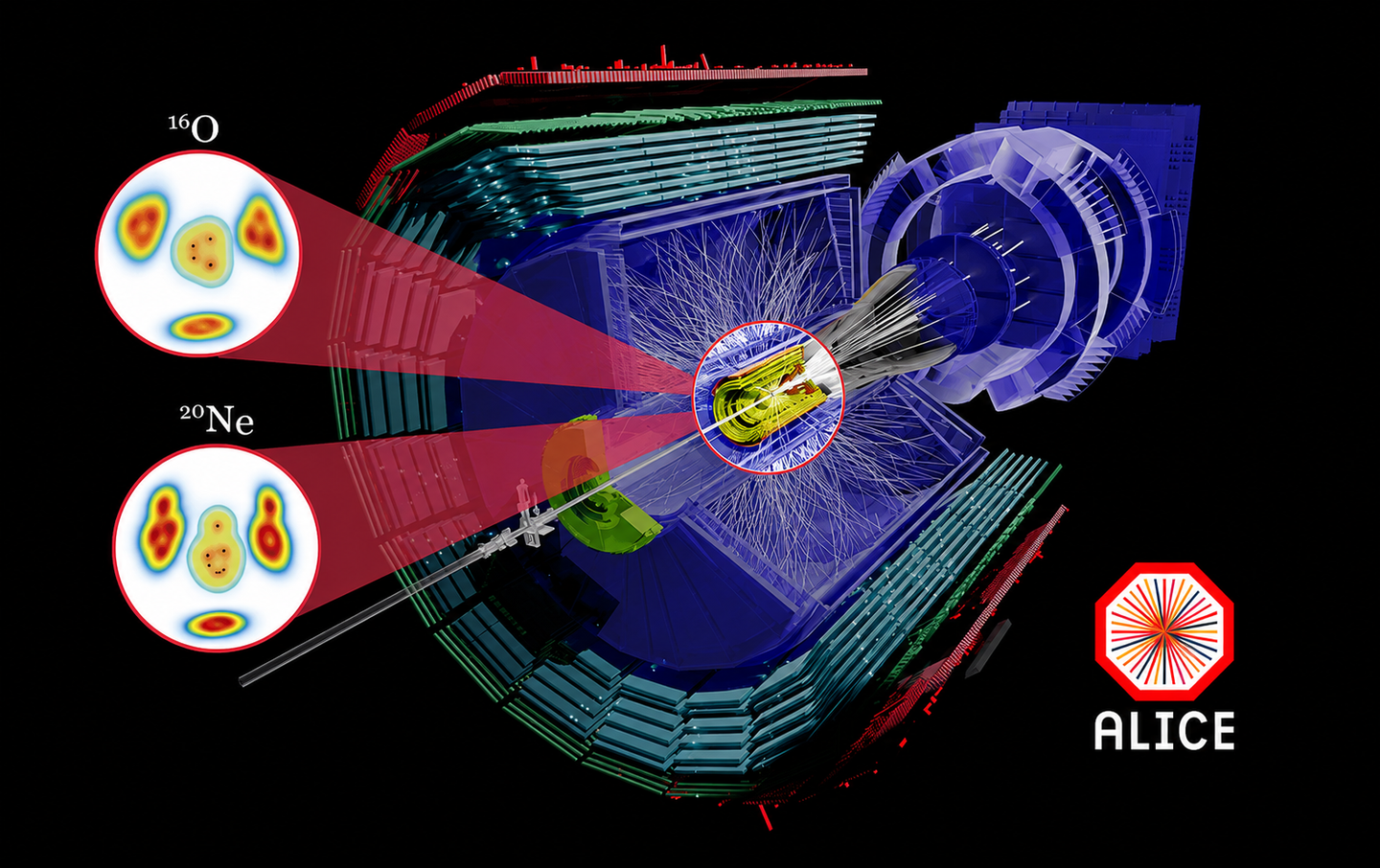
Event display of collisions between Neon-20 and Oxygen-16 at the CERN Large Hadron Collider. (CREDIT: University of Copenhagen)
- Physicists created signs of primordial quark-gluon plasma by colliding oxygen and neon nuclei, much smaller nuclei than traditionally used for these experiments.
- Particle patterns preserved clues about the different shapes of oxygen and neon nuclei, allowing physicists to study nuclear structure through high-energy collisions.
- The method could help researchers determine how small a collision can still produce quark-gluon plasma and improve models of matter in the early Universe.
A collision between two light atomic nuclei can create matter resembling the substance that filled the Universe less than a millionth of a second after the Big Bang. The result pushes physicists closer to finding how small a “Little Big Bang” can be.
Physicists at CERN have long recreated quark-gluon plasma by smashing heavy nuclei together near light speed. Work led by the Niels Bohr Institute at the University of Copenhagen in the international ALICE collaboration shows that lighter oxygen-16 and neon-20 nuclei can also produce collective behavior consistent with this primordial state.
The findings come from collisions recorded by the ALICE detector at the Large Hadron Collider in July 2025. About 3 billion oxygen-oxygen collisions and 400 million neon-neon collisions passed the experiment’s selection criteria.
“We have pushed the boundary for how small the atomic nuclei can be while still recreating this primordial matter – what you could call a Little Big Bang. We now know more about the fundamental conditions required for matter to transition into this extreme state,” said Associate Professor You Zhou, who led the experiment.
Light nuclei leave different fingerprints
Quark-gluon plasma is a hot, dense form of matter in which quarks and gluons move freely instead of remaining bound inside protons and neutrons. As the early Universe expanded and cooled, those particles became confined and eventually helped form ordinary matter.
The plasma produced in nuclear collisions exists for a tiny fraction of a second. Physicists cannot observe it directly. Instead, they measure the particles produced as the droplet expands and transforms.
Those particles preserve clues about the collision’s starting shape. The study measured anisotropic flow, which describes how particles emerge more strongly in some directions than others. Pressure inside the medium converts the geometry of the initial overlap into patterns of particle motion.
Oxygen and neon offered a useful comparison because the nuclei have similar sizes but different internal structures. Modern models describe oxygen-16 as having an irregular tetrahedron-like configuration. Neon-20 resembles oxygen-16 plus an alpha cluster, producing an intrinsic bowling-pin-like form.
“The particles from the primordial matter are directly governed by the geometric shape of the atomic nucleus. If the two nuclei we smash together are spherical, we get one pattern. If they are shaped like bowling pins, we get another. By studying how the particles move after the collision, we can gain insights into atomic nuclei that are otherwise difficult for physicists to obtain,” said Postdoctoral Researcher Emil Gorm Dahlbæk Nielsen of the Niels Bohr Institute.
Flow points to collective behavior
The team measured elliptic flow, called v2, and triangular flow, called v3, in oxygen-oxygen and neon-neon collisions at 5.36 teraelectronvolts per nucleon pair.
A nonzero four-particle measure of elliptic flow showed that the anisotropy was collective. The pattern also differed from behavior previously seen in proton-proton and proton-lead collisions.
Hydrodynamic calculations tested whether the particle motion could be explained as the expansion of a tiny fluid-like system. Calculations using nuclear structures from nuclear lattice effective field theory, or NLEFT, reproduced several flow measurements up to 50% centrality. Predictions using another nuclear model, PGCM, also came close, although agreement was slightly worse in the most central collisions.
The results support the emergence of collective behavior in light-ion collisions and a hydrodynamic expansion of quark-gluon plasma. In heavier ion collisions, such plasma already appears to behave like a nearly perfect fluid with extremely low viscosity.
Neon’s shape stands out
Comparing neon directly with oxygen reduced many effects that occur after the initial collision. That made the ratios especially sensitive to nuclear geometry and the earliest stages of the impact.
In the most central events, the ratio of elliptic flow between neon-neon and oxygen-oxygen collisions peaked near 1.08. It fell to about 1.05 by 10% centrality, then changed only weakly. The enhancement was linked to the stronger quadrupole deformation of neon-20.
Triangular flow followed a different pattern. Its neon-to-oxygen ratio began near one in central collisions and rose to roughly 1.06 at 10% centrality. The smaller central ratio may reflect oxygen-16’s tetrahedral configuration.
Not every model matched equally well. A calculation combining IP-Glasma, JIMWLK, MUSIC and UrQMD reproduced the system ratios well. The comparison pointed to the description of the immediate post-collision state, including the effective transverse size of quarks and gluons inside nucleons, as a possible source of remaining differences.
The measurements favored calculations using a smaller subnucleon width of about 0.1 to 0.2 femtometers. Future analyses could use these ratios to constrain that scale more precisely.
Smashing nuclei to read their shape
The work also reaches into a longstanding problem in nuclear physics: how protons and neutrons are organized inside atomic nuclei. Traditional approaches often study nuclei at low energies through their rotations and vibrations. Here, nuclei are destroyed in high-energy collisions, and their shapes are inferred from the particle patterns left behind.
“It is a bit like shining light on an object and seeing its shadow. You cannot see the object directly, but its shadow reveals its shape. In the same way, the movement of the particles reveals the geometric shape of the atomic nuclei that was present at the beginning of the collision,” Nielsen said.
The interpretation still depends on nuclear-structure models. Oxygen-16 and neon-20 have rotationally symmetric ground states in the laboratory frame, so linking measured flow to intrinsic deformation remains model dependent and complements traditional low-energy measurements.
Researchers also do not yet know the smallest nucleus capable of producing quark-gluon plasma. Experiments with lighter systems, including helium-4, are a possible next step.
Practical implications of the research
Light-ion collisions could give physicists a new way to study two difficult problems at once. The same measurements can test how quark-gluon plasma forms and evolves while probing how protons and neutrons are arranged inside small nuclei.
More precise comparisons may improve models of the earliest stage after impact and tighten estimates of subnucleon structure. Better nuclear inputs could also improve attempts to extract quark-gluon plasma properties from collider data.
Dig deeper into quark-gluon plasma and nuclear structure
These resources explore how oxygen and neon collisions probe quark-gluon plasma, collective flow, nuclear geometry and the earliest stages of high-energy nuclear collisions.
Observation of long-range collective flow in O+O and Ne+Ne collisions and implications for nuclear structure studies
CMS independently measured significant elliptic and triangular flow in oxygen and neon collisions, finding that differences between the two systems are sensitive to their intrinsic nuclear structures and can constrain hydrodynamic models. (Physical Review Letters, 2026)
Evidence for parton energy loss in oxygen-oxygen collisions at √sNN = 5.36 TeV
ALICE found significant evidence that energetic quarks and gluons lose energy in oxygen-oxygen collisions, strengthening the case that even these relatively small nuclear systems can form quark-gluon plasma. (ALICE Collaboration, 2026)
Glauber predictions for oxygen and neon collisions at energies available at the CERN Large Hadron Collider
This work updates a widely used model of nuclear-collision geometry with improved nuclear density profiles and nucleon substructure, providing predictions tailored to the LHC’s oxygen and neon collision program. (Physical Review C, 2026)
Observation of enhanced baryon production using strange hadrons in oxygen-oxygen collisions
CMS observed enhanced production of lambda baryons relative to strange mesons in oxygen collisions, a pattern associated with collective flow and quark recombination that offers another probe of deconfined matter in small systems. (CMS Collaboration, 2026)
Exploiting 20Ne Isotopes for Precision Characterizations of Collectivity in Small Systems
This theoretical study combined first-principles nuclear-structure calculations with hydrodynamic simulations and predicted that neon’s distinctive deformation should leave a measurable imprint on particle flow compared with oxygen collisions. (Physical Review Letters, 2025)
Research findings are available online in the Physical Review Letters.
The original story "CERN physicists recreate matter from the early universe using ‘Little Big Bangs’" is published in The Brighter Side of News.
Related Stories
- Strange red object from the early universe could be the first ‘black hole star’
- Massive black hole from the early universe has astronomers looking back to the Big Bang
- A dead galaxy from the early universe is forcing astronomers to rethink galactic evolution
Like these kind of feel good stories? Get The Brighter Side of News' newsletter.
Joshua Shavit
Writer and Editor
Joshua Shavit is a NorCal-based science and technology writer with a passion for exploring the breakthroughs shaping the future. As a co-founder of The Brighter Side of News, he focuses on positive and transformative advancements in technology, physics, engineering, robotics, and astronomy. Having published articles on AOL.com, MSN, Yahoo News, and Ground News, Joshua's work highlights the innovators behind the ideas, bringing readers closer to the people driving progress.