Potatoes may be the secret to better gluten-free, plant-based meat
Potato protein helps fava beans form strong structures for gluten-free meat alternatives. Researchers now face a flavor challenge: bitterness and aftertaste.
 Heriot-Watt Writer: Sarah McDaid

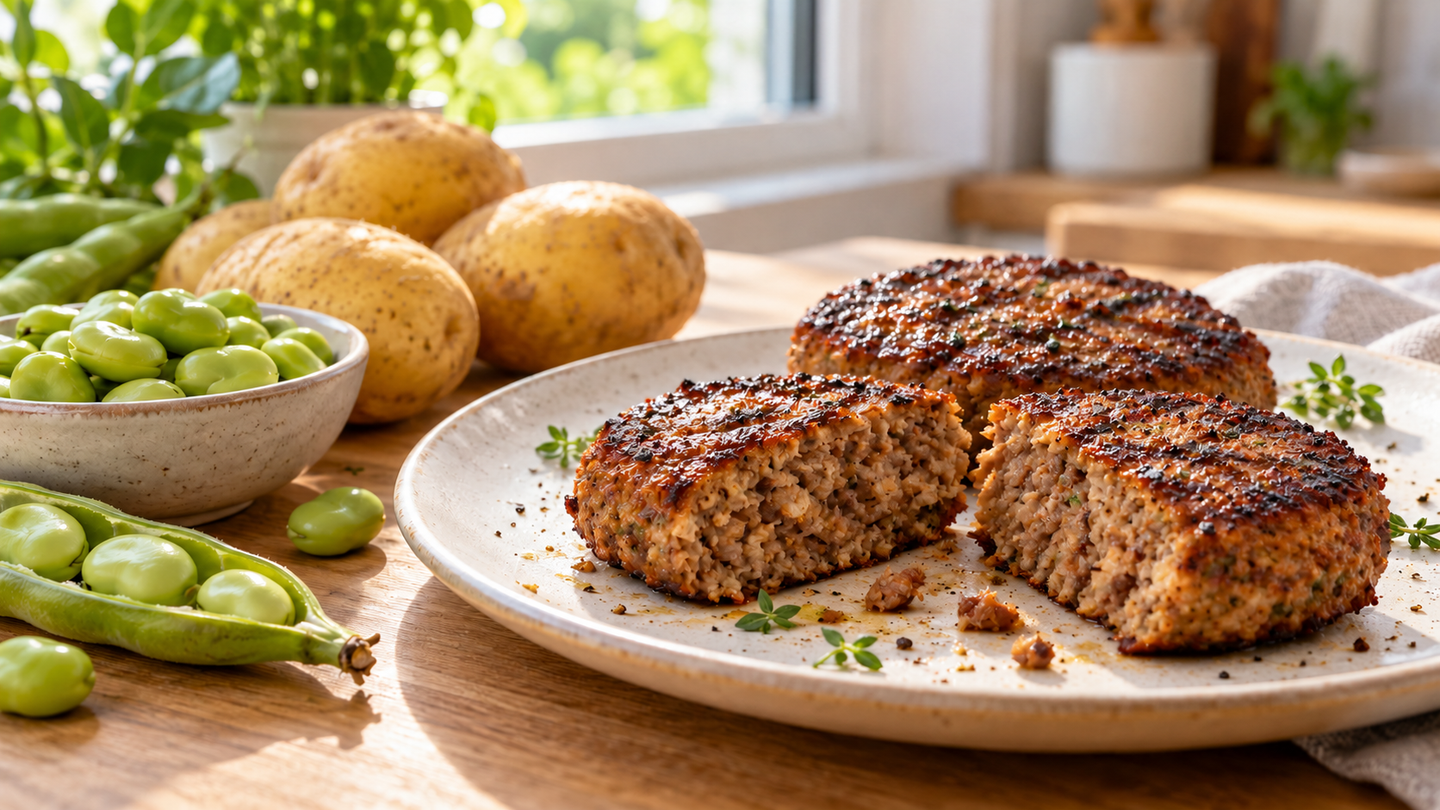
Potato and fava bean proteins form strong gluten-free meat-alternative structures, but taste sensors reveal bitterness and astringency. (CREDIT: Shutterstock)
- Potato protein helped fava bean protein form a strong structure for gluten-free meat alternatives during high-moisture extrusion.
- A 75:25 blend of fava and potato protein ingredients produced a different network from the gluten version, which was softer and springier.
- Electronic taste sensors detected more bitterness, astringency and lingering aftertastes, leaving flavor improvement and consumer testing as important next steps.
Potato protein could help give gluten-free meat alternatives a firmer bite, but the same formulation brings a flavor problem. Combined with fava bean protein, it formed a strong network during extrusion processing. Electronic taste measurements, however, indicated greater bitterness and astringency than the formulation containing wheat gluten.
The findings come from University of Greenwich and Heriot-Watt University researchers writing in Food Hydrocolloids. Their experiments tested whether potato protein could provide structure without relying on gluten’s distinctive elastic behavior. The results support that possibility, while showing that stronger material does not automatically mean a better-tasting finished food.
The work concerns concentrated protein ingredients, rather than mixing ordinary potatoes and beans into a recipe. Researchers compared precisely formulated samples under the same processing conditions and measured their physical and chemical properties. They did not establish whether consumers would prefer the potato formulation or mistake it for meat.
Replacing gluten’s structural role
Wheat gluten helps many plant-based meat products develop elasticity and a characteristic bite. Its usefulness creates a limitation for people with coeliac disease, who need to avoid gluten. Finding another ingredient that can help form a structured product would broaden the options available to food manufacturers.
Fava beans, also called faba beans, are attractive partly because they contain substantial protein and grow in cooler climates. They offer another ingredient alongside the soy, pea and wheat proteins widely used in meat alternatives. The question here was how their isolated protein would behave when paired with a different structuring ingredient.
The team tested three formulations: fava bean protein isolate alone, a fava–gluten blend and a fava–potato blend. Both blends contained 75% fava ingredient and 25% of the second protein ingredient by weight. Those percentages describe the ingredient powders before added water, rather than the composition of a finished retail meal.
“The gluten version was softer and springier, but the potato protein version was still able to provide the structure required for a meat alternative,” said Parag Acharya of Greenwich’s Bezos Centre for Sustainable Protein. That distinction runs through the study. Potato protein offered a different route to structure, rather than reproducing every property of gluten.
Heat and mechanical force reshape the proteins
The researchers used high-moisture extrusion, which combines water, heat and mechanical forces to restructure proteins. A twin-screw extruder mixed and worked the ingredients through a series of heated sections. A cooled die then helped stabilize the emerging structure before the material left the machine.
The equipment ran at 400 revolutions per minute, with barrel temperatures rising as high as 150°C before falling toward the die. Finished experimental samples contained roughly 54% to 55% moisture. Keeping the operating conditions consistent allowed the team to compare the effects of the different ingredient combinations.
Heating and working proteins can unfold their structures and bring previously hidden regions into contact. New interactions then help connect the molecules into larger networks. The researchers investigated those changes using chemical extraction, fluorescence measurements, microscopy and tests of how the material responded to deformation.
The potato blend required more mechanical energy per unit mass than either the gluten blend or fava protein alone in this setup. That finding describes the laboratory processing conditions, rather than the environmental performance of a commercial product. The study did not establish a whole-product sustainability advantage for the potato formulation.
A strong network with a different bite
Both blended systems showed increased disulfide-linked protein fractions compared with fava protein alone. These links connect sulfur-containing groups within proteins and can help hold a network together. The potato formulation also showed evidence of additional interactions, including hydrogen bonding and covalent links beyond disulfide bonds.
Tests involving repeated deformation found that the potato blend had the highest storage modulus across the investigated strain range. This measure describes the material’s elastic response under the test conditions. Together with the chemical measurements, it supported the conclusion that potato protein helped create a strongly interconnected network.
Microscopy nevertheless showed fewer fibrillar features in the potato blend than in the gluten blend. Strong network connections and an abundance of visible fibers are therefore different characteristics. The work suggests that a mechanically robust meat-alternative structure need not develop through exactly the same architecture as gluten.
Texture measurements also revealed important qualifications. The gluten blend was less hard and more springy, while measured chewiness did not differ significantly between the two blends. A cutting-based measure of directional structure tended to be higher with potato protein, but that difference was not statistically significant.
Taste sensors reveal the compromise
The researchers used an electronic taste-sensing system to compare soluble components extracted from the samples. They dispersed the extruded material in water, separated the liquid and tested it with sensors. This procedure measures taste-related signals rather than recording people’s reactions while chewing the intact food.
The potato formulation produced stronger signals associated with bitterness, astringency and lingering aftertastes. Gluten reduced bitterness and astringency relative to the fava-only reference. These results identify a potential formulation problem, without demonstrating the precise flavor experience of a seasoned, cooked consumer product.
“Food companies would need to find ways of reducing the bitterness before this could be widely used in consumer products,” said Stephen Euston of Heriot-Watt’s School of Engineering and Physical Sciences. The warning accompanies the encouraging structural findings. A product that holds together well still needs an acceptable flavor.
The authors connect the stronger off-notes with protein unfolding and increased exposure of water-repelling regions. Residual phenolic compounds in potato protein could also contribute to astringency and persistent aftertaste. These are proposed explanations supported by the broader measurements, rather than proof that one identified compound caused every sensor response.
Building a formulation people would choose
Possible next steps include changing processing conditions and exploring ways to limit the release or perception of bitter compounds. The paper discusses enzyme treatments, protein–polysaccharide combinations and lipid-based flavor encapsulation among potential approaches. It does not demonstrate that those additions solve the problem in this particular fava–potato formulation.
The trial also used one selected blend ratio and one set of extrusion conditions. Different protein preparations, moisture levels, temperatures or screw configurations could change both structure and flavor. Broader optimization is needed before the results can be translated into a consistently appealing product.
Gluten-free formulation should also remain distinct from claims that a food is universally allergy-free or nutritionally superior. Replacing wheat gluten addresses one ingredient constraint, while a finished product’s suitability depends on its complete formulation and manufacturing controls. The study did not test health outcomes or consumers with coeliac disease.
The central advance is a demonstrated route to building structure from an underused combination of plant proteins. Its remaining challenge is to preserve that network while improving flavor and the experience of biting and chewing. Human sensory testing will be needed to determine whether those improvements produce a meat alternative people actually want to eat.
Dig deeper into plant protein texture and flavor
These resources explore extrusion, fava bean flavor and the dietary reasons for developing gluten-free alternatives.
Masking off-flavors of faba bean protein concentrate and extrudate: The role of in situ and in vitro produced dextran
This study investigates fermentation and dextran as ways to reduce undesirable flavor notes in fava bean ingredients and extruded products. (Food Hydrocolloids, May 2024)
The flavor of faba bean ingredients and extrudates: Chemical and sensory properties
Chemical analysis and sensory profiling examine how ingredient composition and extrusion relate to fava bean flavor. (Food Research International, October 2022)
Physical Properties of Extrudates with Fibrous Structures Made of Faba Bean Protein Ingredients Using High Moisture Extrusion
This research compares fava bean protein ingredients and processing conditions to understand the development of fibrous structures. (Foods, April 2022)
High-Moisture Meat Analogues Produced from Yellow Pea and Faba Bean Protein Isolates/Concentrate: Effect of Raw Material Composition and Extrusion Parameters on Texture Properties
Experiments investigate how different pulse protein ingredients and extrusion settings affect the texture of meat alternatives. (Foods, April 2021)
Eating, Diet, & Nutrition for Celiac Disease
This guidance explains gluten avoidance, food labeling and cross-contact considerations for people with coeliac disease. (National Institute of Diabetes and Digestive and Kidney Diseases)
Research findings are available online in the journal Food Hydrocolloids.
The original story "Potatoes may be the secret to better gluten-free, plant-based meat" is published in The Brighter Side of News.
Related Stories
- Scientists make plant-based foods more appealing using extended reality
- Scientists create nutritious vegan-meat alternative from sunflowers
- Plant-based meat ‘healthier and more sustainable than animal products’, study finds
Like these kind of feel good stories? Get The Brighter Side of News' newsletter.
Rebecca Shavit
Writer
Based in Los Angeles, Rebecca Shavit is a dedicated science and technology journalist who writes for The Brighter Side of News, an online publication committed to highlighting positive and transformative stories from around the world. Having published articles on MSN, AOL News, and Yahoo News, Rebecca's reporting spans a wide range of topics, from cutting-edge medical breakthroughs to historical discoveries and innovations. With a keen ability to translate complex concepts into engaging and accessible stories, she makes science and innovation relatable to a broad audience.