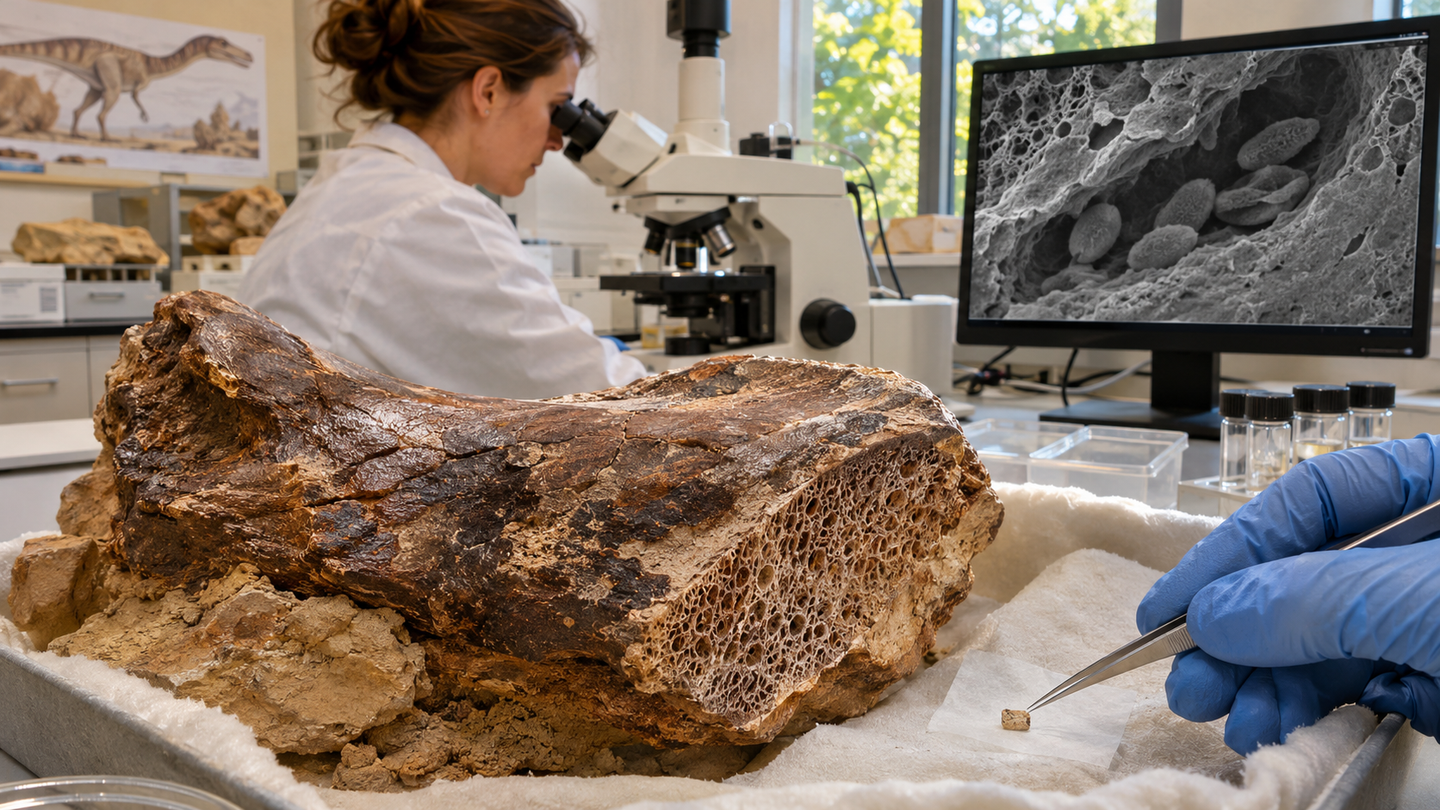
Powerful X-ray scans of Ryugu reveal a missing component in asteroids and meteorites
X-ray measurements of Ryugu and carbonaceous meteorites reveal an overlooked material that may explain chemical preservation during ancient water alteration.
 Kanazawa University Writer: Yuko Mitera

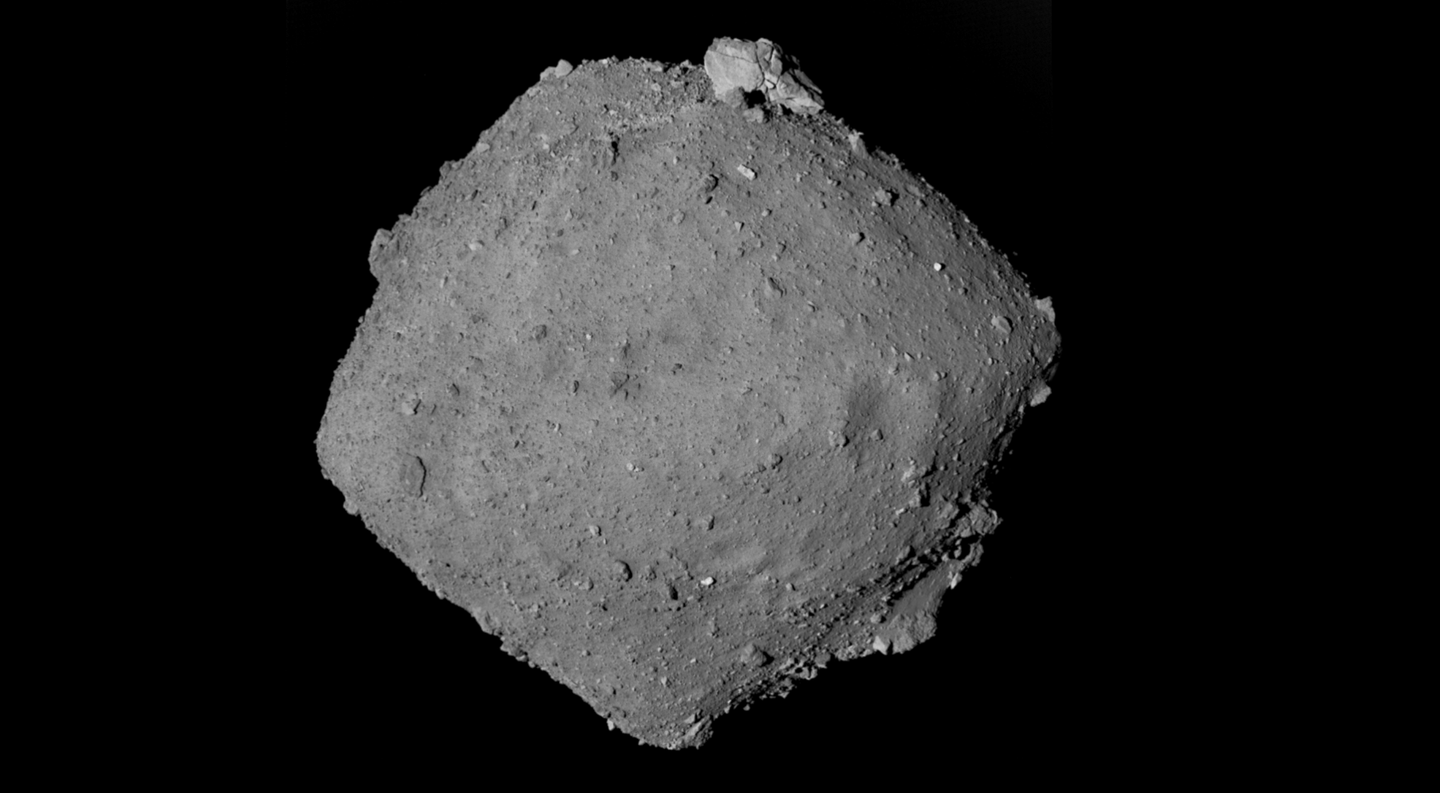
Black-and-white photograph of near-Earth asteroid 162173 Ryugu, taken by the Hayabusa2 spacecraft on 11 September 2018. (CREDIT: JAXA/ISAS, CC BY-SA 4.0)
- X-ray measurements indicate that Ryugu and carbonaceous meteorites contain a substantial, previously under-recognized magnesium-silicate-hydrate-like component.
- Experiments and solubility data suggest different compositions of this material can coexist under similar aqueous conditions.
- The proposed pathway could help explain chemical preservation during water alteration, but its historical sequence remains an interpretation.
Water transformed many of the minerals inside Ryugu’s ancestral rocks, yet the material still preserves a remarkably early chemical record. That combination has puzzled researchers: reactions with water can dissolve and redistribute elements, potentially changing the composition they want to reconstruct. A poorly crystalline material may help explain how extensive alteration left important chemical differences intact.
A team led by Kanazawa University and The University of Tokyo identified evidence for a magnesium silicate hydrate-like component in Ryugu material and carbonaceous meteorites. Their study, published in Communications Earth & Environment, combines X-ray measurements with laboratory experiments and existing solubility data. The findings suggest a mechanism for chemical preservation rather than a direct observation of the asteroid’s ancient reactions.
Chemically primitive does not mean unchanged
Researchers describe Ryugu and some carbonaceous meteorites as chemically primitive because they retain compositions useful for understanding the early Solar System. The term does not mean their minerals have remained untouched since formation. Water can reorganize a rock’s mineral structure even while much of its original elemental inventory remains recognizable.
That distinction separates two questions: what minerals a rock contains and what elements it contains overall. The same elements can become incorporated into different minerals during alteration. However, if water carries substantial amounts away or moves them between regions, the resulting composition may no longer preserve the original local differences.
The puzzle therefore involves more than explaining why wet asteroids contain altered minerals. Researchers also need to understand how different chemical compositions survived while those minerals formed within the small bodies that preceded today’s asteroid fragments. A successful explanation must accommodate both the evidence of extensive reaction and the persistence of an early chemical record.
Bringing asteroid material into the laboratory
Japan’s Hayabusa2 mission returned material from Ryugu to Earth in December 2020. JAXA subsequently measured roughly 5.4 grams of recovered samples, providing material for laboratory investigations. Its curation facilities use vacuum and nitrogen-filled chambers to handle and preserve the grains while limiting contamination.
Those procedures matter because researchers are trying to distinguish extraterrestrial properties from changes introduced after arrival on Earth. JAXA documents particle sizes, weights, images and spectroscopic measurements before making samples available for research. Careful handling helps subsequent experiments address the asteroid’s history rather than the effects of terrestrial exposure.
JAXA’s chambers separate several stages of sample recovery and examination. Some operations take place under vacuum, while others use nitrogen and glove-based handling, with gates isolating the different spaces. This arrangement allows researchers to move from opening the returned container to detailed measurements while managing the environment around the material throughout the process.
In the new study, the team examined mineral chemistry using powerful X-rays at KEK’s Photon Factory and SPring-8. The measurements used soft X-ray absorption spectroscopy, including analysis near magnesium’s K absorption edge. This approach probes the local chemical environment around magnesium atoms, helping researchers compare asteroid material with reference substances.
A less orderly component changes the picture
The conventional mineralogical interpretation emphasizes serpentine and saponite, hydrated silicate minerals associated with reactions between rock and water. These minerals remain part of the picture. The new analysis indicates that they do not fully describe the magnesium environments recorded in the samples.
The measurements also point to a substantial contribution from material resembling poorly crystalline magnesium silicate hydrate, abbreviated M-S-H. Poor crystallinity means its atomic structure lacks the regular, extended ordering associated with a well-developed crystal. Such material can therefore be harder to characterize through a picture focused mainly on familiar crystalline minerals.
The researchers describe an M-S-H-like component, preserving a distinction between a spectroscopic resemblance and an exact structural identification. Their result broadens the interpretation of the fine-grained material that makes up these samples. It does not require discarding the serpentine and saponite already recognized in them.
Different compositions under similar water conditions
M-S-H is especially interesting because it can contain magnesium and silicon in different proportions. That flexibility offers a potential explanation for why neighboring regions could retain different compositions during alteration. The material need not have one fixed magnesium-to-silicon ratio throughout an asteroid.
“What makes M-S-H particularly interesting is that it can accommodate a wide range of magnesium-to-silicon ratios,” said Keisuke Fukushi of Kanazawa University. “This flexibility may be key to understanding how water-rock interactions proceeded without erasing pre-existing chemical differences within their parent asteroids.” His explanation concerns the preservation of compositional variation, rather than a claim that no elements ever moved.
Normally, researchers expect materials with different compositions to favor different aqueous conditions. The team’s laboratory experiments and analysis of previously published solubility data showed that M-S-H with different magnesium-to-silicon ratios can exist under similar conditions. This reduces the need to assign a separate water environment to every local composition observed in the rocks.
A possible precursor to familiar minerals
The proposed sequence begins with M-S-H forming during reactions involving water. Material with different local compositions could then transform into more crystalline minerals, including serpentine and saponite. Under this interpretation, differences in the final minerals partly reflect the compositions of their earlier precursors.
That offers a route to mineral diversity without requiring water to erase the rock’s original chemical contrasts first. An altered mineral assemblage could still carry information inherited from earlier material. The model therefore connects present-day mineral observations with a possible sequence of reactions inside ancient parent asteroids.
The sequence remains a proposed explanation supported by the combined measurements and chemical analysis. Detecting an M-S-H-like component today does not directly show every transformation that occurred billions of years ago. Further tests must establish how effectively such reactions preserve particular elements and whether the proposed pathway accounts for the observed compositions.
Reading a chemical archive more carefully
Earlier research illustrates why this distinction matters for reconstructing the early Solar System. A 2022 study of returned Ryugu particles reported a close compositional match with chemically unfractionated but water-altered CI chondrites. These meteorites are widely used as a reference for bulk Solar System composition.
Related questions extend to other returned asteroid samples, including Bennu. A separate 2025 Nature study identified salts formed from an ancient brine in Bennu’s parent body. That finding provides a different record of aqueous chemistry, rather than demonstrating the same M-S-H pathway proposed for Ryugu.
A 2026 Ryugu study examined another part of the asteroid’s water history: nitrogen-bearing compounds associated with sodium carbonate. Its authors linked those associations to the disappearance of late-stage brines. Such work illustrates why different chemical measurements can illuminate different stages of alteration, while the presence of water alone cannot establish one complete history for every mineral or region inside a parent asteroid.
The new work emphasizes that chemical preservation and mineral transformation can occur together. Understanding that combination requires identifying the less crystalline material as well as the more recognizable minerals. The next question is how much of the original elemental record this flexible precursor can retain as water-driven reactions proceed.
Dig deeper into asteroid water chemistry
These resources explore hydrated silicates, ancient asteroid fluids and the handling of returned samples.
Dissolution of Poorly Crystalline Magnesium Silicate Hydrate: Mechanistic Insights from Solution-Based Measurements
This laboratory study examines how synthetic M-S-H composition affects dissolution, providing materials-science context rather than evidence from asteroid samples. (Langmuir, September 2026)
Ammonium-bearing clays and multiple nitrogen species linked to the late-stage brines of Ryugu’s parent body
Spectroscopic and microscopic measurements investigate nitrogen-bearing minerals associated with the final stages of aqueous activity in Ryugu’s parent body. (Nature Astronomy, August 2026)
An evaporite sequence from ancient brine recorded in Bennu samples
Returned Bennu material preserves salts that help reconstruct the mineral evolution of an ancient extraterrestrial brine. (Nature, January 2025)
A pristine record of outer Solar System materials from asteroid Ryugu’s returned sample
This analysis establishes compositional connections between returned Ryugu particles and chemically primitive, water-altered meteorites. (Nature Astronomy, August 2022)
Hayabusa2 Curation
JAXA explains how returned Ryugu grains are recovered, protected from contamination, characterized and prepared for scientific research. (Japan Aerospace Exploration Agency)
Research findings are available online in the journal Communications Earth & Environment.
The original story "Powerful X-ray scans of Ryugu reveal a missing component in asteroids and meteorites" is published in The Brighter Side of News.
Related Stories
- Asteroid Ryugu fragments carry a magnetic record from the birth of the solar system
- Asteroid Bennu may have formed much closer to the Sun than scientists thought
- NASA’s Lucy spacecraft finds asteroid Donaldjohanson is tumbling through space
Like these kind of feel good stories? Get The Brighter Side of News' newsletter.
Joseph Shavit
Writer, Editor-At-Large and Publisher
Joseph Shavit, based in Los Angeles, is a seasoned science journalist, editor and co-founder of The Brighter Side of News, where he transforms complex discoveries into clear, engaging stories for general readers. With vast experience at major media companies like The Los Angeles Times, Times Mirror and Tribune Publishing, he writes with both authority and curiosity. His writing focuses on space science, planetary science, quantum mechanics, geology. Known for linking breakthroughs to real-world markets, he highlights how research transitions into products and industries that shape daily life.