Rapidly spinning stars could solve a longstanding black hole flare mystery
Fast stellar rotation could explain why some stars survive black hole encounters while producing progressively dimmer flares.
 Syracuse University Writer: Daryl Lovell

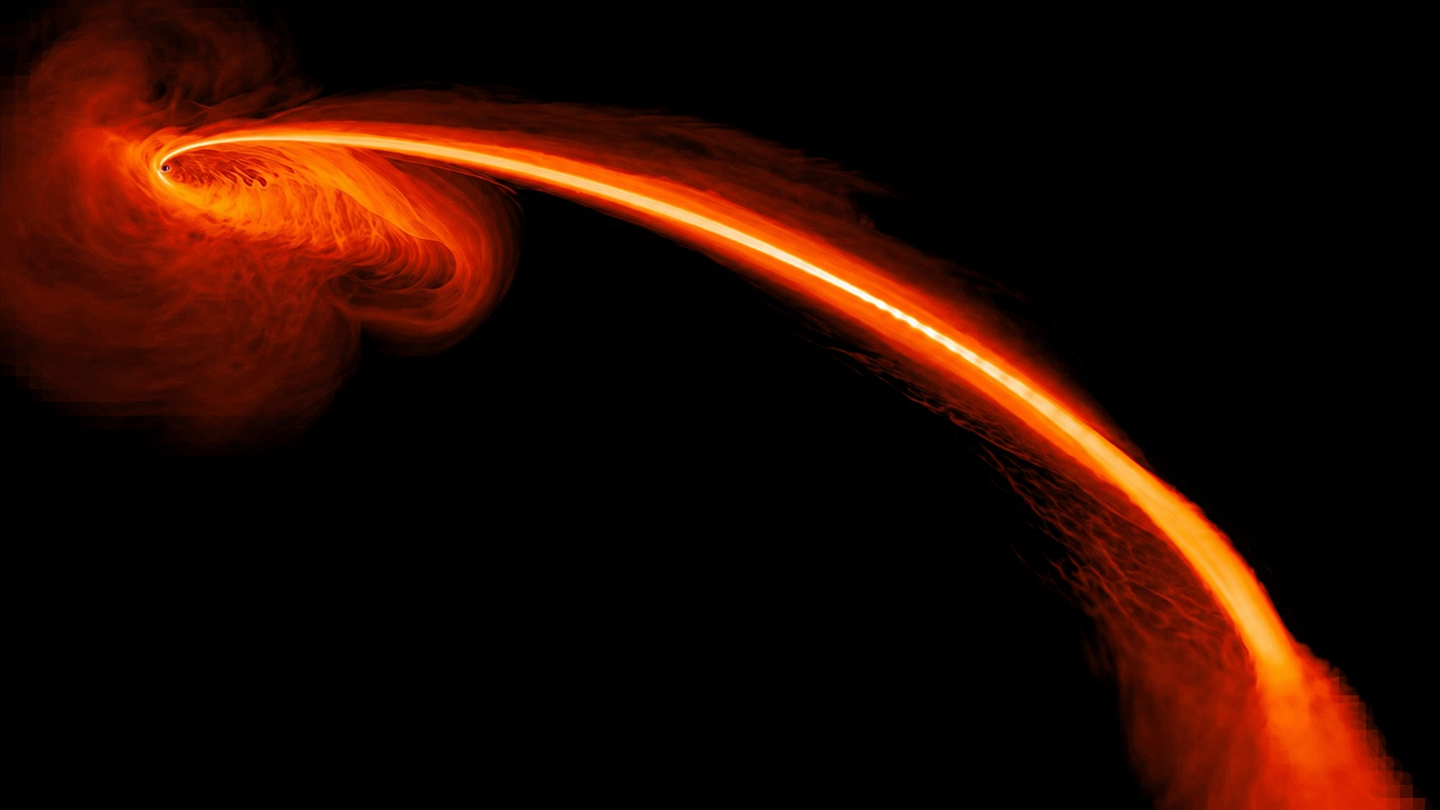
This computer-simulated image shows gas from a tidally shredded star falling into a black hole. Astronomers observed the flare in ultraviolet light using NASA’s Galaxy Evolution Explorer. (CREDIT: NASA/ S. Gezari (JHU)/ J. Guillochon (UCSC))
- Some stars survive repeated close passes around supermassive black holes, but several known systems produce flares that get dimmer each time.
- Computer simulations suggest rapid stellar spin can explain the fading by limiting how much extra rotation the black hole adds during each encounter.
- The same process that may trap these stars near black holes, the breakup of a tight binary star system, could also explain why the stars were spinning so fast beforehand.
A star can skim dangerously close to a supermassive black hole, lose part of itself and survive. Then, months or years later, it can return and do it again. In several known systems, though, each new flare grows mysteriously dimmer.
That pattern has challenged models of repeating partial tidal disruption events, or rpTDEs. These events happen when a black hole strips material from a star without completely destroying it. The surviving stellar core stays in orbit and can return for another close encounter.
Now, hydrodynamical simulations suggest the missing piece may be the star’s rotation before it ever meets the black hole. The work, led by Syracuse University doctoral student Ananya Bandopadhyay, appears in The Astrophysical Journal. Benjamin Amend and Eric Coughlin of Syracuse’s Department of Physics also contributed, along with researchers at other institutions.
“We were puzzled by this for two years,” Bandopadhyay says.
When a black hole fails to finish the job
A conventional tidal disruption event occurs when a star passes close enough to a supermassive black hole for gravity to tear it apart. The difference in gravitational pull across the star overwhelms its own self-gravity.
Some of the stellar debris remains bound to the black hole and eventually falls inward. As that material accretes, it releases energy and produces a bright flare lasting days to months.
More than 100 tidal disruption events have been detected with wide-field surveys. A much smaller group has shown repeated brightening separated by months or years. Known examples include ASASSN-14ko, AT2018fyk, eRASSt-J045650, AT2022dbl, AT2020vdq, AT2021aeuk and AT2023uqm.
Astronomers think these repeating events come from stars that remain intact after each passage. Their orbits carry them repeatedly near the black hole, where another fraction of stellar material gets stripped away.
The puzzle is that these systems do not all evolve the same way.
Low-mass stars can expand after losing material and become more vulnerable during later encounters. Their increasing rotation can also make them easier to strip, producing successively brighter flares.
Higher-mass stars behave differently. Losing their outer material can increase their average density, making their remaining cores harder to disrupt. That should reduce the amount of matter removed during each new passage.
Yet earlier simulations still struggled to produce progressively dimmer flares.
Less mass did not always mean less light
The reason involved rotation.
A black hole does more than remove material from a passing star. Its tidal forces also exert torque, changing the star’s spin. Previous simulations showed that stars initially rotating slowly could gain prograde spin during repeated encounters.
That extra rotation alters how easily the star loses material. Even when later passages strip less mass, the debris can return toward the black hole over a shorter period. The peak fallback rate therefore stays roughly constant instead of steadily declining.
The new simulations changed one important starting condition. The stars were already spinning rapidly before their first encounter.
That produced a different outcome.
When the stellar spin was comparable to the angular frequency of the star’s motion at its closest approach, the black hole transferred much less additional rotation. In some simulations, the encounter even slowed the star slightly.
With the spin changing little afterward, the fallback timescale also remained relatively stable. Meanwhile, the denser surviving star lost progressively less material. The peak fallback rate then declined from passage to passage.
In one simulation, the team modeled a Sun-mass star rotating rapidly in the same direction as its orbit. The peak fallback rate fell by about a factor of 1.5 between the first and second encounters, then declined by smaller amounts afterward.
Simulations of three-solar-mass stars at different stages of their main-sequence lives produced similar fading behavior under suitable spin conditions.
A violent capture could set the star spinning
Rapid initial rotation raises another question: Why would a star orbiting a supermassive black hole already be spinning so quickly?
“It is also extremely difficult to ‘bind’ a star to a supermassive black hole so tightly that it orbits the black hole in a matter of months, and yet they seem to do so in rpTDEs,” Coughlin says.
The Hills mechanism offers a possible answer to both problems.
Under that scenario, two stars begin in a tightly bound binary system. When the pair passes close to a supermassive black hole, the black hole breaks the binary apart. One star can be thrown away while the other becomes trapped on a tight orbit around the black hole.
Very close binaries can also become tidally locked. Each star then rotates at the same rate that the pair orbits one another. Tighter binaries orbit faster, so their stars can also spin rapidly.
That means the same tight binary required to leave a captured star on a short-period orbit could naturally provide the rapid stellar rotation needed for dimming flares.
“Ananya’s work demonstrates that each of these peculiarities can be explained by the same underlying phenomenon: the tidal destruction of a binary system and the capture of one of the stars,” Coughlin says. “From a theoretical standpoint, this is a major step forward in our understanding of the physics at play in these systems.”
The model appears consistent with the more modest declines seen in systems including eRASSt-J045650, AT2022dbl and AT2021aeuk. Their flare peaks have decreased by factors of about two or less.
AT2018fyk remains more difficult. Its peak luminosity dropped by roughly an order of magnitude between its first two outbursts. The simulations suggest stellar rotation alone would require an extremely high spin that could challenge the star’s stability.
The system may involve additional effects. Its black hole has an inferred mass around 10^7.7 solar masses, placing the star’s closest approach in a strongly relativistic regime. Relativistic and chaotic three-body effects could potentially alter the distance of successive close passages and change how much mass gets stripped.
Practical implications of the research
Repeating tidal disruption events give astronomers an unusual chance to watch the same star interact with the same black hole several times. Understanding why their flares brighten, remain steady or fade could help researchers reconstruct the stars’ properties before capture.
Stellar rotation may become an important clue. If progressively fading outbursts point to stars that were already spinning rapidly, those light curves could also preserve information about how the stars reached their present orbits.
That strengthens the case for the Hills mechanism in at least some repeating systems. It could connect three features that otherwise appear separate: short orbital periods, rapid stellar rotation and declining flare brightness.
Coughlin notes that similar capture events may also help explain stars orbiting Sagittarius A*, the supermassive black hole at the center of the Milky Way.
For astronomers, repeated flares therefore offer more than another way to detect feeding black holes. Their changing brightness may reveal the violent history of the stars that survived.
Dig deeper into repeating stellar disruptions
These resources explore how stars survive repeated encounters with supermassive black holes, how their flares evolve, and how binary-star disruption may place them on extreme orbits.
Repeating Nuclear Transients From Repeating Partial Tidal Disruption Events
This 2026 review examines the growing population of repeating partial tidal disruption events, including how stellar mass, structure and orbital properties determine whether a star survives repeated stripping and how its flares change over time. (Astronomische Nachrichten, 2026)
Accretion discs in (repeating) partial tidal disruption events: rapid state transitions, UV plateaus, and flares from disc–remnant collisions
This work explores how reduced fuel supplies change the accretion disks around black holes after partial stellar disruptions, helping explain rapid X-ray state changes and other unusual behavior seen in repeating systems. (Monthly Notices of the Royal Astronomical Society, 2026)
The First Systematically Identified Repeating Partial Tidal Disruption Event
Observations of AT2020vdq established it as a repeating partial tidal disruption event and favored a scenario in which the surviving star originated in a tight binary broken apart through the Hills mechanism. (The Astrophysical Journal, 2025)
Repeating nuclear transients from repeating partial tidal disruption events: reproducing ASASSN-14ko and AT2020vdq
Hydrodynamical simulations showed that higher-mass, evolved stars can survive tens to hundreds of black hole encounters, while lower-mass stars can lose progressively more material and produce increasingly bright flares before destruction. (The Astrophysical Journal, 2024)
A Potential Second Shutoff from AT2018fyk: An Updated Orbital Ephemeris of the Surviving Star under the Repeating Partial Tidal Disruption Event Paradigm
Continued X-ray and ultraviolet monitoring found a second sharp fading of AT2018fyk, strengthening the case that a surviving star repeatedly returns to the same supermassive black hole on an orbit lasting about 1,306 days. (The Astrophysical Journal Letters, 2024)
Research findings are available online in The Astrophysical Journal.
The original story "Rapidly spinning stars could solve a longstanding black hole flare mystery" is published in The Brighter Side of News.
Related Stories
- Milky Way’s fastest star revolves around the central black hole at 8% the speed of light
- Student astronomer discovers rare white dwarf star feeding on a red dwarf companion
- Astronomers solve decades-old mystery of flickering binary stars
Like these kind of feel good stories? Get The Brighter Side of News' newsletter.
Joseph Shavit
Writer, Editor-At-Large and Publisher
Joseph Shavit, based in Los Angeles, is a seasoned science journalist, editor and co-founder of The Brighter Side of News, where he transforms complex discoveries into clear, engaging stories for general readers. With vast experience at major media companies like The Los Angeles Times, Times Mirror and Tribune Publishing, he writes with both authority and curiosity. His writing focuses on space science, planetary science, quantum mechanics, geology. Known for linking breakthroughs to real-world markets, he highlights how research transitions into products and industries that shape daily life.