Meteorite 200x larger than the dinosaur killer reshaped the course of evolution on Earth
Rocks in South Africa reveal how a colossal impact brought tsunamis, darkness and new nutrients to Earth’s earliest microbes.

 Edited By: Joshua Shavit

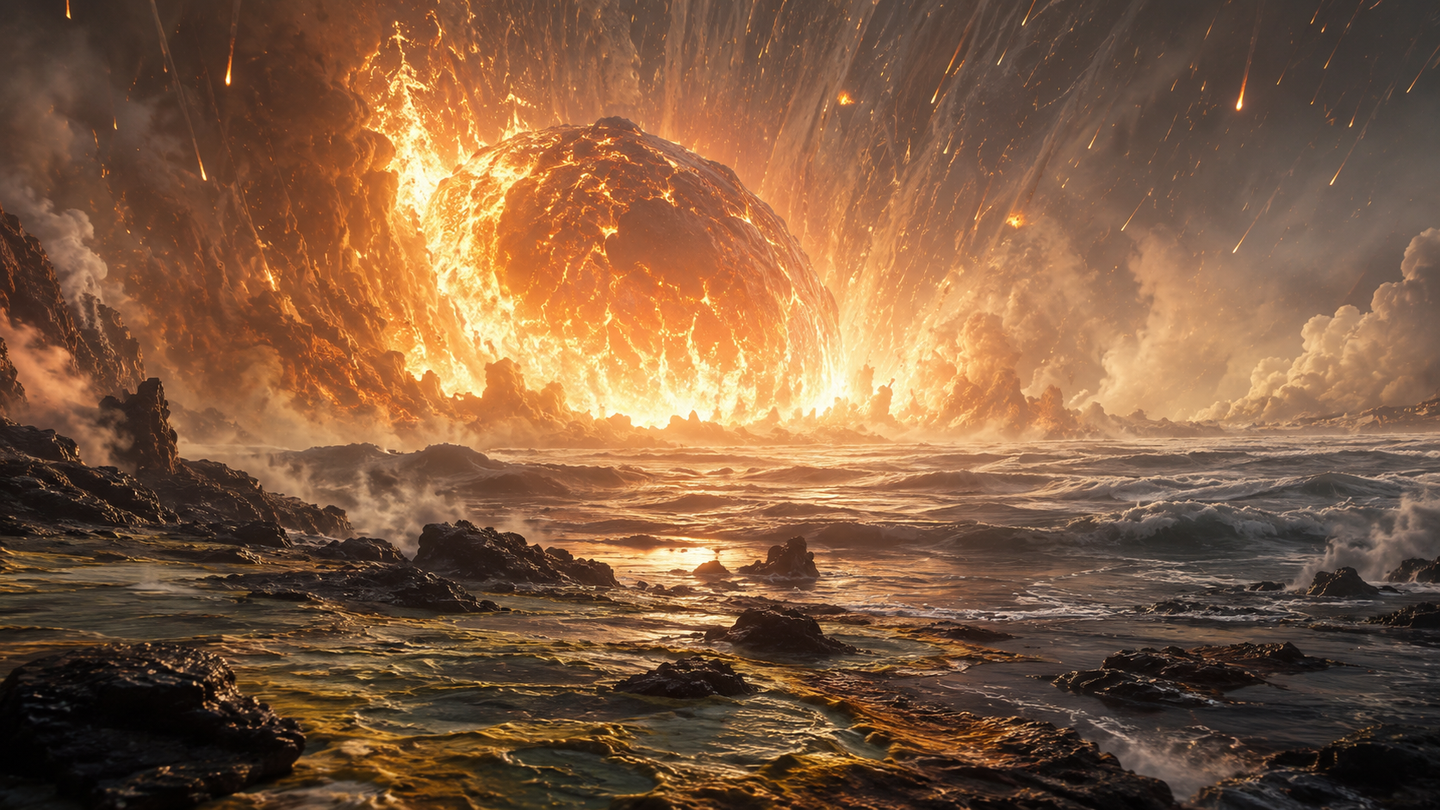
The S2 meteorite impact devastated early Earth but may have supplied iron and phosphorus that helped microbial life recover. (CREDIT: Wikimedia / AI-Generated / CC BY-SA 4.0)
- A meteorite 50 to 200 times more massive than the one linked to the dinosaurs struck Earth 3.26 billion years ago.
- The impact triggered a tsunami, ocean heating and darkness, but it also carried phosphorus and moved iron-rich deep water toward the surface.
- Those nutrients may have helped iron-using microbes recover quickly, showing that early impacts could support life as well as destroy it.
A meteorite far larger than the one linked to the dinosaurs struck Earth 3.26 billion years ago, yet the devastation may have briefly created better conditions for some of the planet’s earliest microbes.
The S2 impactor measured an estimated 37 to 58 kilometers across and carried 50 to 200 times the mass of the Chicxulub object. Its collision unleashed a tsunami, heated the atmosphere, disturbed the oceans and darkened the surface with dust.
Rock layers in South Africa’s Barberton Greenstone Belt record what followed. The evidence points to a disaster that damaged shallow-water life, then supplied iron and phosphorus that may have fueled a rapid microbial rebound.
A tsunami rewrote the seafloor
The impact struck during the Paleoarchean era, when bacteria and archaea dominated Earth. Giant space rocks hit the young planet far more often than they do today, perhaps at intervals of at least 15 million years.
To reconstruct the S2 event, Dr. Nadja Drabon of Harvard University and her colleagues studied two rock sections called Umbaumba and Bruce’s Hill. Their work appeared in the Proceedings of the National Academy of Sciences.
Both sites contain a bed of tiny impact-made spheres mixed with coarse debris. The layers begin with erosive surfaces, include material ripped from the seabed and become finer upward as the water lost energy.
Those features closely match tsunami deposits. At Bruce’s Hill, three thick, sphere-bearing sandstone beds may record several powerful currents, backwash flows or reflected waves.
“Picture yourself standing off the coast of Cape Cod, in a shelf of shallow water. It’s a low-energy environment, without strong currents. Then all of a sudden, you have a giant tsunami, sweeping by and ripping up the sea floor.”
The sequence formed quickly. Impact spheres likely reached the area within hours, while the slower tsunami followed. Fine debris then settled through the water, creating fallback layers within days.
Heat, darkness and evaporating seawater
The collision caused more than violent waves. Rock vapor, melted material and atmospheric heating may have boiled away meters to tens of meters from the ocean’s upper layer.
Unusual crystal-shaped structures appear within and just above the fallback deposit at Umbaumba. The original minerals later dissolved and were replaced by silica, but their shapes remained.
The team argues that these structures most likely formed from aragonite or nahcolite, minerals associated with concentrated brines. Some grew inside sediment, while others may have formed near the surface and settled downward.
Their position directly above the impact layer supports partial ocean evaporation. Those conditions may have lasted slightly more than a year as heat and erosion reshaped coastal environments.
Dust added another blow. Material thrown into the atmosphere may have blocked sunlight for years or decades, while suspended particles made the ocean murky.
That combination would have struck photosynthetic microbes especially hard. The tsunami also tore through microbial communities living on the shallow seafloor.
Deep iron reached the sunlit ocean
The same tsunami that caused destruction also mixed ocean layers that had remained chemically separate.
Before the impact, shallow water at both sites contained little dissolved iron. Deeper water held much more ferrous iron, a form that some microbes could use.
Iron concentrations rose sharply after S2. At Bruce’s Hill, average values increased about sixfold. At Umbaumba, they later climbed as much as 17-fold.
The researchers considered volcanic activity, crustal uplift, hydrothermal systems and changes in water depth. The evidence did not show the shifts expected from a major rise in volcanic material or global hydrothermal activity.
Ocean mixing offered the simplest explanation. The tsunami likely crossed the chemical boundary separating iron-rich deep water from depleted surface water, lifting ferrous iron into the sunlit zone.
Phosphorus also increased. Concentrations reached 1,300 parts per million in one Bruce’s Hill sample with the greatest abundance of impact spheres.
Some phosphorus may have come from the meteorite. More arrived as the tsunami washed debris into the sea and the hot post-impact climate accelerated weathering on land.
Microbial life returned quickly
The immediate effects were almost certainly harmful. Shallow-water organisms faced seafloor erosion, darkness, heat, evaporation and turbid water.
Yet the rocks do not preserve evidence of a long biological collapse. Instead, carbon chemistry and iron-rich minerals indicate that life persisted and may have recovered rapidly.
Bacteria and archaea can have huge populations, fast reproduction and flexible metabolisms. Their rebound could therefore have occurred much faster than the recovery of animals after the Chicxulub impact.
The strongest biological signal involves iron cycling. More ferrous iron in shallow water could have supported microbes that used iron during photosynthesis. The resulting oxidized iron could support other microbes that consumed organic matter through iron reduction.
Iron oxides, siderite and related minerals became unusually common above the impact horizon. Siderite repeatedly appears beside organic matter, supporting the idea that microbial iron reduction helped form it within sediment.
Carbon isotope values also became more stable in iron-rich layers with little reworked debris. The pattern suggests a connection between the changing carbon cycle and the sudden availability of iron, although uncertainty remains.
“We think of impact events as being disastrous for life,” Drabon explained. “But what this study is highlighting is that these impacts would have had benefits to life, especially early on … these impacts might have actually allowed life to flourish.”
Practical implications of the research
The S2 record changes how scientists can assess giant impacts on the early biosphere. Destruction was only one part of the outcome.
For microbes near the surface, the first years may have brought severe stress or death. Organisms deeper in the water, including those that did not depend on sunlight, likely faced fewer immediate effects.
Once dust cleared and evaporated water returned, the ocean contained more nutrients and usable iron. Those changes may have triggered a temporary bloom of iron-cycling microbes.
The findings give geologists clues to seek at other ancient impact sites, including tsunami deposits, evaporite minerals, phosphorus spikes, iron-rich layers and shifts in carbon chemistry.
They also show why early impacts cannot be judged only through later mass extinctions. On a microbial Earth, a catastrophe could destroy habitats, create new ones and briefly expand the resources available to life.
Research findings are available online in the journal Proceedings of the National Academy of Sciences.
The original story "Meteorite 200x larger than the dinosaur killer reshaped the course of evolution on Earth" is published in The Brighter Side of News.
Related Stories
- Rare meteorite points to a long-lost planet from our early solar system
- Lunar meteorite discovery reveals violent chapter in the inner solar system 3.5 billion years ago
- Meteorite discovery solves the mystery of Earth’s lost elements
Like these kind of feel good stories? Get The Brighter Side of News' newsletter.
Joseph Shavit
Writer, Editor-At-Large and Publisher
Joseph Shavit, based in Los Angeles, is a seasoned science journalist, editor and co-founder of The Brighter Side of News, where he transforms complex discoveries into clear, engaging stories for general readers. With vast experience at major media companies like The Los Angeles Times, Times Mirror and Tribune Publishing, he writes with both authority and curiosity. His writing focuses on space science, planetary science, quantum mechanics, geology. Known for linking breakthroughs to real-world markets, he highlights how research transitions into products and industries that shape daily life.