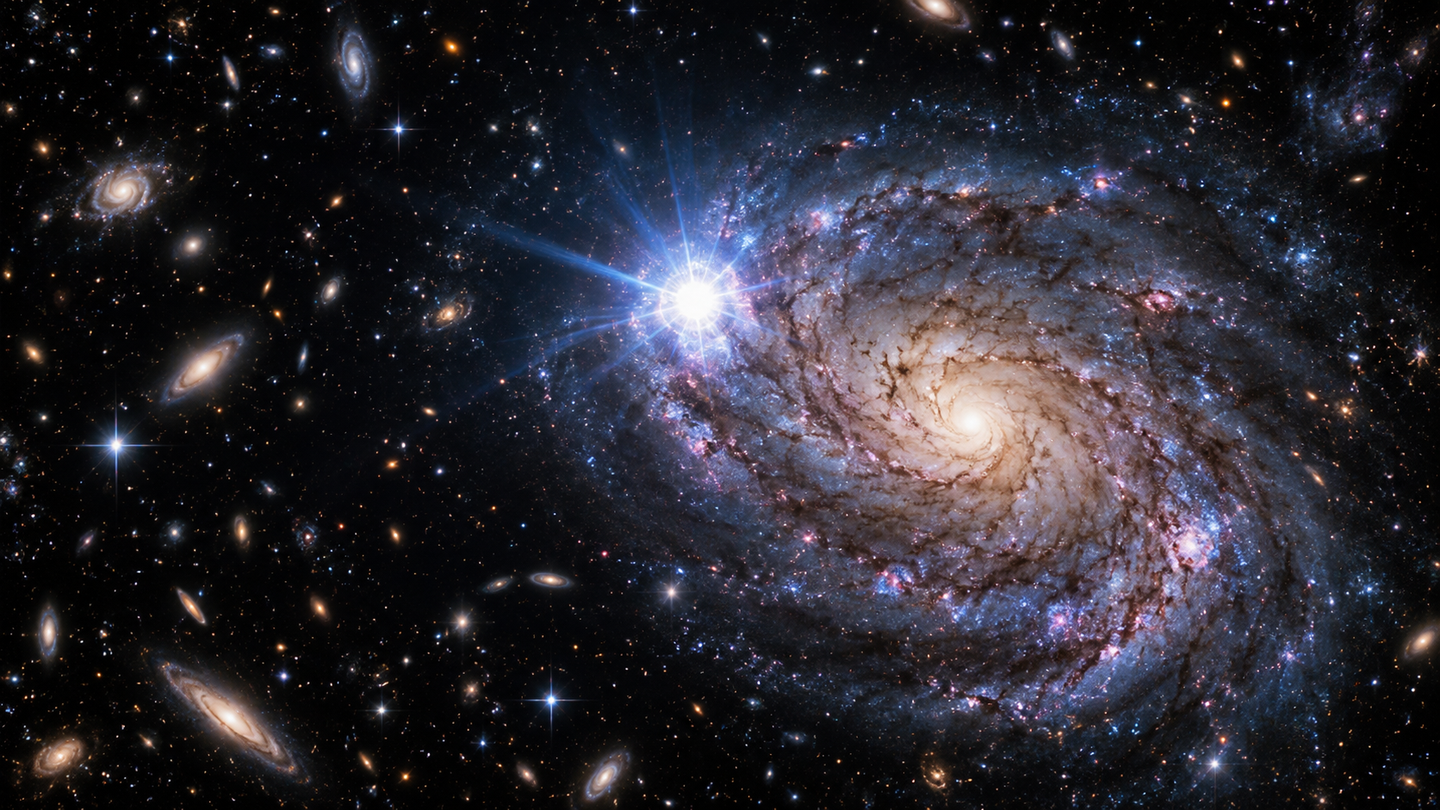
Astronomers use AI to discover seven rare quasar lens candidates
Simulated cosmic lenses trained a neural network to spot faint galaxy signals buried beneath brilliant quasars.

 Edited By: Joseph Shavit

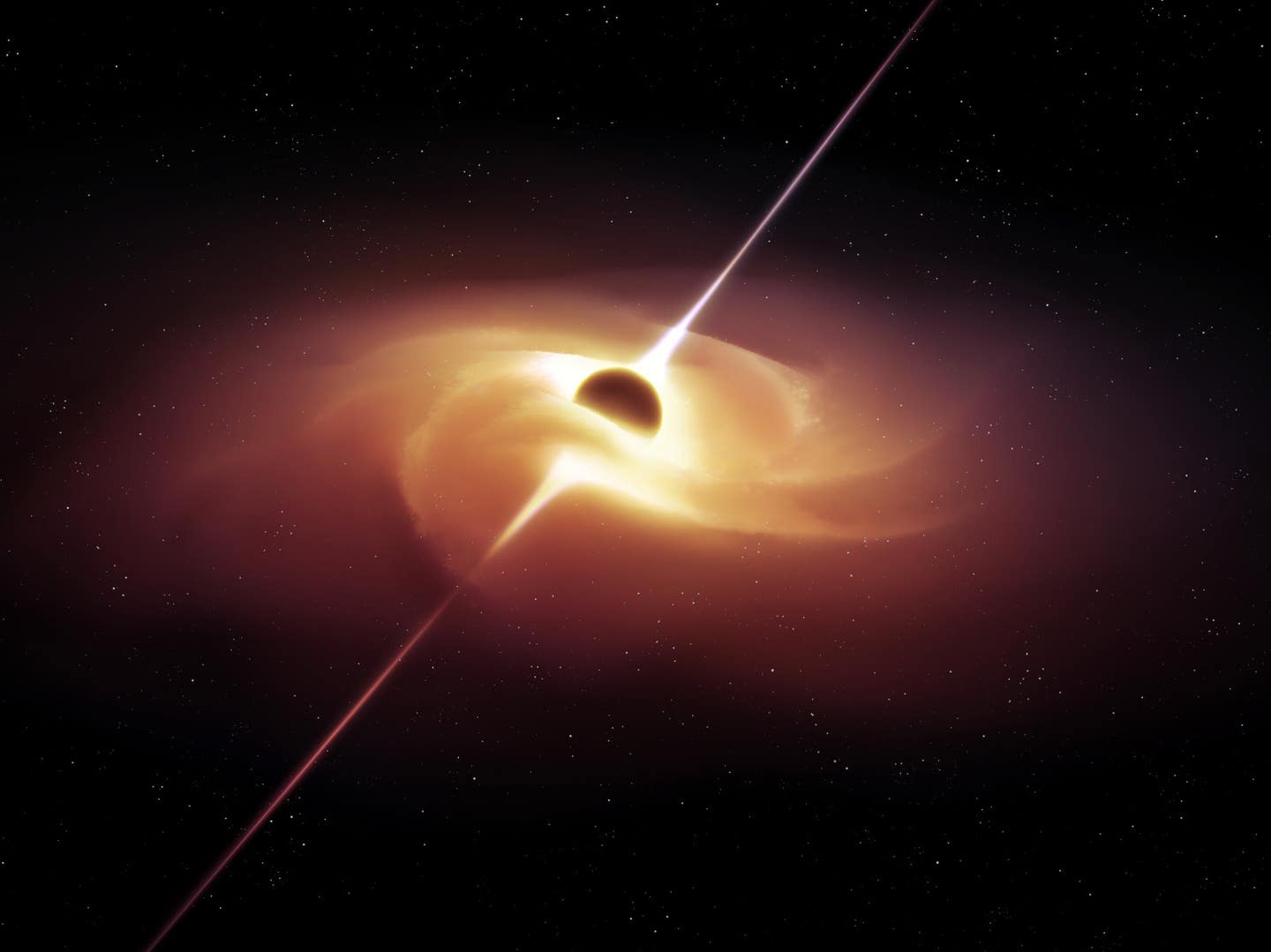
Simulated cosmic lenses trained a neural network to spot faint galaxy signals buried beneath brilliant quasars. (CREDIT: Shutterstock)
- Artificial intelligence narrowed more than 800,000 quasar observations to seven strong candidates for an exceptionally rare type of gravitational lens.
- The system learned from simulated examples that combined real quasar and galaxy data, then researchers manually checked its most promising results.
- Follow-up observations must confirm the candidates, but the method could help astronomers study how galaxies and supermassive black holes grew together.
Seven unusual signals emerged from a collection of more than 800,000 quasars, offering astronomers possible new tools for weighing distant galaxies and tracing the growth of enormous black holes.
An international research team found the candidates with a machine learning system trained to recognize quasars acting as strong gravitational lenses.
Quasars are intensely bright galactic cores powered by supermassive black holes. Their brilliance allows astronomers to observe them across vast distances, but it can also overwhelm the light from their surrounding galaxies.
That glare makes it difficult to measure the host galaxy and examine how it developed alongside the black hole at its center.
“Quasars are like the baby pictures of a supermassive black hole,” said Everett McArthur, the study’s lead author and an astronomy graduate student at The Ohio State University. “So exploring how we get from quasars to those black holes is really important.”
A Rare Alignment Turns a Quasar into a Lens
Strong gravitational lensing offers one way around the glare.
In these systems, a quasar and its host galaxy sit in front of a more distant galaxy. The foreground galaxy’s gravity bends and magnifies the background galaxy’s light.
Astronomers can use the distortion to estimate the mass of the foreground galaxy. That provides another way to study a host whose light would otherwise be difficult to separate from the quasar.
Such alignments are exceptionally uncommon. Earlier surveys had produced only a small number of confirmed examples and candidates, leaving researchers with too few systems for broad statistical studies.
The team searched for more within data from the Dark Energy Spectroscopic Instrument, or DESI. The survey records spectra, which divide an object’s light into wavelengths that can reveal its composition and motion.
Researchers examined more than 800,000 high-quality quasar spectra from DESI. The candidates lie about 5 billion to 6 billion light-years or more from Earth.
Finding additional systems could clarify how galaxies and central black holes change together over cosmic time.
“By studying the tight correlation between galaxies and black holes, we could understand why our galaxy is the way that it is and perhaps why our own black hole is sometimes dormant,” McArthur said.
Simulated Lenses Trained the Neural Network
The shortage of known quasar lenses created a problem for the artificial intelligence system. Machine learning models usually need many examples from which to learn.
The researchers addressed that gap by constructing realistic mock lenses. They combined spectra from actual quasars with spectra from more distant galaxies.
Those simulated systems preserved the variety and observational noise found in real DESI data. They also taught the model to identify emission lines from a background galaxy within the brighter quasar spectrum.
The team used a convolutional neural network, a type of artificial intelligence designed to recognize subtle patterns in complex data.
Unlike traditional approaches that first try to model and subtract the quasar’s light, the network learned to recognize the combined signatures of a foreground quasar and background galaxy.
“This method created a simulation so impressive that the AI was able to recognize the subtle differences between normal and abnormal quasars with unique features,” McArthur said.
“What this proves is our architecture was able to parse through a diverse array of quasar spectra in a really significant way.”
The model also estimated the redshift of the possible background galaxy. Redshift measures how much an object’s light has stretched toward longer wavelengths as the universe expands.
Tests showed that the machine learning system could recover those redshifts more accurately than DESI’s standard software across observations of differing quality.
Human Review Reduced the List to Seven
After training, the system searched the full quasar collection and identified several hundred possible matches.
Researchers then examined the shortened list by hand. They looked for clear signs of a more distant galaxy, especially a distinctive pair of oxygen emission lines known as the [O II] doublet.
Additional hydrogen and oxygen lines strengthened several identifications.
That review produced seven high-quality candidates. Six had not been identified previously, while one had appeared in an earlier search using a different method.
Four candidates contained additional emission lines beyond the main oxygen signal, increasing confidence that their spectra included light from background galaxies.
One case remains less certain because a nearby galaxy may have entered the area measured by DESI. Higher-resolution images will be needed to determine whether it is a genuine lens or an unrelated neighboring object.
The seven systems also remain candidates rather than confirmed gravitational lenses. The team plans to seek direct confirmation with powerful space-based instruments such as the Hubble Space Telescope.
Big Surveys Create Room for Rare Discoveries
The search shows how artificial intelligence can help astronomers manage the enormous datasets produced by modern observatories.
DESI contains observations of millions of astronomical objects. Manually examining every spectrum for rare anomalies would require enormous amounts of time.
Machine learning can reduce that workload by directing researchers toward the small fraction of observations most likely to contain something unusual.
The approach is not immune to mistakes. Atmospheric emission, calibration problems, and features within quasar spectra can imitate the signals of a distant galaxy.
Researchers found that visual checks and added quality controls could remove many of those false positives.
“You can very well expand this type of study to find many rare anomalies in a spectrum,” McArthur said. “We’re in an era when science has suddenly become more accessible than ever, and applying AI to astronomy and machine learning methods to big data sets is part of that.”
Practical Implications of the Research
Confirmation of the seven candidates would expand the number of quasar lens systems available for detailed study.
A larger sample could allow astronomers to measure galaxy masses across different periods of cosmic history. Those measurements may help test how closely the growth of galaxies follows the development of their central black holes.
The search method could also be applied to future spectroscopic surveys containing millions of observations. Rather than replacing astronomers, the system would help them identify the most promising objects for careful review and follow-up.
Its broader value may lie in finding other rare signals hidden inside large datasets. With suitable training examples, similar models could search for unusual spectral patterns that traditional pipelines overlook.
For the current candidates, sharper imaging remains the crucial next step. Until that work is completed, the seven objects provide promising evidence that artificial intelligence can make some of astronomy’s rarest alignments easier to find.
Research findings are available online in the journal The Astrophysical Journal.
The original story "Astronomers use AI to discover seven rare quasar lens candidates" is published in The Brighter Side of News.
Related Stories
- First AI-powered self-monitoring satellite launched into space
- Deep-space water reservoir contains trillions of times more water than all Earth’s oceans combined
- SpaceX Falcon 9 rocket stage is about to slam into the Moon on August 5
Like these kind of feel good stories? Get The Brighter Side of News' newsletter.
Shy Cohen
Writer