Salty Indian Ocean water does not directly control Atlantic circulation, study finds
Ancient seafloor records challenge the idea that salty Indian Ocean water directly controls Atlantic circulation.
 Utrecht University Writer: Stephan Meulebrouck

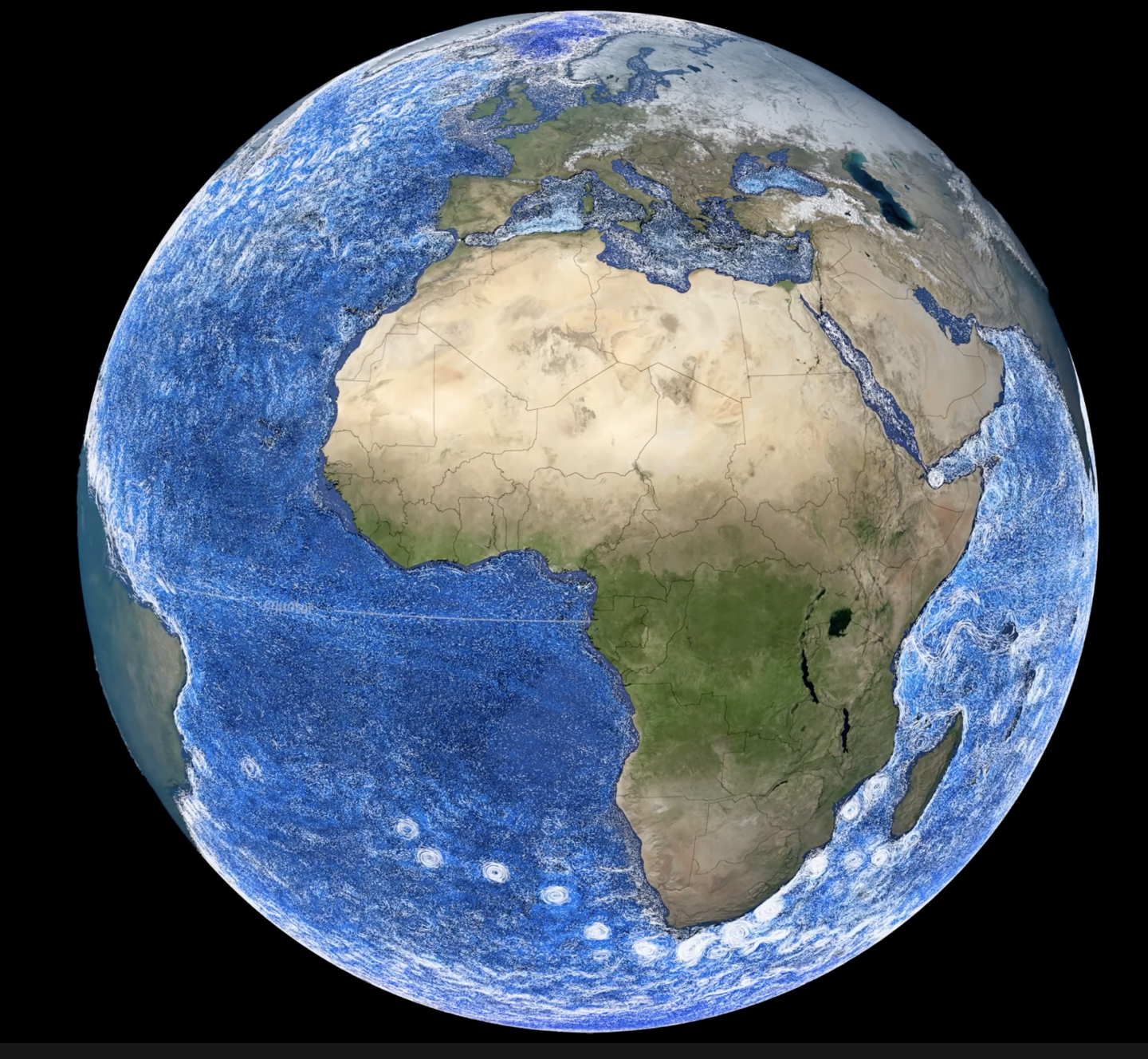
Agulhas Leakage and AMOC records show Atlantic overturning strengthened even as Indian Ocean water inflow weakened. (CREDIT: NASA Goddard)
- Warm Indian Ocean water entering the Atlantic weakened sharply during a cooling event 3.3 million years ago, yet deep Atlantic circulation grew stronger.
- Seafloor fossils, temperature records and climate simulations point to a broad ocean reorganization rather than a simple response to salt.
- The results challenge a long-standing explanation of Atlantic circulation, but they do not directly predict what will happen under modern warming.
Warm, salty water spilling from the Indian Ocean into the Atlantic has long seemed essential to a major part of Earth’s climate system. But evidence from 3.3 million years ago tells a more complicated story.
The Atlantic Meridional Overturning Circulation, or AMOC, carries warm surface water northward. It returns colder, denser water southward at depth. This movement shapes climate across the North Atlantic and much of Europe.
For decades, scientists linked the strength of that circulation to Agulhas Leakage. This flow carries Indian Ocean water around South Africa and into the Atlantic through eddies and filaments.
The usual explanation was simple. Extra salt from the Indian Ocean would help Atlantic surface water become dense enough to sink in the north. That sinking would support North Atlantic Deep Water formation and help maintain the AMOC.
“This was basically the first textbook concept, that I learnt when I was a bachelor student. It was surprising to find geological evidence showing that it isn’t universally true. The AMOC can remain strong even when Agulhas Leakage weakens,” said lead author Dr Suning Hou of Utrecht University.
A cold interval breaks the expected link
Hou and an international team from the Netherlands, United States, China and United Kingdom examined the late Pliocene.
They focused on Marine Isotope Stage M2, a brief cooling event around 3.3 million years ago. It came before the mid-Piacenzian Warm Period, when global conditions were warmer than today.
The shift gave the team a natural test of ocean circulation near South Africa and across the Atlantic.
The researchers analyzed a sediment core from International Ocean Discovery Program Site U1475 on the Agulhas Plateau. The site lies about 500 kilometers south of South Africa.
The core contained fossil cysts from dinoflagellates, tiny marine plankton whose species can reveal where ocean fronts once sat.
“If you find a change in the dinocyst assemblage in the sediment, this means that the front shifted. For instance, if you find more of the warmer species and less of the colder ones, the front has moved south. A more southerly front generally opens a wider pathway for Indian Ocean water to leak into the Atlantic, and vice-versa,” Hou said.
Fossils trace a northward-moving front
The dinoflagellate record showed that the Southern Ocean subtropical front moved northward from about 3.4 million years ago into the M2 cooling event.
At the same time, the Agulhas region cooled by about 3 degrees Celsius. Site U1475 developed subpolar conditions, marked by cold-water species linked today with the polar front.
That combination suggests Agulhas Leakage weakened sharply and may have nearly shut down.
Under the traditional view, less leakage should have meant less salt entering the Atlantic. That should have weakened deep-water formation and slowed the overturning circulation.
Instead, the Atlantic behaved differently.
Evidence from sediment records and climate simulations indicates that the North Atlantic Current reached less far into high northern latitudes. Yet North Atlantic Deep Water formation intensified farther south.
The stronger lower-latitude overturning also coincided with a shallower thermocline across much of the Atlantic.
A basin-wide reorganization emerges
The team compared the Agulhas Plateau record with temperature evidence from Ocean Drilling Program Site 625 in the northern Gulf of Mexico. They also used published records from the equatorial Atlantic, North Atlantic and Caribbean Sea.
At several sites, two temperature indicators began to diverge around 3.4 million years ago. The pattern pointed to colder subsurface waters and a thermocline moving closer to the surface.
Co-author Carolien van der Weijst first noticed the signal years earlier in one sediment record.
“When the same pattern was discovered in the Agulhas Plateau, we realized we were looking at a basin-wide reorganization of the ocean thermocline rather than a local anomaly. Then we confirmed this with climate model simulations,” said Prof. Francien Peterse of Utrecht University. “The whole story suddenly made sense.”
The simulations supported the geological evidence. During M2, the modeled AMOC was stronger at greater depths and lower latitudes, but weaker near the surface and north of 58 degrees north.
The modeled circulation strength reached about 11.78 Sverdrups during M2, compared with 10.94 Sverdrups during the later warm period.
The warm upper layer also became noticeably shallower during M2. That matched the temperature patterns found in the sediment records.
Salt supply was not the main control
The results show no clear relationship between Agulhas Leakage and AMOC strength during this part of the late Pliocene.
Even when the subtropical front shifted south again during M2 deglaciation, reopening the route for Indian Ocean water, the team found no abrupt response in deep-water strength.
During the mid-Piacenzian Warm Period, the front moved farther south and leakage potential rose. Yet Caribbean waters were fresher and North Atlantic Deep Water formation was weaker than during M2.
That contrast suggests local processes in the North Atlantic played a larger role. High-latitude precipitation, sea ice, Arctic gateways and the location of deep-water formation may all have influenced the circulation.
Late Pliocene geography differed from today, including Arctic freshwater pathways, ice sheets and ocean boundaries.
The conclusion therefore does not offer a direct forecast for modern or future warming.
Practical implications of the research
The findings change how scientists may interpret links among different parts of global ocean circulation. Agulhas Leakage can still carry heat and salt into the Atlantic, but its influence on overturning may depend on the climate state and the geography of ocean gateways.
Future assessments of AMOC behavior may need to weigh southern salt supply alongside local North Atlantic conditions. The work also shows why geological records from several ocean basins matter. A pattern that looks local in one core may reflect a much larger reorganization.
Most importantly, the study shows that the dominant controls on Atlantic overturning have not remained fixed through time. Understanding those changing controls could help researchers build more realistic models of past and future circulation.
Research findings are available online in the journal Nature Geoscience.
The original story "Salty Indian Ocean water does not directly control Atlantic circulation, study finds" is published in The Brighter Side of News.
Related Stories
- Geophysicists solve the mystery of a 75-year-old ‘gravity hole’ in the Indian Ocean
- The Red Sea was completely dry before a massive Indian Ocean flood revived it
- A massive rift is splitting Africa apart forming Earth's sixth ocean
Like these kind of feel good stories? Get The Brighter Side of News' newsletter.
Joshua Shavit
Writer and Editor
Joshua Shavit is a NorCal-based science and technology writer with a passion for exploring the breakthroughs shaping the future. As a co-founder of The Brighter Side of News, he focuses on positive and transformative advancements in technology, physics, engineering, robotics, and astronomy. Having published articles on AOL.com, MSN, Yahoo News, and Ground News, Joshua's work highlights the innovators behind the ideas, bringing readers closer to the people driving progress.