Scientists build ultra-sensitive quantum detectors to search for invisible dark matter
Tiny energy bursts inside silicon may explain a stubborn background limiting some of the world’s most sensitive particle detectors.
 Texas A&M Writer: Lesley Henton

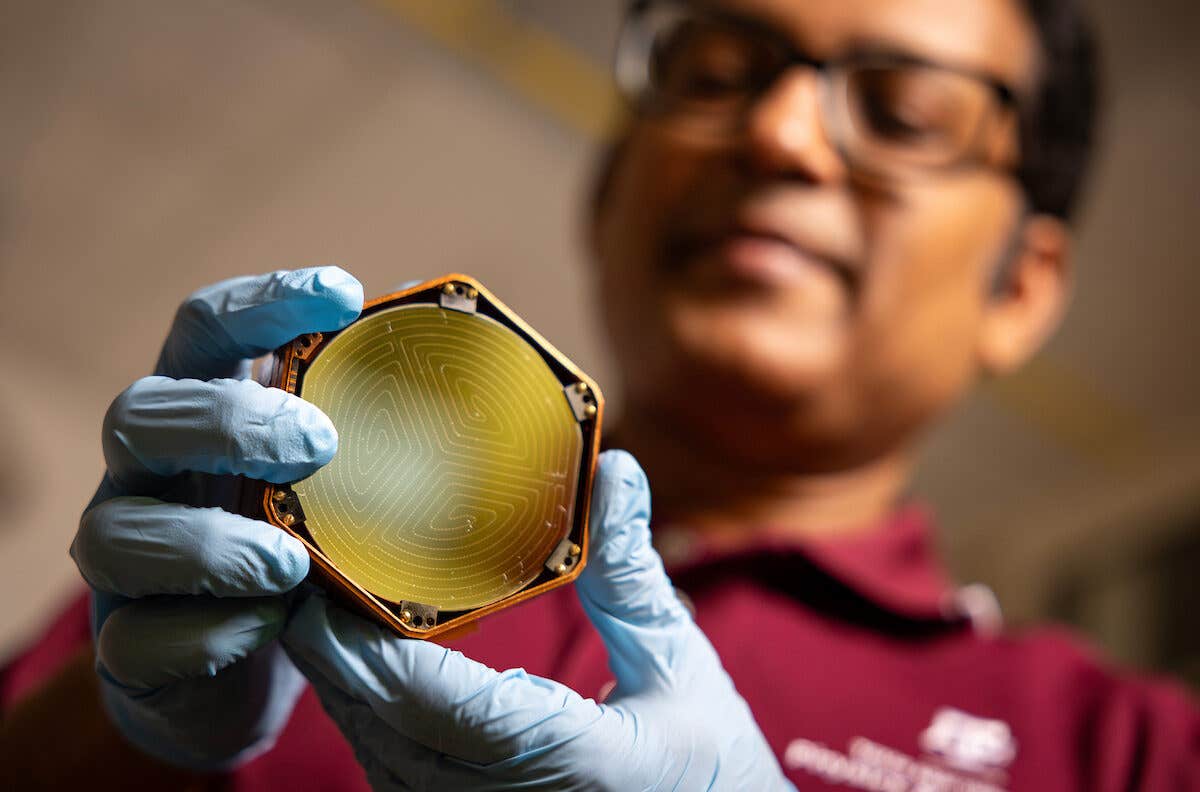
Dr. Rupak Mahapatra, an experimental particle physicist, holds a SuperCDMS detector. The highly sensitive devices, which are fabricated at Texas A&M University, are deepening the search for dark matter and have potential applications in quantum computing. (CREDIT: Laura McKenzie/Texas A&M University Division of Marketing & Communications)
- Researchers traced a major source of unexplained low-energy noise in ultrasensitive silicon detectors to the bulk silicon substrate itself, rather than primarily to the metal sensor films.
- The unwanted phonon background scaled with silicon thickness and gradually weakened after cooldown, helping the team narrow down the likely physical source of the mysterious signals.
- The result could improve searches for extremely light dark matter while also helping explain quasiparticle poisoning, a separate problem that limits superconducting quantum devices.
Dark matter detectors are built to notice almost nothing. The particles scientists hope to find may interact so weakly with ordinary matter that a detector could wait months or years for a meaningful event, making every unexplained pulse inside the hardware a serious problem.
Researchers have now traced one of those mysterious backgrounds to the silicon itself. A team involving Texas A&M University and collaborators studying ultrasensitive cryogenic detectors found that spontaneous bursts of lattice vibrations, or phonons, appear to originate mainly inside the bulk silicon substrate rather than in the metal sensor films on its surface.
The work, published in Applied Physics Letters, could help improve experiments searching for extremely light dark matter. It may also illuminate a separate problem in superconducting quantum computers, where similar energy bursts can create unwanted quasiparticles and disrupt fragile quantum states.
A background that grows as detectors become more sensitive
Dark matter is inferred from its gravitational influence on galaxies and galaxy clusters, but its particle identity remains unknown. One major search strategy uses cryogenic crystals to detect the tiny recoil or energy deposit that could occur if a dark matter particle interacts with ordinary matter.
The challenge becomes especially severe for low-mass candidates because they would deposit very little energy. Researchers therefore cool silicon detectors to extremely low temperatures and measure phonons, quantized vibrations traveling through the crystal lattice, with superconducting transition-edge sensors.
As detector thresholds have fallen, scientists have repeatedly encountered an unexplained population of low-energy events. Known as the low-energy excess, or LEE, these events can overwhelm the backgrounds expected from radioactivity or cosmic rays and can resemble the sort of tiny signals researchers are trying to find.
Two thicknesses exposed where the noise begins
To identify the source, the researchers compared two nearly identical silicon detectors with an area of one square centimeter. One had a 1-millimeter-thick substrate weighing 0.233 grams, while the second was 4 millimeters thick and weighed 0.932 grams.
Both were fabricated using nearly identical procedures and operated together under similar cryogenic conditions. Their sensors used tungsten transition-edge devices coupled to aluminum fins that collect phonon energy, allowing the team to distinguish events shared across multiple channels from events localized in a single sensor.
The critical difference was the amount of silicon. Correlated phonon noise in the 4-millimeter detector was about four times larger than in the 1-millimeter device, and the shared low-energy background followed the same thickness scaling.
That relationship makes the metal films an unlikely dominant source of the shared bursts. Comparisons with other silicon detector geometries also favored a process that scales with the substrate volume, pointing toward the crystal bulk itself.
The detector became quieter after cooling
Time provided another clue. The team monitored the devices for 12 days after cooldown and found that correlated phonon noise steadily decreased, while the energy resolution improved.
The electrical bias power needed to keep the superconducting sensors operating also changed with nearly the same time dependence. The researchers argue that both trends are likely connected to a common population of tiny energy releases occurring inside the detector.
Modeling the relationship between the noise and parasitic power yielded a characteristic sub-threshold event energy of 0.68 plus or minus 0.38 millielectronvolts. Individual events at that scale are too small to trigger the detector on their own, but many can combine into measurable shot noise.
The precise mechanism remains uncertain. One possibility is that crystal defects store energy while the silicon is warm and slowly relax into lower-energy configurations after the device is cooled to millikelvin temperatures, occasionally producing larger avalanche-like phonon bursts.
Record sensitivity raises the stakes
The thinner detector ultimately reached a baseline phonon energy resolution of 258.5 plus or minus 0.4 millielectronvolts. The researchers describe that result as world-leading for this class of device.
Such sensitivity matters because dark matter particles below roughly a billion electronvolts in mass can produce extraordinarily small signals. TESSERACT and related experiments are designed to push direct detection into this low-mass territory by measuring energy deposits that conventional detectors would miss.
A separate 2025 TESSERACT analysis used a 0.233-gram silicon detector to place the strongest direct-detection constraints at the time on dark matter masses between 44 and 87 megaelectronvolts per speed-of-light squared. That result depended in part on distinguishing substrate events from backgrounds coupled to individual sensors.
Better control of the newly identified bulk phonon source could lower thresholds further. Researchers can now test whether crystal quality, fabrication methods, thermal cycling or changes in detector geometry reduce the background without sacrificing sensitivity.
The same problem may reach quantum computers
The implications extend beyond particle physics because superconducting quantum processors also commonly sit on silicon substrates. Their circuits can suffer from quasiparticle poisoning when stray energy breaks superconducting Cooper pairs and creates excitations that shorten qubit coherence or generate correlated errors.
Phonons are already known to carry disruptive energy through quantum chips. The new study suggests that some of those phonons may arise spontaneously inside silicon, even when devices are carefully shielded from external radiation and mechanical vibration.
The researchers estimated that the phonon power observed in their detectors could produce quasiparticle densities broadly comparable with values measured in modern superconducting devices. That does not establish substrate relaxation as the only source of poisoning, but it identifies a mechanism that both dark matter experiments and quantum engineers may need to control.
For dark matter searches, understanding that background is itself a step toward discovery. When an experiment is designed to detect signals that may occur only rarely and release almost no energy, knowing exactly how the detector behaves on its own becomes essential before scientists can confidently identify something new.
Dig deeper into low-energy dark matter detectors
These studies examine recent advances in cryogenic phonon detectors, unexplained low-energy backgrounds and their potential connection with superconducting quantum hardware.
First Limits on Light Dark Matter Interactions in a Low Threshold Two-Channel Athermal Phonon Detector from the TESSERACT Collaboration: TESSERACT used an ultrasensitive silicon phonon detector to set leading constraints on dark matter masses between 44 and 87 MeV/c². (Physical Review Letters, 2025)
Correlated Quasiparticle Poisoning from Phonon-Only Events in Superconducting Qubits: Researchers observed correlated qubit poisoning that decreased after cooldown, supporting the idea that nonionizing phonon bursts can generate disruptive quasiparticles. (Physical Review Letters, 2025)
A stress-induced source of phonon bursts and quasiparticle poisoning: Experiments showed that mechanical stress in silicon can sharply increase low-energy phonon events and identified stress relaxation as one possible background source. (Nature Communications, 2024)
Modeling phonon-mediated quasiparticle poisoning in superconducting qubit arrays: This study models how energetic phonons spread through silicon substrates and generate correlated quasiparticle errors across superconducting qubit arrays. (Physical Review B, 2024)
Results on sub-GeV dark matter from a 10 eV threshold CRESST-III silicon detector: A cryogenic silicon detector achieved an exceptionally low threshold while characterizing the unexplained low-energy excess that complicates light dark matter searches. (Physical Review D, 2023)
Research findings are available online in the journal Physical Review Letters.
The original story "Scientists build ultra-sensitive quantum detectors to search for invisible dark matter" is published in The Brighter Side of News.
Related Stories
- NIST scientists invent a quantum crystal detector to hunt for dark matter
- A tiny semiconductor device lifts quantum photon interference visibility to 90%
- Physicists convert microwaves to light helping quantum computers communicate over optical networks
Like these kind of feel good stories? Get The Brighter Side of News' newsletter.
Shy Cohen
Writer