Scientists detect key process that triggers new star formation
Researchers detect ambipolar diffusion in a prestellar core, revealing how stars begin to form from collapsing gas clouds.
 Kyushu University Writer: Raymond Terhune

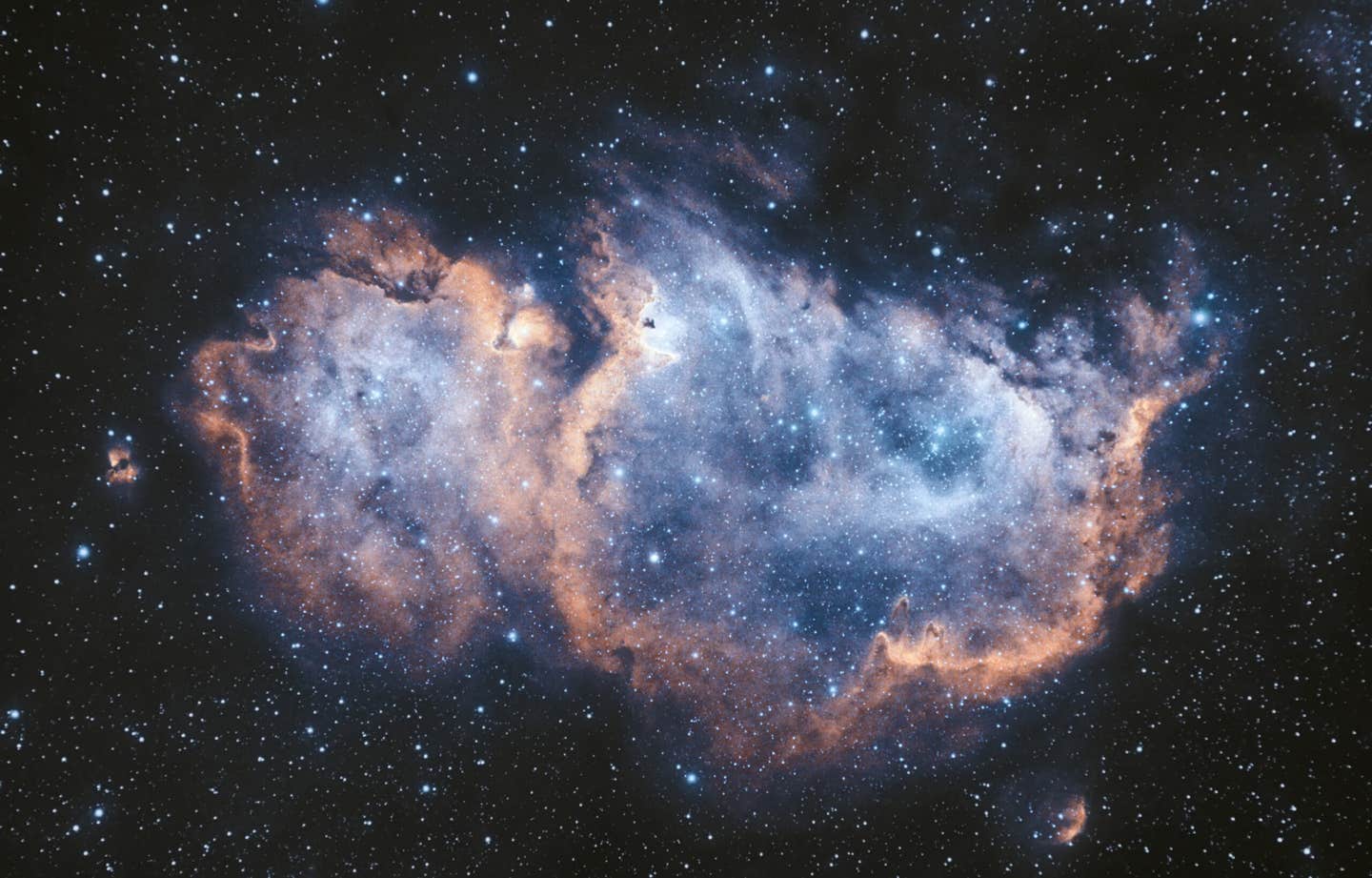
A new study captures the first clear evidence of ambipolar diffusion, a process that allows stars to form from dense cosmic clouds. (CREDIT: Shutterstock)
- Neutral gas inside the prestellar core L1544 was measured moving slightly faster than charged gas, providing the first clear detection of ambipolar diffusion in such a core.
- The tiny speed difference supports a long-predicted process in which neutral particles slip past ions tied to magnetic fields, allowing gravity to gain influence.
- The result gives astronomers a new way to test how stars begin forming and could guide higher-resolution observations of other cold stellar nurseries.
Deep within a dark cloud in the constellation Taurus, a quiet shift is taking place. It is not visible to the eye, and it moves at a pace slower than a gentle breeze. Yet this subtle motion may mark one of the most important steps in the birth of a star.
A new study reports the first clear detection of a process called ambipolar diffusion inside a prestellar core. The research, led by scientists from Kyushu University and the Max Planck Institute for Extraterrestrial Physics, offers rare insight into how stars like the Sun begin to form.
The Hidden Beginnings Of Stars
Stars are born from cold, dense clumps of gas and dust known as prestellar cores. These regions sit inside larger molecular clouds and remain shielded from most radiation. Temperatures drop to extremely low levels, allowing complex chemistry to unfold.
Inside these cores, gravity pulls material inward. At the same time, magnetic fields act as a counterforce, holding the gas in place. This balance can delay the collapse needed to form a protostar, the earliest stage of a star.
Doris Arzoumanian, the study’s first author and an associate professor at Kyushu University, described the challenge. “Prestellar cores are fascinating stellar bodies. They are dense and cold, and a source of a lot of complex chemistry,” she said. “One of the questions we are investigating is the role of magnetic fields in star formation.”
If magnetic fields remain too strong, they can prevent collapse for long periods. Scientists have long suspected that some process must weaken this support, allowing gravity to take over.
A Process Long Predicted
That process is known as ambipolar diffusion. It describes how neutral particles, which make up most of the gas, slowly slip past charged particles tied to magnetic field lines.
In these environments, gas is only partially ionized. Charged particles, called ions, remain strongly linked to magnetic fields. Neutral particles interact more loosely. Over time, neutrals drift inward under gravity, while ions stay behind.
This creates a small difference in speed between the two types of particles. As this drift continues, the magnetic field becomes less effective at supporting the core. Eventually, gravity dominates, and collapse begins.
For decades, scientists predicted this effect. However, detecting it directly has been extremely difficult. The expected speed difference is very small, making it hard to measure.
Searching Inside A Stellar Nursery
To find evidence, the research team turned to a well-known prestellar core called L1544. This object lies in the Taurus molecular cloud, one of the closest star-forming regions to Earth.
Using the IRAM 30-meter radio telescope, the team observed molecules inside the core. Because these regions are so cold, many common molecules freeze onto dust grains and cannot be detected.
To overcome this, the scientists selected two specific tracers. One was diazenylium-d1, an ion known as N2D+. The other was para-monodeuterated ammonia, a neutral molecule called para-NH2D.
“These molecules are generally located in similar high-density regions within prestellar cores,” explained Silvia Spezzano, a co-author from the Max Planck Institute. “We therefore collected spectral data of the core and modeled the velocity of the two molecules.”
By comparing their motion, the team aimed to detect the tiny drift predicted by theory.
A Small But Crucial Difference
The results revealed a clear pattern. The neutral molecules moved slightly faster than the ions, with a velocity difference of about 0.05 kilometers per second.
This difference may seem small, but it is significant. It matches theoretical predictions for ambipolar diffusion and exceeds the uncertainty of the measurements.
The drift appears because neutral particles fall inward under gravity. At the same time, ions remain linked to the magnetic field and move more slowly.
As density increases, the core becomes shielded from radiation. This reduces ionization and weakens the coupling between gas and magnetic fields. The decoupling allows neutral particles to accelerate toward the center.
“This process is known as ambipolar diffusion. Until now, observing this phenomenon in a prestellar core was a major challenge,” Arzoumanian said.
The detection provides direct evidence that this long-suspected process is at work in real star-forming environments.
How Magnetic Fields Lose Their Grip
The findings help explain how magnetic fields weaken during star formation. At first, the field holds the gas in place, slowing collapse. Over time, ambipolar diffusion allows neutral material to slip through.
As more gas gathers in the center, the magnetic field becomes less influential. Eventually, gravity takes control, and the core collapses into a protostar.
This transition marks the moment when a star begins to form. The process sets the stage for everything that follows, from nuclear fusion to the creation of planetary systems.
The study also highlights the importance of chemistry in this process. The cold environment allows molecules to form and interact in ways that influence the physics of collapse.
Complex molecules, including precursors to organic compounds, can develop in these regions. This connection links star formation to the broader story of how the building blocks of life may arise.
A Window Into Stellar Origins
The observations required careful coordination between theory and measurement. The team combined expertise in gas dynamics, astrochemistry, and dust physics to interpret the data.
“This interdisciplinary collaboration made these results possible,” Arzoumanian said. “Understanding star formation addresses a fundamental question about the origin of life in planetary systems and helps us better understand the universe as a whole.”
The study also opens new paths for research. By observing other prestellar cores, scientists can test whether ambipolar diffusion operates in the same way across different environments.
Higher-resolution observations may reveal how the drift changes within a core. This could provide a more detailed picture of how collapse begins and evolves.
A Subtle Shift With Cosmic Impact
The detection of ambipolar diffusion marks a key milestone in astrophysics. It confirms that magnetic fields do not remain fixed barriers to collapse. Instead, they gradually lose their influence as matter moves inward.
This insight helps explain how stars form from cold clouds of gas. It also sheds light on the conditions that shape planetary systems like our own.
The motion itself is quiet and slow. It does not produce bright light or dramatic events. Yet its effects are profound, guiding the transformation of diffuse gas into the stars that fill the night sky.
Practical Implications Of The Research
This discovery strengthens the scientific understanding of how stars form, which has broad implications for astronomy and planetary science. By confirming the role of ambipolar diffusion, researchers can improve models that describe the early stages of star formation. These models are essential for predicting how stars, planets, and solar systems develop over time.
The findings also support future observations using advanced telescopes. By knowing what signals to look for, scientists can study other star-forming regions more effectively. This may help identify environments where planets and organic molecules are more likely to form.
Beyond astrophysics, the research connects to larger questions about the origin of life. The same regions where stars form also host complex chemical reactions. Understanding these environments may provide clues about how life-supporting molecules arise.
In the long term, this work helps build a clearer picture of the universe’s evolution. It shows how small physical processes, such as the drift of particles in a magnetic field, can shape the formation of stars and galaxies.
Dig deeper into magnetic fields and the earliest stages of star formation
These resources explore how magnetic fields, ion-neutral drift and collapsing molecular clouds shape the transition from cold prestellar cores to newborn stars and disks.
Ambipolar diffusion and the mass-to-flux ratio in a turbulent collapsing cloud
This 3D chemo-dynamical modeling study follows how neutral-ion drift and the balance between mass and magnetic flux evolve during cloud collapse, offering a detailed theoretical picture of when ambipolar diffusion becomes important. (Astronomy & Astrophysics, 2025)
The mass-to-flux ratio in molecular clouds: What are we really measuring?
This analysis examines how viewing angle can distort measurements of the mass-to-magnetic-flux ratio, a key quantity for determining whether gravity can overcome magnetic support in a molecular cloud. (Astronomy & Astrophysics, 2026)
Can we observe the ion-neutral drift velocity in prestellar cores?
Simulations show why ambipolar diffusion is so difficult to detect observationally and examine how chemistry, radiative transfer and telescope limitations can mask the tiny velocity difference between ions and neutral gas. (Monthly Notices of the Royal Astronomical Society, 2023)
Protostellar discs in their natural habitat: the formation of protostars and their accretion discs in the turbulent interstellar medium
These simulations compare star formation with no magnetic field, ideal magnetohydrodynamics and ambipolar diffusion, finding that magnetic decoupling can substantially influence early disk formation and outflows around forming stars. (Monthly Notices of the Royal Astronomical Society, 2025)
Magnetic Fields in Molecular Clouds
This authoritative review explains how astronomers measure magnetic fields in molecular clouds and assesses their competing roles alongside gravity, turbulence and ambipolar diffusion, providing foundational context for interpreting newer observations of prestellar cores. (Annual Review of Astronomy and Astrophysics, 2012)
Research findings are available online in the journal Astronomy and Astrophysics.
The original story "Scientists detect key process that triggers new star formation" is published in The Brighter Side of News.
Related Stories
- Organic molecules can survive violent supernova explosions - fueling star and planet formation
- Two collisions, one star, and a new view of planet formation
- Giant planet found orbiting tiny star challenges theories on planetary formation
Like these kind of feel good stories? Get The Brighter Side of News' newsletter.
Joshua Shavit
Writer and Editor
Joshua Shavit is a NorCal-based science and technology writer with a passion for exploring the breakthroughs shaping the future. As a co-founder of The Brighter Side of News, he focuses on positive and transformative advancements in technology, physics, engineering, robotics, and astronomy. Having published articles on AOL.com, MSN, Yahoo News, and Ground News, Joshua's work highlights the innovators behind the ideas, bringing readers closer to the people driving progress.