Ultra-thin polymer coating boosts condensation heat transfer up to 5.5 times
Nanoscale polymer structures create more droplets, while heat treatment helps them leave the surface before growing large.
 KAIST Writer: Jeonga Lee

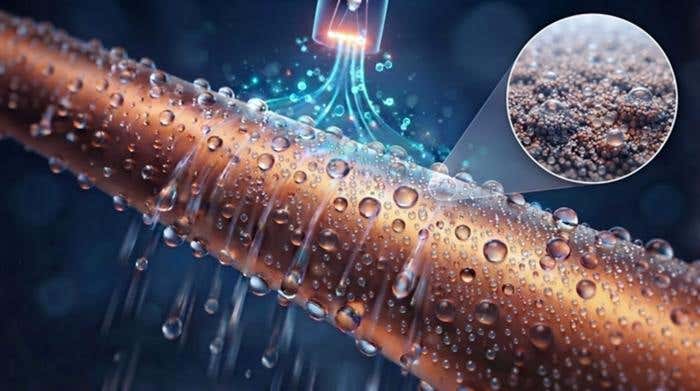
Nanoscale polymer structures create more droplets, while heat treatment helps them leave the surface before growing large. (CREDIT: KAIST)
- KAIST researchers tuned an ultrathin polymer coating to encourage water droplets to form and then leave the surface quickly.
- The best coating reached a condensation heat-transfer coefficient of about 88 kilowatts per square meter per kelvin, roughly 5.5 times bare copper.
- Both thin coatings maintained dropwise condensation for at least four weeks in controlled tests, while longer-term performance remains unestablished.
A condensation surface has to do two jobs that normally work against each other. It needs places where water droplets can form, yet it must also let those droplets leave quickly. A nanoscale polymer coating developed at KAIST appears to do both.
The coating uses a fluoropolymer called pPFDMA deposited by initiated chemical vapor deposition, or iCVD. Researchers tuned the film thickness and then heat-treated the surface to control two different parts of condensation separately.
The work was led by Youngsuk Nam of KAIST’s Department of Mechanical Engineering and Sung Gap Im of the Department of Chemical and Biomolecular Engineering.
At its best, the coating reached a condensation heat-transfer coefficient of about 88 kilowatts per square meter per kelvin. That was roughly 5.5 times the performance of bare copper undergoing filmwise condensation under matching conditions.
A thin coating creates more places for droplets to begin
Condensation transfers heat when water vapor turns into liquid. On ordinary hydrophilic metals, water often spreads into a continuous film.
That film adds thermal resistance and slows heat flow. Conventional filmwise condensation typically produces heat-transfer coefficients of about 10 to 20 kilowatts per square meter per kelvin.
Dropwise condensation performs better because droplets form, grow, merge and leave the surface, exposing fresh areas for more condensation.
Researchers created pPFDMA coatings with nominal thicknesses of 25, 100 and 500 nanometers.
The thinnest films contained many small semi-crystalline polymer aggregates. The thickest film contained fewer but much larger structures.
Before heat treatment, surface roughness measured 2.1 nanometers on the 25-nanometer film and 4.2 nanometers on the 100-nanometer film. The 500-nanometer coating reached 26 nanometers.
The density of smaller aggregates in the thin films was about 10 to 15 times greater.
Those structures turned out to be useful.
Environmental scanning electron microscopy and optical microscopy showed that the 25- and 100-nanometer films produced about three times the droplet nucleation density of the 500-nanometer coating.
Heat treatment makes droplets easier to remove
The same surface structures that encourage nucleation can also pin water in place.
The team addressed that problem by annealing the films at 80 degrees Celsius for one hour.
The treatment reduced roughness to 1.2 nanometers on the 25-nanometer coating and 2.2 nanometers on the 100-nanometer coating. The 500-nanometer film declined more modestly, from 26 to 21 nanometers.
Measurements showed that the polymer begins cold crystallization near 69 degrees Celsius and continues through roughly 82 degrees Celsius.
Crystalline organization increased during the 80-degree treatment and stabilized after about 50 to 60 minutes.
Annealing also sharply lowered contact angle hysteresis, a measure related to how strongly droplets resist moving across a surface.
On copper, hysteresis fell from around 40 degrees to 19.6 degrees for the 25-nanometer film and 19.3 degrees for the 100-nanometer film.
The 500-nanometer coating remained much higher at 43.6 degrees.
The team therefore separated two effects that usually conflict. Film thickness controlled how readily droplets formed, while heat treatment mainly improved how easily they moved.
Smaller droplets cleared the surface more often
Researchers then tested the coatings under pure water vapor with less than 0.5% non-condensable gas.
Vapor and surface temperatures stayed near 28 and 25 degrees Celsius.
Images recorded once per second allowed a computer-vision system to track large numbers of droplets as they formed, merged and departed.
The thinner coatings produced smaller departure diameters and more frequent sweeping events than the 500-nanometer film.
Before annealing, droplets on the 25- and 100-nanometer films departed at diameters about 27% smaller. Sweeping frequency was 1.37 times higher.
Annealing improved the thin coatings again.
Departure diameter fell another 31% for the 25-nanometer film and 33% for the 100-nanometer film.
Sweeping frequency increased by 11% and 30%, respectively.
The 500-nanometer coating gained almost nothing from the same treatment.
Its departure diameter increased slightly, while sweeping frequency declined by about 2%.
Heat transfer rose far above bare copper
The final experiments used coated copper tubes under pure-water-vapor conditions.
Before annealing, the 25- and 100-nanometer coatings reached heat-transfer coefficients of roughly 55 to 65 kilowatts per square meter per kelvin.
After treatment, performance rose by about 35% to 40%, reaching 75 to 88 kilowatts per square meter per kelvin.
The 500-nanometer coatings stayed between 37 and 45 kilowatts per square meter per kelvin.
Bare copper reached only 16 to 17 kilowatts per square meter per kelvin.
The optimized coatings also delivered about 1.5 times the heat-transfer performance of benchmark dropwise-condensation surfaces tested or compared in the study.
The improvement came from combining dense nucleation sites with faster droplet removal.
Thin films also remained stable for weeks
Durability tests added another practical advantage.
Both the 25- and 100-nanometer coatings maintained stable dropwise condensation for at least four weeks under pure-vapor vacuum conditions.
An HTMS reference coating degraded rapidly toward filmwise condensation.
The researchers highlighted the 100-nanometer coating as a particularly attractive practical option because it preserved the thin-film performance while offering a larger thickness margin.
“This research is meaningful because it uses nanostructures previously regarded as defects as features that help droplets form,” Nam said. “We have presented a new method for improving heat transfer efficiency by separately controlling droplet formation and removal.”
Dig deeper into condensation coatings and heat transfer
These resources examine droplet behavior, coating durability and the challenges of translating laboratory gains into practical condenser performance.
Enhancement versus practicality in steam condensation heat transfer: Examines experimental practices and practical barriers to applying enhanced condensation technologies. (Joule, 2025)
Durable, Ultrathin, and Antifouling Polymer Brush Coating for Efficient Condensation Heat Transfer: Investigates a different thin polymer coating and its performance during steam condensation. (ACS Applied Materials & Interfaces, 2024)
A review of dropwise condensation: Theory, modeling, experiments, and applications: Reviews condensation models, measurement methods and applications where dropwise behavior can improve heat transfer. (International Journal of Heat and Mass Transfer, 2020)
Nanoscale control by chemically vapour-deposited polymers: Explains how vapor deposition controls polymer films for a range of nanoscale surface applications. (Nature Reviews Physics, 2020)
Review of Micro–Nanoscale Surface Coatings Application for Sustaining Dropwise Condensation: Surveys coating strategies and the trade-offs between durability, thickness and thermal resistance. (Coatings, 2019)
Research findings are available online in the journal Nature Communications.
The original story "Ultra-thin polymer coating boosts condensation heat transfer up to 5.5 times" is published in The Brighter Side of News.
Related Stories
- Microlightning in water droplets may have ignited life on Earth
- The fountain of life: Water droplets hold the secret ingredient for building life
- Rock glaciers worldwide may hold about 48 gigatons of water
Like these kind of feel good stories? Get The Brighter Side of News' newsletter.
Joseph Shavit
Writer, Editor-At-Large and Publisher
Joseph Shavit, based in Los Angeles, is a seasoned science journalist, editor and co-founder of The Brighter Side of News, where he transforms complex discoveries into clear, engaging stories for general readers. With vast experience at major media companies like The Los Angeles Times, Times Mirror and Tribune Publishing, he writes with both authority and curiosity. His writing focuses on space science, planetary science, quantum mechanics, geology. Known for linking breakthroughs to real-world markets, he highlights how research transitions into products and industries that shape daily life.