Scientists discover a surprising link between breathing and reaction time
A study of 35 adults links breathing phase and reaction time, but does not show that changing breaths improves real-world performance.
 Northwestern University Writer: Stephanie Kulke

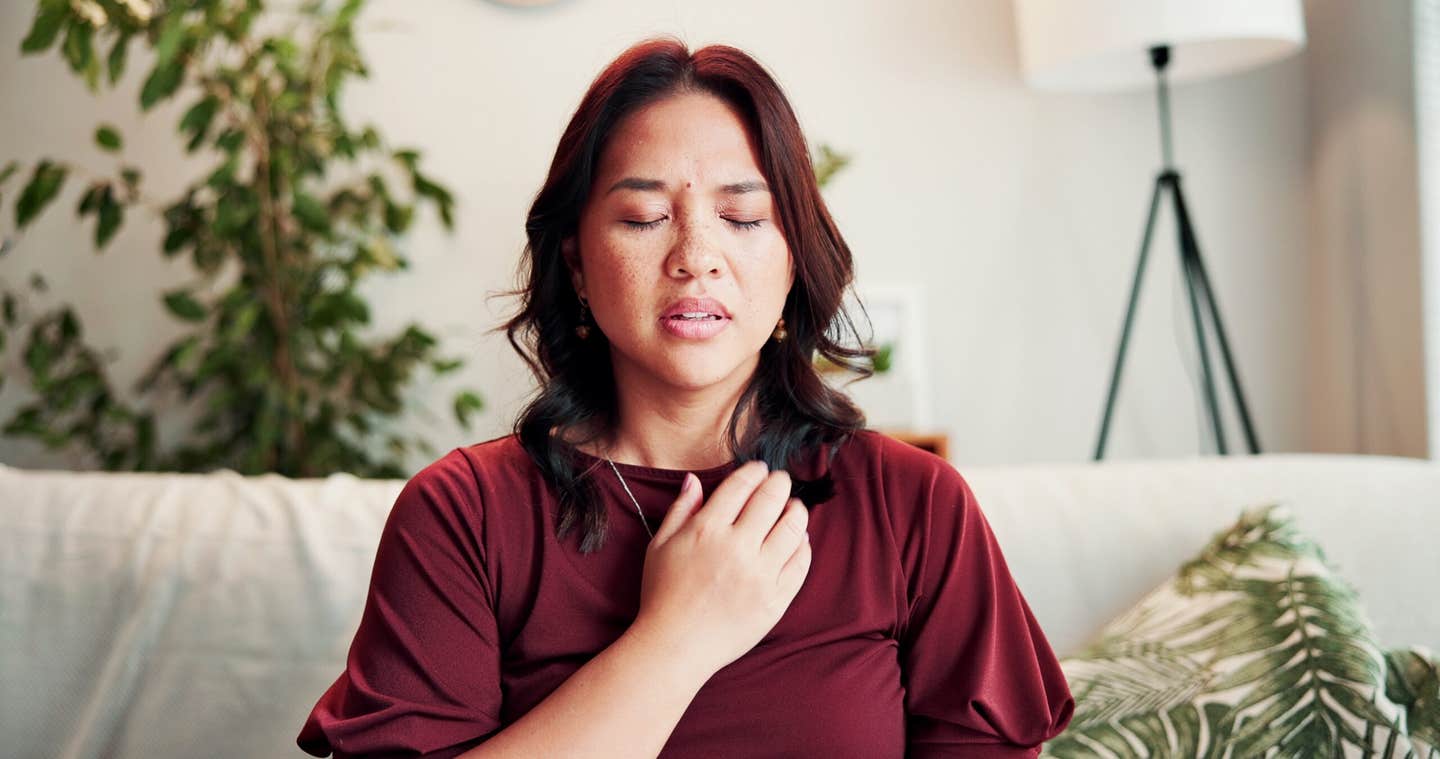
Young adults reacted faster during exhalation and natural breathing pauses in a visual attention test. Practical benefits remain untested. (CREDIT: Shutterstock)
A yellow square on a computer screen drew slower responses when it appeared during inhalation. During exhalation and natural pauses between breaths, participants pressed a key faster. The difference links an ordinary bodily rhythm with brief fluctuations in attention, without establishing a breathing technique for improving performance.
Neuroscientist Erika M. Yamazaki and senior author Ken Paller, the James Padilla Professor of Psychology, at Northwestern University analyzed responses from 35 adults. Their study, published in iScience, examined inhalation, exhalation and pauses separately. It adds to evidence connecting breathing rhythms with brain function.
The timing differences amounted to tens of milliseconds. Across 20 portions of the breathing cycle, the fastest and slowest responses differed by 40.9 milliseconds. Responses during pauses averaged 21.6 milliseconds faster than during inhalation, offering two distinct measurements of the relationship.
A simple signal tests sustained attention
Participants watched a red square and pressed the space bar when it turned yellow. This three-minute Psychomotor Vigilance Task measures how consistently someone stays ready to respond. Unlike tests of memory, it requires a simple reaction to an expected signal rather than remembering information.
The square changed after randomly chosen delays of one, two, three or four seconds. After each response, the screen displayed the reaction time before another trial began. A nasal airflow sensor recorded breathing throughout, allowing researchers to identify the respiratory phase when each target appeared.
The volunteers were healthy, right-handed adults aged 18 to 33, including 22 females. They reported no neurological or sleep disorders. Their average age was about 21, making this a study of young adults rather than the full range of people whose cognitive performance might vary with breathing.
Researchers gave no breathing instructions during the attention task. Participants had, however, completed a separate respiration-training task between laboratory visits. The reported analysis followed their spontaneous breathing during testing, without randomly assigning targets to a particular breathing phase or prescribing exhalation as an intervention.
The slowest responses cluster around inhalation
Participants averaged approximately one breath every four seconds. Inhalations lasted about 1.37 seconds, exhalations 1.68 seconds and pauses 1.03 seconds. These changing phases provide a more detailed view of breathing than simply counting breaths per minute.
Each administration yielded about 47 usable trials, with an overall mean reaction time of 307.25 milliseconds. Researchers excluded false starts below 100 milliseconds and some beginning or ending trials affected by breathing-analysis limitations. Their statistical models accounted for repeated measurements from the same participants.
This matters because dozens of responses from one person do not represent dozens of independent volunteers. The analysis also accounted for the experiment and whether testing occurred before or after sleep.
Targets appearing during inhalation produced significantly slower responses than targets during exhalation or pauses. The exhalation-versus-pause comparison did not reach statistical significance. That result does not establish that the two phases yield identical performance. Pauses following inhalation and exhalation likewise showed no statistically significant reaction-time difference. Including these quiet intervals prevented the researchers from treating the breathing cycle as only two continuous phases.
Dividing the cycle into 20 portions revealed the slowest responses around peak inhalation. This pattern adds behavioral detail to the wider relationship between respiration and brain activity. Importantly, the 40.9-millisecond range describes the fastest-to-slowest portions, rather than a guaranteed benefit from breathing out. The researchers classified trials by the phase when the target appeared, rather than by the phase when the key press ended. Their result therefore concerns the bodily state at signal arrival.
Checking anticipation and sleep conditions
Waiting itself can sharpen readiness. Participants responded more slowly to targets appearing after one second than to later targets. As time passes without a signal, its arrival becomes more expected, potentially complicating studies of visual attention.
The researchers therefore included the waiting interval in another statistical analysis. Breathing phase remained a significant predictor after they accounted for elapsed time. Anticipation alone could not explain the observed pattern, although the analysis cannot rule out every influence on response speed.
The data came from two sleep experiments. Ten participants completed the task before and after an overnight stay with eight hours in bed. Another 25 completed it before and after a 90-minute afternoon nap opportunity, creating different contexts for examining sleep and attention.
The breathing-related pattern held across experiments and testing sessions, even though overall reaction times differed. Time of day and temporary grogginess after waking may explain some variation. These findings do not establish that sleep caused the respiratory-phase effect, or that the same relationship persists during severe sleep deprivation.
A possible rhythm in brain efficiency
Breathing does more than supply oxygen: previous studies have linked its rhythm with electrical fluctuations in several brain regions. Those findings offer a possible explanation for changing response speed. They also connect this work with broader investigations of sleep and breathing.
The authors propose that respiration may influence neural circuits involved in sustained attention. Two relevant networks, the default mode and frontoparietal networks, include regions where earlier research found breathing-linked activity. The current analysis did not establish that these networks generated the measured reaction-time differences.
“We don’t yet know exactly how they are linked,” Paller said. He suggested differences in neurophysiological efficiency as one possibility. That interpretation requires further testing rather than treating breathing phase as a direct measure of how efficiently the brain works.
Earlier experiments sometimes found better performance during inhalation, particularly for emotional judgments, memory or perception. Such results suggest that different cognitive tasks may favor different phases. The authors propose that responding to a neutral signal may differ from integrating incoming information with stored knowledge, but this remains an explanation to investigate.
What the timing differences cannot yet tell us
Most participants followed the average pattern, but eight responded faster during inhalation than exhalation. Twenty-seven showed slower inhalation responses. This variation matters when considering whether brain-body interactions could eventually inform individualized performance strategies.
The researchers did not track eye position or require nasal breathing. Their sample also lacked sufficient statistical power to evaluate sex or gender differences. Because participants were generally well-rested, the study could not adequately examine whether respiratory phase changes the likelihood of missed signals.
Using the task’s conventional threshold of more than 355 milliseconds, about 13% of responses counted as lapses. That label describes a delayed response, rather than necessarily failing to press the key at all.
Driving and competitive starts make milliseconds consequential, but neither formed part of this experiment. Braking involves recognizing hazards and choosing an action, while athletic starts use different signals and trained movements. Translating a keyboard result into those settings requires direct testing under realistic conditions.
Future studies must establish whether deliberately coordinating breaths with a task changes performance, and whether any effect persists with fatigue. Related sleep research may help clarify the underlying physiology. For now, breathing phase helps explain some momentary variation in a simple attention test; its practical value remains unresolved.
Dig deeper into breathing and cognition
These studies explore how respiration relates to perception, neural activity and different mental tasks.
- Inhalation boosts perceptual awareness and decision speed: A visual discrimination experiment finds an inhalation advantage, illustrating why breathing effects may depend on task demands. (Journal of Neurophysiology, August 2023)
- Respiration aligns perception with neural excitability: Combined breathing and brain measurements examine links between respiratory timing, visual detection and neural excitability. (eLife, December 2021)
- Human non-olfactory cognition phase-locked with inhalation: Experiments investigate how inhalation relates to cognitive tasks beyond smelling. (Nature Human Behaviour, March 2019)
- Breathing above the brain stem: volitional control and attentional modulation in humans: Intracranial recordings explore neural activity associated with deliberate breathing and attention to respiration. (Journal of Neurophysiology, January 2018)
- Nasal Respiration Entrains Human Limbic Oscillations and Modulates Cognitive Function: Neural recordings and behavioral experiments connect nasal breathing with limbic rhythms, emotional judgments and memory. (The Journal of Neuroscience, December 2016)
Research findings are available online in the journal iScience.
The original story "Scientists discover a surprising link between breathing and reaction time" is published in The Brighter Side of News.
Related Stories
- Every breath you take, every distinct pattern in the brain you make
- Handheld breath detector reveals when the body starts burning fat
- Breath test for blood cancer shows promise in first-ever human study
Like these kind of feel good stories? Get The Brighter Side of News' newsletter.
Mac Oliveau
Writer
Mac Oliveau is a Los Angeles–based science and technology journalist for The Brighter Side of News, an online publication focused on uplifting, transformative stories from around the globe. Having published articles on MSN, and Yahoo News, Mac covers a broad spectrum of topics including medical breakthroughs, health and green tech. With a talent for making complex science clear and compelling, they connect readers to the advancements shaping a brighter, more hopeful future.