An unidentified powder offers new clues to understanding Mercury
A blind test of Mercury-like powder shows how BepiColombo’s X-ray and infrared measurements can jointly identify surface materials.
 Planetary Science Institute Writer: Samantha Riestenberg

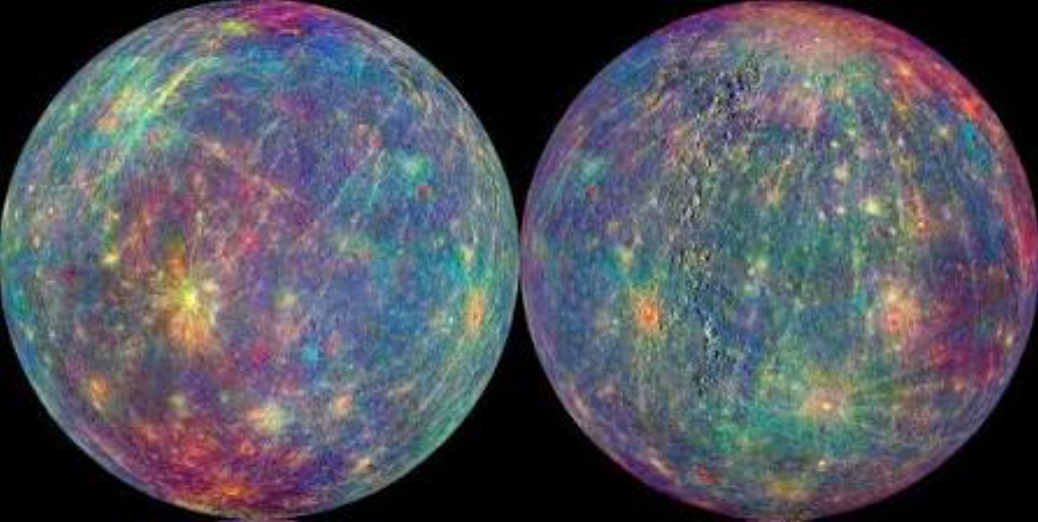
A laboratory benchmark shows how three BepiColombo techniques complement one another, while exposing limits in mineral identification. (CREDIT: NASA/JHU-APL/Carnegie Institute of Washington)
An unidentified powder has given planetary scientists a practical test of how to decipher Mercury's surface. Laboratories analyzed the same material without knowing its recipe, then compared their conclusions with its actual ingredients. The exercise showed why identifying surface minerals requires several kinds of measurement working together.
Océane Barraud of the German Aerospace Center led the international study, with contributions from Deborah Domingue and Neil Pearson at the Planetary Science Institute. Published in Planetary and Space Science, the study examines a fine-grained simulant called Mercury Y. The findings support efforts to reconstruct Mercury's geological history.
The timing matters as BepiColombo begins its orbital arrival sequence. The joint European Space Agency and Japan Aerospace Exploration Agency mission entered Mercury orbit on November 21, 2026. ESA schedules the science phase for April 2027, following further spacecraft separation and orbital adjustments in preparation for regular scientific measurements.
An unknown recipe tests the interpretation
NASA's MESSENGER mission mapped elements on Mercury while orbiting from 2011 to 2015. Identifying elements, however, does not uniquely identify the minerals containing them. Different combinations of crystalline materials and glass can produce similar overall surface chemistry.
Mercury Y gave researchers a known reference against which to test that problem. Its recipe contained 44% plagioclase, 25% pyroxene, 20% volcanic glass, 10% olivine and 1% graphite by weight. The developers used natural and synthetic components to approximate important characteristics inferred from MESSENGER observations.
Ten laboratories participated in the investigation, applying methods representative of three BepiColombo instruments. Keeping the composition confidential tested what analysts could recover from the measurements themselves. It also exposed ambiguities that might remain hidden if everyone began with the correct answer.
The mixture intentionally reproduced Mercury's low-iron character, but it was not an exact copy of the planet. Its limitations matter because a benchmark evaluates methods under selected conditions. Mercury's real crust contains additional chemical and physical complexity that laboratory interpretation must eventually address.
A blind test makes the comparison especially useful because the answer exists independently of the interpretation. Researchers can distinguish a correct identification from a plausible but incomplete explanation. They can also see which errors persist when multiple laboratories examine material with the same underlying composition.
X-rays identify elements more readily than minerals
MIXS, the Mercury Imaging X-ray Spectrometer, examines characteristic X-ray emission associated with chemical elements. Laboratory measurements corresponding to this instrument reproduced Mercury Y's bulk elemental composition and confirmed its low iron content. That provides an important foundation for investigating planetary rocks.
Researchers identified major rock-forming elements including magnesium, aluminum, silicon, potassium, calcium and iron. Most estimated elemental concentrations fell within 30% of their measured reference values, although performance differed among elements. This was useful agreement, rather than an exact recovery of every abundance.
Translating those elements into minerals proved more difficult. A model estimated approximately 65.5% feldspar, 25.2% combined pyroxene and 8.1% olivine. It substantially overestimated feldspar and failed to identify the volcanic glass, despite broadly capturing the other two components.
The result illustrates a fundamental ambiguity: elemental inventories alone do not establish how atoms are arranged. Crystals and glass can share chemical ingredients while having different structures. Resolving that distinction requires measurements sensitive to mineral properties, alongside the elemental information.
The percentages in a calculated mineral assemblage answer a different question from the elemental concentrations. The former describe proposed material proportions; the latter describe the chemical inventory. Agreement in the inventory can therefore coexist with an incorrect mineral recipe, as the missing glass demonstrates.
Reflected light supplies clues rather than firm identifications
SIMBIO-SYS combines imaging and spectroscopy, including observations of visible and near-infrared light reflected from the surface. Seven laboratories examined Mercury Y across wavelengths of approximately 400 to 2,000 nanometers. These measurements tested another route to understanding rocky surfaces.
The powder's absorption features were weak, with depths below 5%. Researchers noted a subtle feature near 1,100 nanometers consistent with contributions from magnesium-rich minerals and glass. The spectra narrowed plausible interpretations without providing definitive identification of individual minerals.
That limited response reflects the challenge posed by low iron content and fine particles. Spectral appearance also depends on how the sample reflects light at different viewing angles. PSI's measurements explored those variations, helping researchers anticipate how comparable material might appear from orbit.
The visible and near-infrared results also suggested a darkening component, but could not establish graphite directly. Its presence required interpretation alongside other evidence. Understanding dark materials remains relevant to Mercury's unusually low reflectance and the possible history of its carbon-rich crust.
Thermal infrared reveals the major ingredients
MERTIS, the Mercury Radiometer and Thermal Imaging Spectrometer, adds measurements in the thermal infrared. Here, features associated with atomic vibrations inside materials can distinguish mineral structures. Laboratory experiments examined Mercury Y at temperatures including 250°C, 335°C, 350°C and 400°C, relevant to interpreting a hot planetary surface.
These spectra identified the four major ingredients: plagioclase, magnesium-rich pyroxene, olivine and glass. Estimated proportions included approximately 54% plagioclase, with roughly 14% to 16% each for the other three. The quantities differed from the recipe, but the technique recovered the principal material types.
Graphite remained harder to pin down because it lacked a distinctive identifying feature in the examined ranges. Adding about 1% graphite to spectral models improved their agreement with measurements. The team therefore inferred it through changes in reflectance and emissivity, rather than detecting a unique graphite signature.
This distinction preserves the scope of the success. The study demonstrated complementary constraints on an unknown sample, while revealing remaining errors and ambiguities. Combining chemistry with infrared spectroscopy gave a more informative result than either approach alone.
Identifying an ingredient and estimating its abundance also represent separate achievements. Recovering plagioclase did not mean recovering its exact share of the mixture. Comparing the thermal estimates with the withheld recipe makes those remaining quantitative differences visible, providing a basis for refining the interpretation.
A benchmark for interpreting Mercury from orbit
Mercury Y does not reproduce important sulfur and chlorine abundances or the full effects of long exposure to space. Its appearance also differs from the actual planet's darker surface. Those gaps limit how directly researchers can transfer the sample's behavior to Mercury's changing surface.
Further laboratory work involving irradiation, laser exposure and thermal processing can investigate some of these differences. The goal is to understand how environmental alteration changes the same material's measured properties. Otherwise, a weathered surface might be mistaken for a different mixture.
“The composition of Mercury's surface is key to understanding its formation and evolution,” Domingue said. Mineral identification can complement MESSENGER's elemental discoveries by helping researchers interpret the rocks, volcanic materials and darkening agents present on the planet.
The benchmark does not establish Mercury's mineral map in advance. It shows how MIXS chemistry, SIMBIO-SYS observations and MERTIS mineral signatures can constrain one another. As orbital science begins, that tested combination should help scientists separate genuine compositional differences from the uncertainties inherent in remote surface measurements.
Dig deeper into Mercury's composition
These studies explain the mission instruments and the MESSENGER discoveries that motivate the laboratory benchmark.
- The BepiColombo Mercury Imaging X-Ray Spectrometer: Science Goals, Instrument Performance and Operations: Describes how MIXS measures elemental abundances and the considerations needed to interpret its observations. (Space Science Reviews, November 2020)
- Studying the Composition and Mineralogy of the Hermean Surface with the Mercury Radiometer and Thermal Infrared Spectrometer (MERTIS) for the BepiColombo Mission: An Update: Explains MERTIS's thermal infrared measurements and the diagnostic features relevant to mineral identification. (Space Science Reviews, September 2020)
- SIMBIO-SYS: Scientific Cameras and Spectrometer for the BepiColombo Mission: Details the imaging and spectroscopic suite supplying complementary observations of Mercury's surface. (Space Science Reviews, June 2020)
- Remote sensing evidence for an ancient carbon-bearing crust on Mercury: Examines MESSENGER evidence connecting Mercury's dark surface materials with carbon and a possible ancient graphite-rich crust. (Nature Geoscience, March 2016)
- The Major-Element Composition of Mercury's Surface from MESSENGER X-ray Spectrometry: Presents elemental measurements that revealed Mercury's unusual surface chemistry and informed later mission questions. (Science, September 2011)
Research findings are available online in the journal Planetary and Space Science.
The original story "An unidentified powder offers new clues to understanding Mercury" is published in The Brighter Side of News.
Related Stories
- Mercury’s cratered surface has been hiding evidence of a much smaller planet
- Mercury’s surface chemistry reveals clues to a much hotter volcanic past
- Mercury’s polar water ice may have arrived in one giant impact
Like these kind of feel good stories? Get The Brighter Side of News' newsletter.
Joseph Shavit
Writer, Editor-At-Large and Publisher
Joseph Shavit, based in Los Angeles, is a seasoned science journalist, editor and co-founder of The Brighter Side of News, where he transforms complex discoveries into clear, engaging stories for general readers. With vast experience at major media companies like The Los Angeles Times, Times Mirror and Tribune Publishing, he writes with both authority and curiosity. His writing focuses on space science, planetary science, quantum mechanics, geology. Known for linking breakthroughs to real-world markets, he highlights how research transitions into products and industries that shape daily life.