Scientists recreate Enceladus’s ocean and watch Earth microbes thrive
Water-rock chemistry helped methane-producing microbes survive extreme alkaline conditions modeled on Enceladus’s hidden ocean.

 Edited By: Joshua Shavit

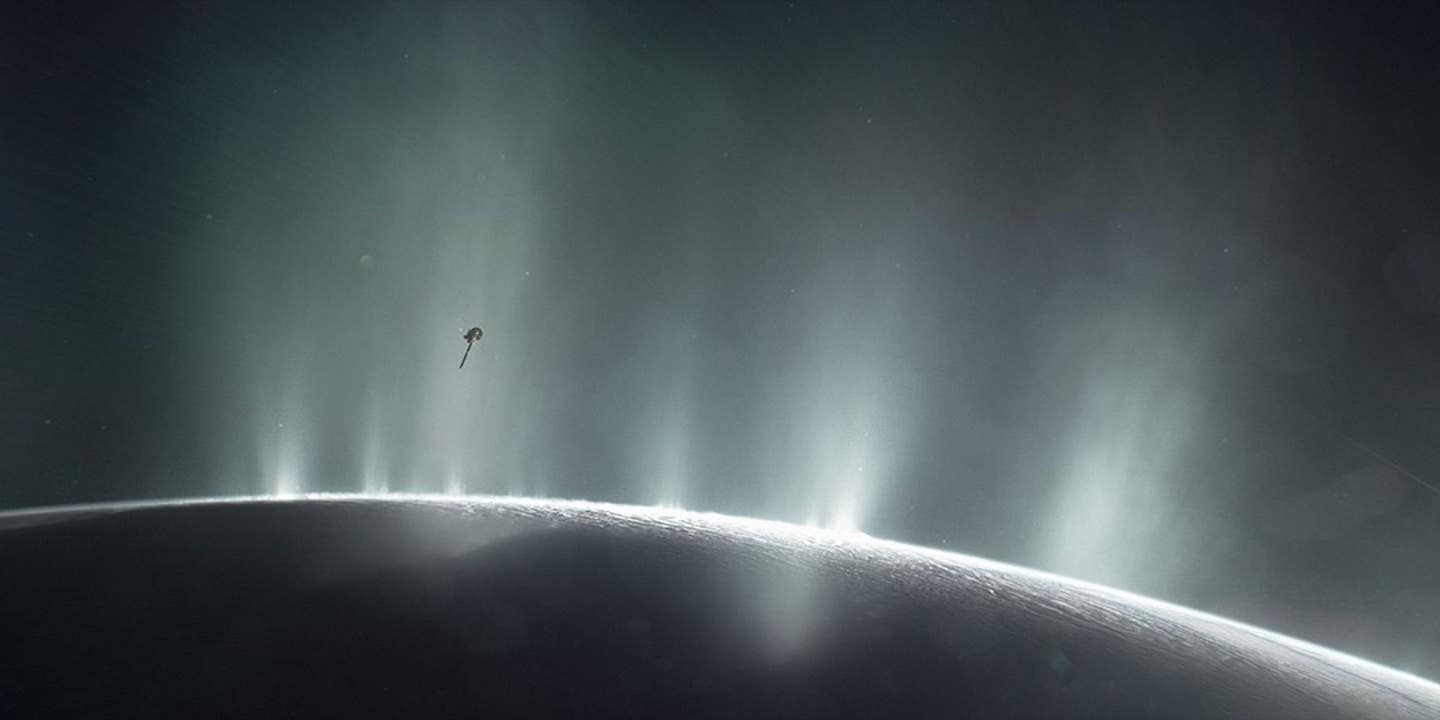
Dramatic plumes spray water ice and vapor from many locations along the famed “tiger stripes” near the south pole of Saturn’s moon Enceladus. (CREDIT: NASA / JPL-Caltech / Space Science Institute)
- Laboratory experiments show that a methane-producing archaeon from Earth can grow under simulated Enceladus seafloor conditions at pH values as high as 11, far beyond its previously reported natural range.
- Water-rock reactions in the experiment produced hydrogen that fueled microbial metabolism, while Enceladus-like concentrations of dissolved inorganic carbon helped the organisms overcome the severe shortage of available carbon dioxide.
- The results do not show that life exists on Saturn’s moon, but they broaden the conditions considered potentially habitable and strengthen the case for future missions that directly sample Enceladus’s ocean-derived plumes.
Beneath the frozen surface of Saturn’s moon Enceladus lies an ocean unlike anything familiar on Earth. It is dark, highly alkaline and separated from space by kilometers of ice, yet its chemistry may be surprisingly accommodating to life.
Laboratory experiments now show that an Earth microorganism can grow under conditions designed to reproduce parts of the moon’s hydrothermal seafloor. The microbe survived at pH values reaching 11, producing methane while drawing energy and carbon from reactions involving water, rock, hydrogen and dissolved carbonate.
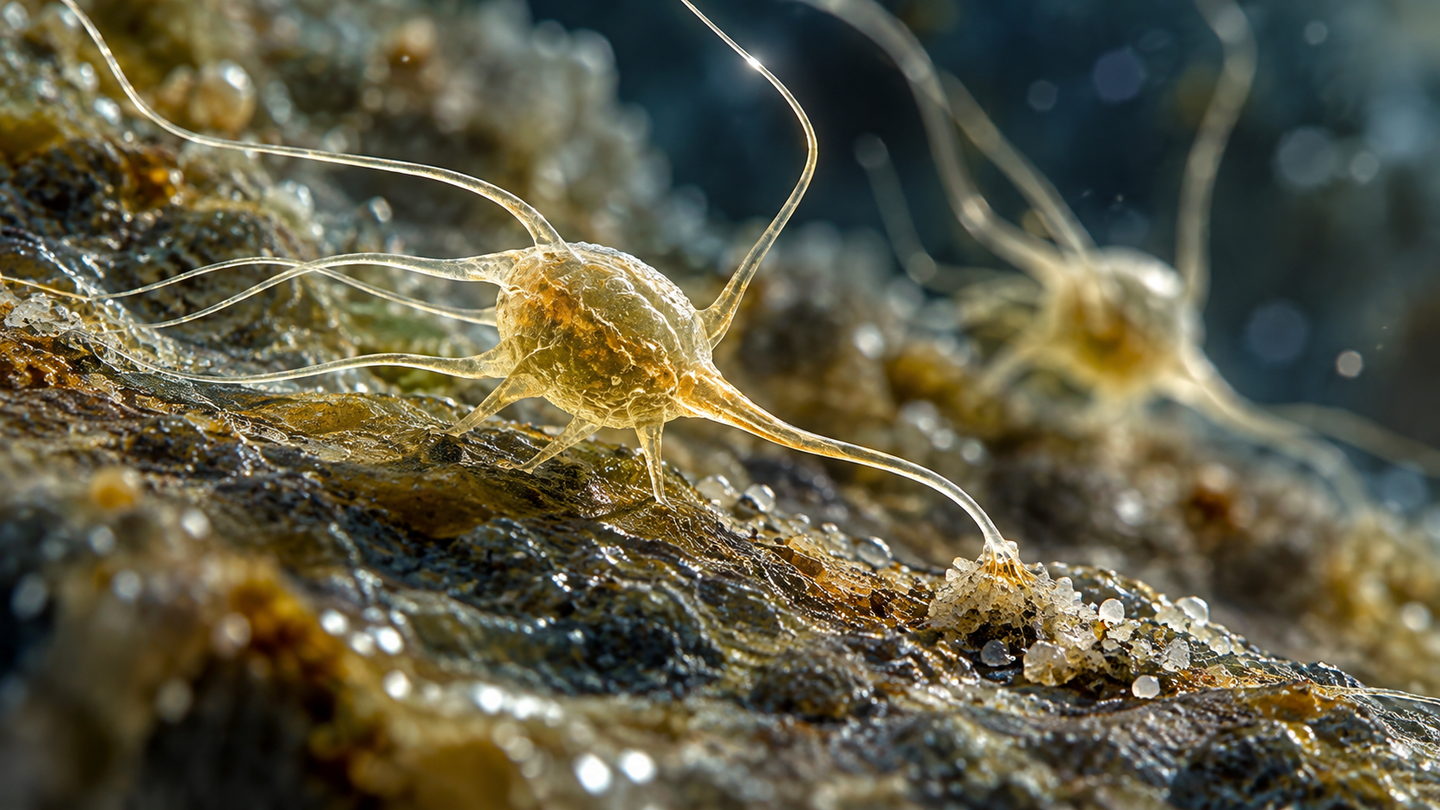
Researchers led by Ludwig-Maximilians-Universität München recreated these conditions using a methane-producing archaeon called Methanothermococcus okinawensis. Their findings, published in Science Advances, suggest that Enceladus’s unusual chemistry may help microorganisms overcome conditions previously considered major barriers to habitability.
The experiments do not demonstrate that microbes live on Enceladus. Instead, they test whether a metabolism already found on Earth could function there.
An ocean beneath an icy shell
Enceladus measures only about 500 kilometers across, yet evidence from NASA’s Cassini mission revealed a global ocean beneath its ice.
Jets erupting from fractures near the south pole carry water vapor and ice grains hundreds of kilometers into space. Cassini repeatedly sampled that material, effectively giving scientists access to ocean-derived chemistry without drilling through the frozen crust.
Those measurements revealed salts, organic compounds, methane and molecular hydrogen. Other observations point toward ongoing interactions between liquid water and Enceladus’s rocky core.
That combination is particularly interesting because similar water-rock reactions on Earth can produce hydrogen through processes associated with serpentinization. Some microorganisms can use that hydrogen as an energy source.
The moon’s ocean, however, presents a formidable complication. Estimates place its pH somewhere within an alkaline range, potentially approaching 11 or higher. At high pH, most dissolved inorganic carbon exists as bicarbonate and carbonate rather than freely available carbon dioxide.
Methanogens need carbon dioxide, creating what appeared to be a serious bottleneck.
Researchers recreated the seafloor chemistry
Vanessa Helmbrecht, William Orsi and colleagues built an Enceladus simulant intended to reproduce conditions near the rocky ocean floor.
The mixture contained high concentrations of dissolved inorganic carbon and powdered minerals chosen to resemble Enceladus’s proposed chondrite-like rocky core. Experiments were conducted without oxygen and tested environments between pH 9 and 11.
The researchers then introduced M. okinawensis, a heat-loving archaeon originally isolated from a hydrothermal vent in Japan’s Okinawa Trough.
Its metabolism is unusually simple in its requirements. The organism consumes molecular hydrogen while reducing carbon dioxide, generating methane and building cellular material.
In a conventional laboratory growth medium, the archaeon struggled as alkalinity increased. Growth declined sharply at pH 9 and 10 and disappeared entirely at pH 11.
Inside the Enceladus simulant, the outcome changed dramatically.
Water-rock reactions supplied the fuel
Chemical reactions between minerals and water generated substantial amounts of hydrogen inside the simulated environment.
The researchers measured hydrogen concentrations between roughly 166 and 281 micromolar in their abiotic simulations. When microbes were present, those concentrations dropped by about one-third, indicating that M. okinawensis was consuming the hydrogen.
Isotope experiments provided stronger evidence. When the researchers supplied carbon labeled with carbon-13, they detected carbon-13 in newly produced methane, demonstrating biological methanogenesis.
Methane production continued even at pH 11. In the conventional laboratory medium, comparable methane production had stopped by that point.
The result indicates that Enceladus-like water-rock chemistry can provide one of the fundamental ingredients required for hydrogen-consuming life: a continuing chemical energy source.
The experiments used higher iron concentrations than scientists expect in Enceladus’s actual hydrothermal fluids, allowing reactions to occur on laboratory time scales. The authors therefore caution that the measured hydrogen production rate should not be treated as a direct estimate for the moon.
An abundance of carbon solved another problem
Hydrogen alone could not explain why the microorganisms performed better in the simulated Enceladus environment.
The conventional growth medium actually contained more available hydrogen. Its weakness was carbon.
At extremely alkaline pH, free carbon dioxide becomes scarce because dissolved carbon shifts predominantly into bicarbonate and carbonate. Yet M. okinawensis needs CO2 to build biomass.
Enceladus may possess an unexpected solution. Its ocean is thought to contain unusually high concentrations of dissolved inorganic carbon.
The researchers gave their simulant about 10 times more dissolved inorganic carbon than the conventional medium. Even though only a tiny proportion remained as free CO2, the absolute amount available to cells was still substantially greater.
At pH 10 and 11, the Enceladus simulations produced one to two orders of magnitude more cells than conventional controls. At pH 11, cultures reached roughly 140,000 cells per milliliter despite showing no measurable growth in the comparison medium.
The microbes changed how they used carbon
Genetic activity revealed how the organisms responded to the extreme conditions.
At pH 11, M. okinawensis increased the activity of numerous genes involved in methanogenesis and the reductive acetyl-CoA pathway, a metabolic pathway used to capture carbon dioxide and convert it into cellular material.
The microbes appeared to intensify their carbon-harvesting machinery as free CO2 became increasingly scarce. Genes associated with sodium transport were also active, potentially helping cells generate energy when the shortage of hydrogen ions at high pH makes ordinary proton-based energy systems difficult to maintain.
“Our findings suggest that the chemistry of Enceladus itself can help overcome this major barrier to life,” Orsi said.
The result pushes the organism’s experimentally demonstrated growth range far beyond its previously reported upper limit of about pH 8.5.
Enceladus keeps gaining ingredients for habitability
The new work joins several discoveries that have steadily strengthened the scientific interest in Enceladus.
Cassini measurements have revealed molecular hydrogen capable of supplying chemical energy, methane, complex organic chemistry and phosphorus. In 2023, researchers reported phosphate concentrations in ocean-derived ice grains that could substantially exceed those found in Earth’s oceans.
More recent analysis of freshly ejected plume particles has expanded the list of organic compounds associated with the subsurface environment.
None of these discoveries constitutes evidence of life. Habitability means that an environment possesses conditions capable of supporting organisms, not that organisms actually inhabit it.
The new experiment narrows that distinction in an important way. Instead of simply identifying chemicals microbes might theoretically use, researchers showed that a living terrestrial organism can exploit a laboratory approximation of the same geochemistry.
A future spacecraft sampling Enceladus’s plumes could eventually look for molecular patterns that distinguish biological methane production from purely geological chemistry. Until then, the moon remains uninhabited as far as science can establish, but increasingly difficult to dismiss as inhospitable.
Dig deeper into Enceladus and its hidden ocean
These studies provide recent evidence about Enceladus’s organic chemistry, hydrothermal activity and potential ability to support microbial metabolism.
Detection of organic compounds in freshly ejected ice grains from Enceladus’s ocean: Analysis of Cassini measurements identified previously unseen organic fragments in fresh plume grains, expanding the known chemical diversity emerging directly from Enceladus’s subsurface ocean. (Nature Astronomy, 2025)
Seafloor hydrothermal control over ocean dynamics in Enceladus: Modeling explores how hydrothermal heating from Enceladus’s rocky core could influence ocean circulation and transport material from the seafloor toward the ice shell. (Nature Astronomy, 2025)
Detection of HCN and diverse redox chemistry in the plume of Enceladus: Reanalysis of Cassini data identified hydrogen cyanide and additional organic compounds while revealing chemical energy sources potentially available for metabolism. (Nature Astronomy, 2024)
Detection of phosphates originating from Enceladus’s ocean: Cassini ice-grain measurements provided the first detection of phosphorus in an extraterrestrial ocean and indicated unexpectedly abundant phosphate. (Nature, 2023)
Bayesian analysis of Enceladus’s plume data to assess methanogenesis: Statistical modeling found that Cassini’s hydrogen and methane observations are compatible with habitable hydrothermal conditions and microbial methanogenesis, while also allowing nonbiological explanations. (Nature Astronomy, 2021)
Research findings are available online in the journal Science Advances.
The original story "Scientists recreate Enceladus’s ocean and watch Earth microbes thrive" is published in The Brighter Side of News.
Related Stories
- Saturn's moon Enceladus offers new clues in the search for alien life
- Saturn’s icy moon Enceladus may make alien life easier to find than scientists thought
- Key building block for life found at Saturn’s moon Enceladus
Like these kind of feel good stories? Get The Brighter Side of News' newsletter.
Joseph Shavit
Writer, Editor-At-Large and Publisher
Joseph Shavit, based in Los Angeles, is a seasoned science journalist, editor and co-founder of The Brighter Side of News, where he transforms complex discoveries into clear, engaging stories for general readers. With vast experience at major media companies like The Los Angeles Times, Times Mirror and Tribune Publishing, he writes with both authority and curiosity. His writing focuses on space science, planetary science, quantum mechanics, geology. Known for linking breakthroughs to real-world markets, he highlights how research transitions into products and industries that shape daily life.