Scientists reshape light to control magnetic memory and a material’s magnetic properties
Shrinking and shaping laser beams changed how magnetic domains flipped, opening another route toward faster, denser data storage.
 UCSD Writer: Liezel Labios

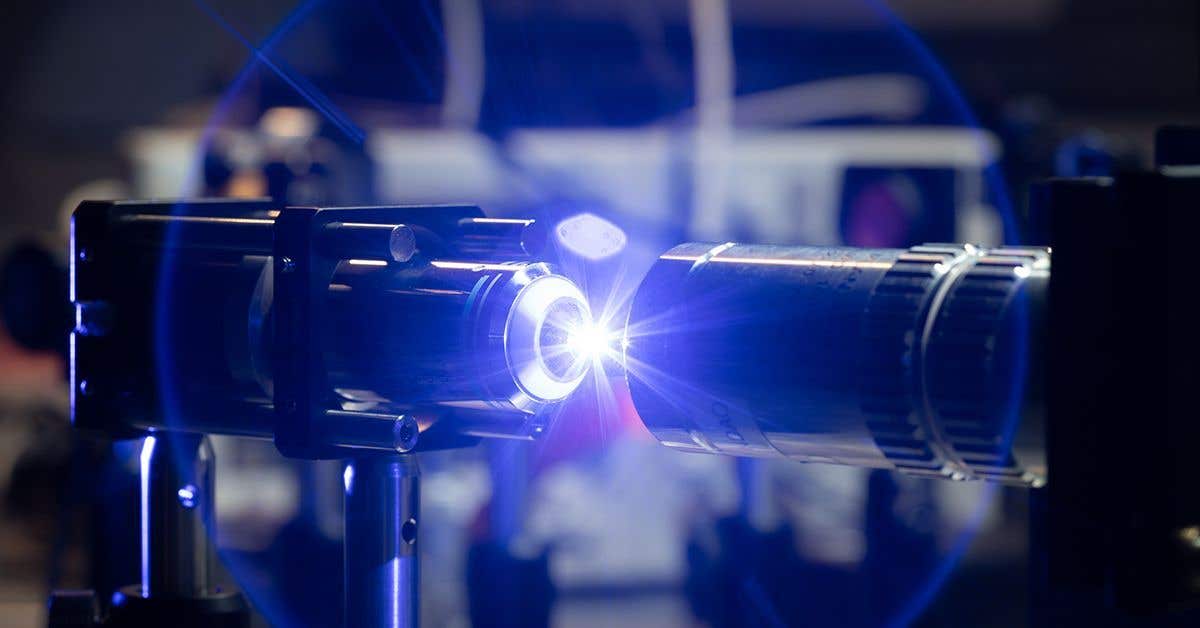
Using a specially engineered beam of light from an ultrafast laser, UC San Diego engineers demonstrate a new approach to switch magnetic information in materials without using an external magnetic field. (CREDIT: David Baillot/UC San Diego Jacobs School of Engineering)
- UC San Diego engineers showed that carefully shaped ultrafast laser beams can reverse magnetization in platinum-cobalt multilayers without an external magnetic field.
- Shrinking the laser spot changed the underlying switching behavior, allowing polarization-independent reversal in structures containing as many as nine Pt/Co repeats.
- The work could eventually support faster and denser magnetic storage, but it remains a laboratory demonstration using repeated femtosecond pulses rather than a finished memory device.
A magnetic bit normally changes state because a field pushes its orientation from one direction to another. UC San Diego researchers have shown that carefully engineered light can perform that job instead, even in magnetic films thicker than those used in earlier optical-switching experiments.
The team shaped ultrafast laser pulses into tightly focused vector beams and used them to reverse magnetization in platinum-cobalt multilayers without an external magnetic field. By shrinking the illuminated region and controlling how light was distributed across it, the researchers could switch between two optical-reversal mechanisms.
The work, published in Nature Communications, suggests that optical beam design itself can become a control knob for magnetic memory. That could eventually support faster and denser data storage, although the current setup remains a laboratory experiment.
Magnetic memory usually depends on fields
Magnetic storage represents information through tiny regions whose magnetization points in one of two stable directions. Changing that direction writes a new state, corresponding to a digital 0 or 1.
Ultrashort laser pulses offer another possibility. Light can deposit energy within femtoseconds and can be focused into microscopic areas. Researchers have therefore spent years investigating all-optical switching, in which magnetization is manipulated with light rather than an applied magnetic field.
Much of that work has depended on carefully chosen materials, precise compositions or circularly polarized light whose handedness determines the final magnetic state. Those requirements complicate efforts to turn the effect into a scalable technology.
The researchers redesigned the light
Instead of developing a new magnetic material, the UC San Diego team changed the optical beam. The researchers worked with thin films containing alternating layers of platinum and cobalt and tested structures with between one and 10 repeated Pt/Co bilayers.
Their key tool was a circularly polarized vector beam. Unlike a conventional Gaussian laser beam, this structured beam redistributes polarization across the focal region and can concentrate energy into a smaller area when tightly focused.
Using high-numerical-aperture microscope objectives, the team reduced the effective laser spot from about 1.92 micrometers to 0.96 micrometers in one set of experiments. Calculations showed that the vector beam could create a focal spot up to about 15% narrower than a comparable Gaussian beam under the same focusing conditions.
“We’ve optically engineered the light to change the physics that’s happening in the material at the micro- and nanoscale,” first author Muhammad Waleed Khalid said.
Shrinking the beam changed the switching physics
At larger spot sizes, the platinum-cobalt film behaved in the more familiar way. The final magnetic state depended on whether the incident light had right- or left-handed circular polarization.
That process, called all-optical helicity-dependent switching, develops over repeated pulses. Initial pulses heat the material and nucleate reversed domains, while later pulses favor the growth of one magnetic orientation.
When the researchers tightened the beam, that dependence began disappearing. In a three-repeat Pt/Co stack, magnetization became helicity independent once the effective spot reached about 1.36 micrometers or smaller.
Right- and left-circular vector beams then produced essentially the same final magnetic state. The geometry of the illumination, rather than the handedness of the light, had become the dominant factor.
The researchers attribute the change to intense local heating combined with dipolar magnetic fields from the surrounding unheated film. A smaller illuminated region is easier for those neighboring magnetic regions to stabilize after the laser pulse drives it close to the Curie temperature.
Thicker films could also be switched
Previous work with standalone Pt/Co multilayers faced an important thickness problem. As more magnetic layers were added, equilibrium domains became smaller and laser heating tended to leave complicated multidomain patterns rather than a single reliably reversed region.
Beam confinement changed that balance. With four Pt/Co repeats, helicity-independent switching appeared across all tested spot sizes. In samples containing five through nine repeats, deterministic reversal was retained when the light was focused near the wavelength scale.
That result matters because greater magnetic volume can improve thermal stability, helping stored information resist spontaneous changes over time. Beyond nine repeats, however, stripe-shaped domains prevented uniform reversal.
The experiment did not demonstrate a finished memory cell. The researchers scanned a femtosecond laser across thin-film samples and observed magnetic domains with a Faraday microscope. Their system used 120-femtosecond pulses at 800 nanometers and a repetition rate of 1 kilohertz.
Repeated pulses build the reversed region
The mechanism differs from single-shot optical switching demonstrated in some ferrimagnetic materials. In these Pt/Co films, deterministic reversal developed cumulatively through multiple pulses.
The first pulses heated a confined region and initiated a reversed magnetic domain. Continued illumination allowed that domain to grow and settle into a stable configuration.
That distinction matters when considering speed. Femtosecond light can trigger magnetization dynamics extremely rapidly, but this experiment did not demonstrate a storage device writing independent bits thousands of times faster than a commercial hard drive.
Its main advance is control. By adjusting beam size, focusing and polarization distribution, researchers changed which magnetic-switching pathway dominated without redesigning the material.
“Instead of designing a new material to enable optical switching, we redesigned the light itself and showed new properties that were not previously thought to be possible,” senior author Abdoulaye Ndao said.
A route toward optical magnetic memory
Several obstacles remain before optically written magnetic memory could move onto a chip. The laboratory system uses a specialized ultrafast laser and optical components that cannot simply be added to conventional storage electronics.
Researchers will need smaller integrated light sources, nanoscale optical structures and materials that switch reliably at lower energies. The team is also investigating ways to confine the light to only a few hundred nanometers.
The work nevertheless changes part of the design problem. If beam geometry can determine how magnetization reverses, future memory devices might be built by co-optimizing the magnetic stack and the light that writes to it.
That approach could eventually make magnetic storage faster and more compact without requiring entirely new magnetic materials.
Dig deeper into all-optical magnetic switching
These resources provide recent and directly relevant context on ultrafast magnetic control, optical memory and the path toward integrated devices.
Demonstration of on-chip all-optical switching of magnetization in integrated photonics: Demonstrates all-optical magnetization switching inside an integrated photonic platform, directly addressing the challenge of moving optical magnetic control toward chip-scale technology. (Nature Nanotechnology, 2026)
From ultrafast demagnetization to ultrafast Spintronics: a 30-year story: Reviews three decades of ultrafast magnetism and highlights routes toward hybrid photonic-spintronic memory devices and practical switching architectures. (Journal of Magnetism and Magnetic Materials, 2026)
Optically assisted ultrafast spintronics: A review: A comprehensive recent review covering all-optical switching in ferrimagnets, ferromagnets, multilayers, Heusler alloys and two-dimensional materials, with emphasis on memory and device applications. (Physics Reports, 2025)
All-Optical Switching: A Path to Recording Technology Beyond HAMR: Examines whether all-optical switching could succeed heat-assisted magnetic recording and discusses the materials and switching physics needed for future high-density storage. (IEEE Transactions on Magnetics, 2025)
Transient domain boundary drives ultrafast magnetisation reversal: Investigates the ultrafast domain dynamics underlying light-driven magnetic reversal, providing recent mechanistic context for how optical pulses reshape magnetic states. (Nature Communications, 2025)
Research findings are available online in the journal Nature Communications.
\The original story "Scientists reshape light to control magnetic memory and a material's magnetic properties" is published in The Brighter Side of News.
Related Stories
- Ultra-thin new material shields spacecraft from electromagnetic waves and radiation
- Time-varying magnetic fields can create exotic quantum matter
- Earth’s magnetic field is influencing how we age, study finds
Like these kind of feel good stories? Get The Brighter Side of News' newsletter.
Joshua Shavit
Writer and Editor
Joshua Shavit is a NorCal-based science and technology writer with a passion for exploring the breakthroughs shaping the future. As a co-founder of The Brighter Side of News, he focuses on positive and transformative advancements in technology, physics, engineering, robotics, and astronomy. Having published articles on AOL.com, MSN, Yahoo News, and Ground News, Joshua's work highlights the innovators behind the ideas, bringing readers closer to the people driving progress.