MIT’s tiny flying robot carries onboard sensors and computing for flight stabilization
A 1.29-gram robot flies with onboard sensing and computing, but still needs external power; its flower landing was human-guided.
 Massachusetts Institute of Technology Writer: Abby Abazorius

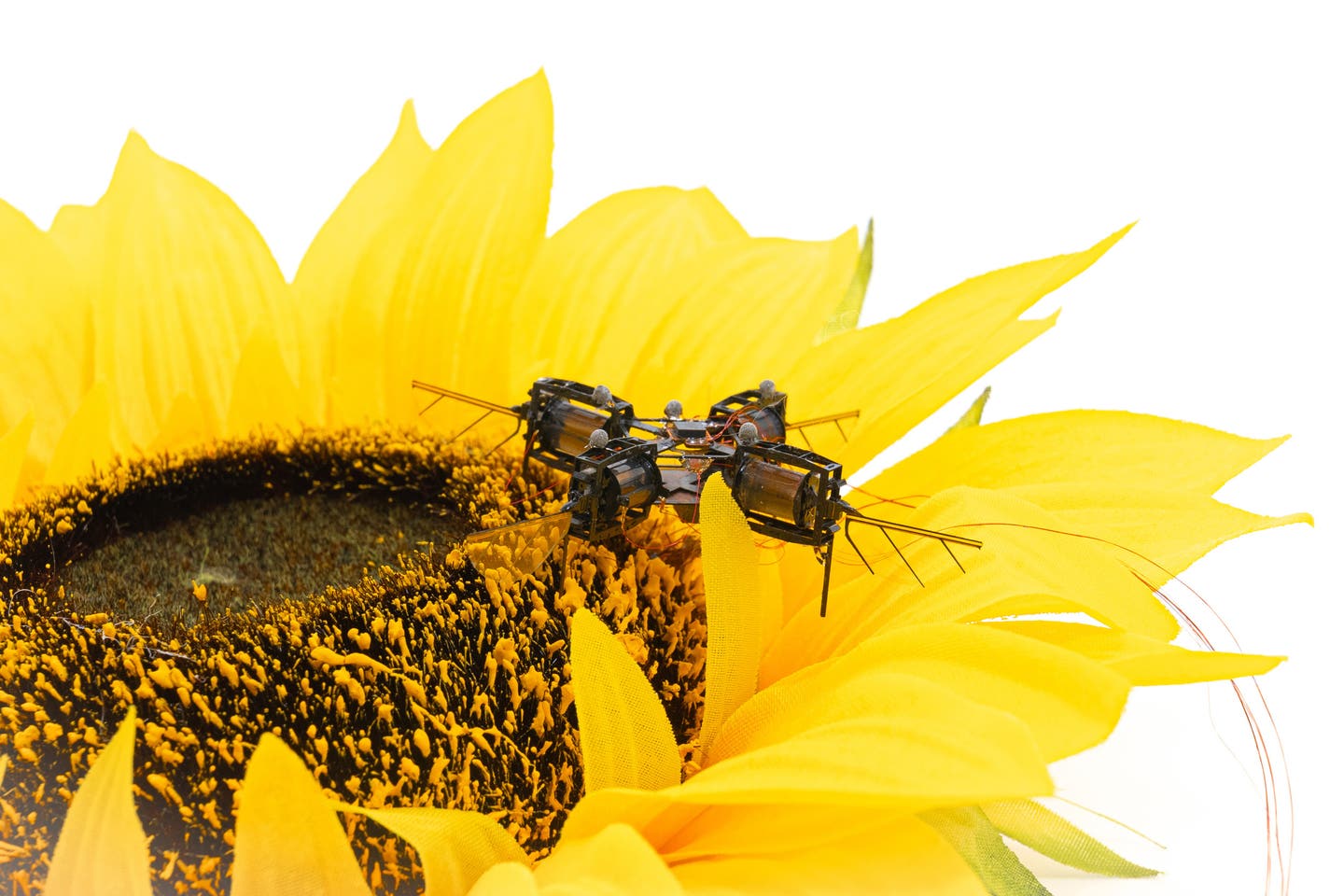
A flapping-wing microrobot demonstrated onboard flight control, while a separate human-guided sunflower landing used offboard computation. (CREDIT: MIT)
A flying robot weighing 1.29 grams can carry the sensors and computer needed to stabilize its own flight. Separate hovering and trajectory tests demonstrated onboard computation, while a human-guided demonstration ended with a sunflower landing outside a motion-capture arena. Together, the results address a major barrier for aerial microrobots, although power still arrives through wires.
The study appeared in Science Robotics. Researchers at the Massachusetts Institute of Technology, working with Cornell University, redesigned flight hardware and electronics together. That approach tackles the difficulty of giving tiny flying robots useful sensing without adding more weight than their wings can support.
Stronger artificial muscles make room for electronics
The robot has four flapping-wing modules, each powered by a dielectric elastomer actuator, a soft artificial muscle that deforms electrically. These modules generate lift through rapid wing motion. Expanding them required balancing extra mass against useful output, a challenge distinct from simply making a larger version of an insect-inspired aircraft.
The team increased actuator length from four to six millimeters and adjusted the transmission mechanism. Operating at 330 wingbeats per second, each redesigned module increased its net lift by 46 percent. The result helped accommodate electronics without abandoning the lightweight design that distinguishes small aerial vehicles.
The aircraft weighed approximately 1.05 grams before adding the complete flight-electronics package. That package contributed 244 milligrams, bringing total mass to about 1.29 grams. With it installed, the robot achieved a maximum lift-to-weight ratio of 1.9, meaning its maximum lift exceeded its weight by a substantial margin.
That margin matters because hovering requires enough lift to balance weight, while maneuvering demands additional control authority. A robot that barely supports its electronics may struggle to correct disturbances. Designing the flight muscles and sensor package together helped preserve that capacity rather than treating sensing as an afterthought.
Three sensors replace external position feedback
An inertial measurement unit measures acceleration and rotation, supporting estimates of body orientation. An optical-flow sensor tracks movement of the surface below to estimate lateral velocity. A time-of-flight sensor measures distance downward, providing height information, combining complementary measurements for robot navigation.
The individual sensors weigh approximately 14, 90 and 13 milligrams, respectively. A dual-core microcontroller weighing seven milligrams performs computation in the fully onboard configuration. Circuit boards, supports and other components bring the entire package above the sum of those devices, illustrating the integration challenge faced by miniature robots.
The sensors do not directly supply an absolute position in the room. Instead, estimation algorithms combine measurements to infer orientation, motion and location over time. Small errors can accumulate into drift, so the team optimized sensor selection and calculations to keep those errors manageable during short flights.
The researchers found that frequent, simplified estimates could outperform slower, more elaborate calculations. Their onboard feedback controller updated 480 times per second. Mounting the electronics on a fiberglass substrate also helped reduce vibration-related problems, because even a suitable sensor can produce poor measurements if the structure around it shakes excessively.
Onboard flight tests establish a specific capability
The study separated tests using onboard sensing with offboard computation from tests that also moved computation onto the aircraft. This distinction matters: carrying sensors alone does not eliminate dependence on an external computer. The fully onboard configuration demonstrates another step toward independent flight control.
With the microcontroller installed, the robot hovered for 10 seconds at a commanded height of 7.5 centimeters. Its lateral root-mean-square tracking error was 2.17 centimeters, while altitude error was 0.32 centimeters. Root-mean-square error summarizes deviations across the flight, rather than identifying the largest momentary error, an important distinction when assessing drone performance.
A second onboard-computation test followed two commanded positions separated by 30 centimeters over seven seconds. Lateral error was 2.21 centimeters, with altitude error of 0.57 centimeters. External motion-capture cameras recorded these flights for later evaluation; their measurements did not provide the onboard controller’s feedback.
Other experiments used an external computer to process onboard sensor measurements. These included hovering at different heights, point-to-point movement and curved trajectories. Their errors ranged from a few centimeters upward depending on the maneuver, so the results do not establish identical precision across every path, speed or computing configuration.
The offboard-computation hovering tests also illustrate how altitude affects sensing. At five centimeters above ground, lateral tracking error was 3.24 centimeters over 12 seconds. At ten centimeters, it rose to 3.65 centimeters, while altitude error remained around a quarter of a centimeter. These measurements show that vertical and horizontal accuracy can differ substantially.
Curved flights added another comparison: a figure-eight maneuver produced a positional error of 2.19 centimeters, versus 6.09 centimeters for a faster circular maneuver. A single accuracy number therefore cannot summarize every tested behavior. Keeping the path, duration and computing arrangement beside each result helps explain what the system has actually demonstrated.
The sunflower landing still had a human guide
For the flower demonstration, an operator used a joystick to send high-level position commands. The robot used onboard sensing while computation remained offboard. This arrangement allowed flight beyond the motion-capture arena without demonstrating fully independent route planning.
During a 30-second experiment, the robot followed a route of about 1.2 meters, passed around an obstacle and approached a sunflower. It descended until its downward sensor indicated roughly one centimeter of clearance, then stopped its wings to settle. The sequence demonstrates controlled approach and landing relevant to future artificial pollination.
It does not demonstrate that the robot identified the flower, detected obstacles independently or transferred pollen successfully. Those are separate capabilities. A human supplied the navigation decisions, while the sensing and control system handled lower-level flight corrections needed to execute the commands.
MIT graduate students Yi-Hsuan Hsiao, Quang Phuc Kieu and Zhongtao Guan share lead authorship. Kevin Chen, an MIT electrical engineering and computer science associate professor, co-supervised the work with MIT aeronautics professor Jonathan How and Cornell assistant professor Elizabeth Farrell Helbling. The collaboration spans flight mechanics, sensing and control rather than treating autonomy as a single component.
Power autonomy remains a larger challenge
At demanding settings, the flight electronics consumed 120 milliwatts, roughly 6 percent of the approximately two watts required by the actuators. The wings and artificial muscles therefore dominate the power budget. Efficient computation helps, but it does not remove the energy demands facing flying robots.
The controller used roughly one-quarter of one microcontroller core’s computational capacity, leaving room to explore additional functions. Researchers want to add a camera for object recognition and obstacle avoidance, alongside onboard batteries and power electronics. These remain development goals for autonomous navigation, rather than tested outdoor capabilities.
The wires themselves can disturb flight, and integrating their power supply onboard would add weight. Future work must balance that payload with lift, endurance and useful sensing. The present result establishes short-duration flight with onboard sensing and computation; independent, untethered operation around real crops is the next substantially broader test.
Dig deeper into insect-scale robotic flight
These studies trace advances in flight mechanics, compact control and onboard power.
- Aerobatic maneuvers in insect-scale flapping-wing aerial robots via deep-learned robust tube model predictive control: This work develops high-rate control for agile maneuvers, providing context for the flight capabilities that onboard sensing must support. (Science Advances, December 2025)
- Acrobatics at the insect scale: A durable, precise, and agile micro–aerial robot: Earlier flapping-wing experiments examine endurance, precision and agility, while leaving sensing and power autonomy as subsequent challenges. (Science Robotics, January 2025)
- Insect-inspired AI for autonomous robots: This review explores resource-efficient approaches to autonomy, including the mass and power constraints that become especially important in small robots. (Science Robotics, June 2022)
- Untethered flight of an insect-sized flapping-wing microscale aerial vehicle: A light-powered aircraft demonstrates untethered flight, illustrating why removing a power wire differs from achieving onboard sensing and navigation. (Nature, June 2019)
- Controlled flight of a biologically inspired, insect-scale robot: This foundational robotic-insect study demonstrates controlled flight and establishes context for later efforts to move sensing and computation onboard. (Science, May 2013)
Research findings are available online in the journal Science Robotics.
The original story "MIT’s tiny flying robot carries onboard sensors and computing for flight stabilization" is published in The Brighter Side of News.
Related Stories
- Bird-inspired robot swims, plunges, and flies using flapping wings
- Bee-inspired navigation system lets tiny robots fly without GPS
- Tiny flapping drone matches insect speed with an AI brain
Like these kind of feel good stories? Get The Brighter Side of News' newsletter.
Shy Cohen
Writer