Six-million-year-old whale fossil reveals an extraordinarily lopsided face
The newly described Scaphokogia huachafo had an unusually crooked skull and a heavy, downward-pointing snout, supporting a proposed seafloor-feeding lifestyle.
 University of Zurich Writer: Melanie Nyfeler

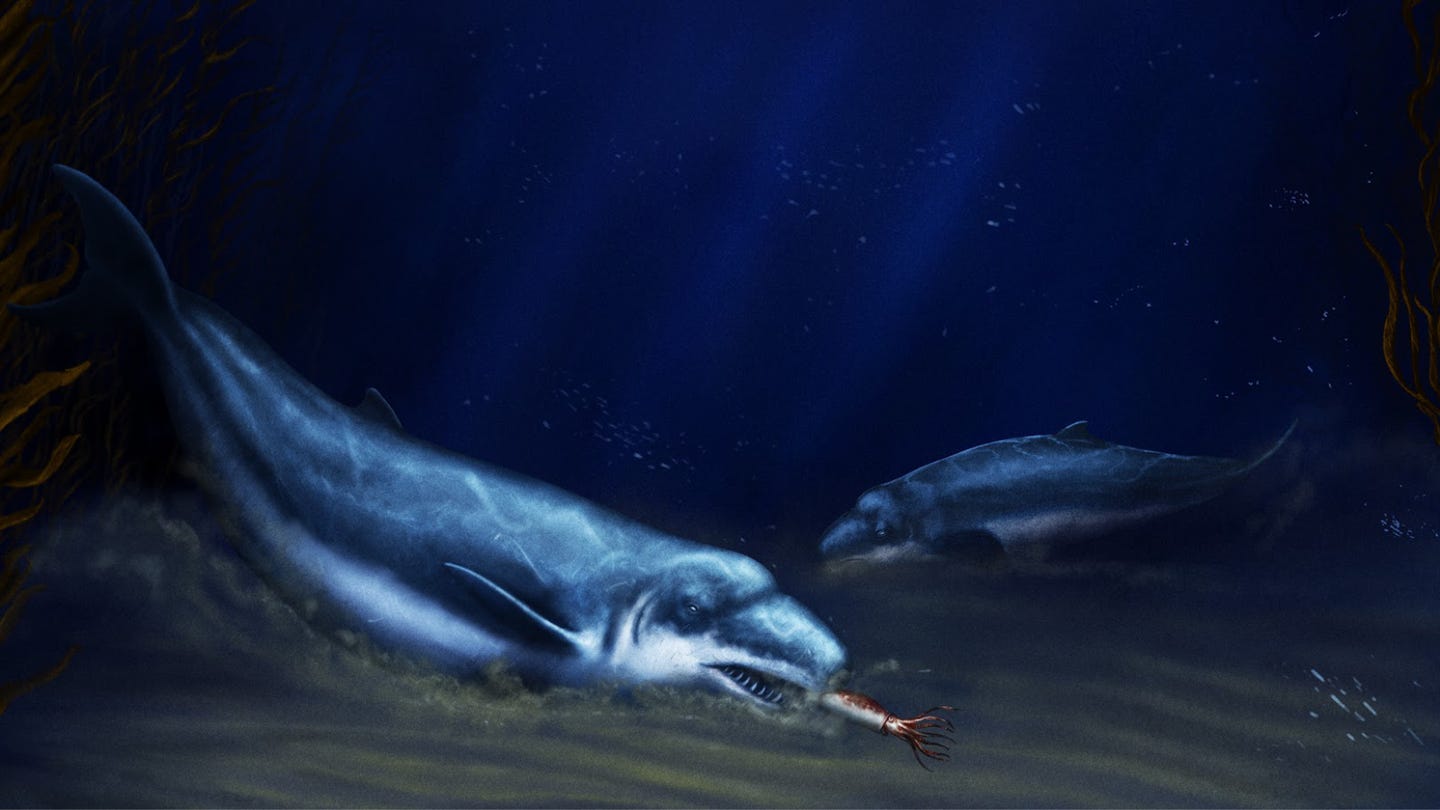
An illustration shows how the unusual skull and neck anatomy of Scaphokogia huachafo, an extinct relative of modern pygmy sperm whales, positioned its snout toward the seafloor, suggesting an adaptation for feeding near the ocean bottom. (CREDIT: Jaime Bran Sarmiento)
- Researchers described Scaphokogia huachafo, an extinct pygmy sperm whale with both bony nostril openings displaced entirely to the skull’s left side.
- Its dense, downward-pointing snout and reconstructed neck articulation support a proposed seafloor-feeding lifestyle in coastal waters.
- The study identifies extreme asymmetry in the genus, while its precise sonar capabilities and feeding behavior remain inferred from anatomy.
A whale skull from southern Peru looks so crooked that crushing after burial would seem a reasonable explanation. Its facial bones differ dramatically in size and position, and both bony nostril openings sit left of the midline. Researchers conclude that this remarkable arrangement belonged to the living animal.
The fossil represents a newly described pygmy sperm whale, Scaphokogia huachafo, that lived between 6.3 million and 5.6 million years ago. Its estimated length was about 2.7 meters, or nine feet. The study, published in Communications Biology, explores how its unusual head might have supported life near the seabed.
Lead author Aldo Benites-Palomino studied the specimen during his doctorate at the University of Zurich. He is now an assistant professor at Friedrich-Alexander-Universität Erlangen-Nürnberg. The lopsided whale adds another distinctive feeding specialization to the diversity revealed by ancient whales.
Toothed whales already depart from the balanced skulls familiar in most mammals. Their facial architecture supports organs involved in producing sound and finding prey through echoes. Modern sperm whale clicks demonstrate the importance of sound in these animals, although their recordings cannot reveal exactly how this extinct relative sounded.
A lopsided whale hiding in a museum collection
The skull was collected in the mid-1990s from deposits in the Sacaco basin of southern Peru. Its fossil-bearing horizon records a shallow marine setting during the Late Miocene. Today, the region’s desert exposures preserve evidence of coastal ecosystems whose inhabitants differed substantially from the marine mammals living offshore now.
Benites-Palomino encountered the specimen in 2015 while working on his undergraduate thesis at Lima’s Museo de Historia Natural. The fossil, cataloged as MUSM 972, preserves most of an adult skull. Fully closed cranial sutures and well-ossified bones indicate that the animal had finished growing, rather than representing an unusual juvenile stage.
Distinguishing original anatomy from later damage is essential when interpreting fossil skulls. Sediment pressure can flatten or twist bones, producing misleading shapes. Here, the researchers found no corresponding deformation elsewhere that could explain the arrangement. “The skull looks completely crooked,” Benites-Palomino said, describing the animal’s genuine asymmetry.
Its species name reflects that appearance. In Peruvian Spanish, huachafo can describe something extravagant, bizarre or over-the-top. The name captures a face whose differences are structural, not merely superficial. As with other discoveries emerging from museum collections, recognizing its significance required detailed comparison rather than a recent excavation.
Uneven bones expand the limits of whale anatomy
The asymmetry extends beyond the nostril openings. Bones around the forehead differ in their size, extent and arrangement, including the paired premaxillae near the front of the skull. The right side expands much farther backward than the left. A deep basin above the face would have supported enlarged nasal structures.
In living toothed whales, fatty forehead tissues and associated structures contribute to sound production and transmission. That connection helps researchers interpret the fossil, but soft tissues themselves rarely survive millions of years. Attachment areas and surrounding bones suggest a specialized system without preserving its exact dimensions or acoustic performance.
Researchers used three-dimensional shape comparisons to place the fossil among sperm whales and other toothed cetaceans. This quantitative approach examines coordinated differences across the skull. Comparable skull reconstructions illustrate why anatomy can reveal functional possibilities while still leaving questions about tissues that have disappeared.
The record claim needs qualification. The analyses identify Scaphokogia as the most asymmetric cetacean genus in their sample. Although S. huachafo occupies an extreme position overall, a comparison restricted to the paired premaxillary bones placed S. totajpe farther out. These distinctions matter when comparing the sensory adaptations of different marine mammals.
A heavy snout permanently pointed downward
The lopsided whale also had a thick, tubular snout built from unusually dense bone and reinforced by ossified cartilage. Its mass likely shifted the center of gravity forward. The researchers interpret that construction as potential ballast, helping the animal control its position while moving close above the bottom.
The snout angles downward by about 31 degrees relative to the main skull axis. Other members of Scaphokogia show smaller downward angles, indicating that this feature belongs to a broader anatomical pattern within the genus. The new species combines it with a particularly robust, enlarged snout.
To investigate movement, the team used another Scaphokogia specimen, MUSM 171, that preserves the atlas, the first neck vertebra. Reconstructions placed the snout at downward angles of roughly 22 to 55 degrees relative to the body axis. Those figures describe reconstructed orientations, not 55 degrees of neck bending in the newly named species.
“The entire cranio-cervical complex is modified to point the snout directly toward the bottom,” said co-author Gabriel Aguirre-Fernández. Its uneven joint surfaces also suggest a curved movement path. Unlike feeding documented in living orcas or behavior inferred from ancient predators, this interpretation rests on reconstructed mechanical possibilities.
A possible sonar-assisted search for bottom-dwelling prey
Taken together, the heavy snout, downward orientation and neck articulation support a benthic-foraging hypothesis. Benthic means associated with the seabed. Rather than pursuing squid through deep open water like living sperm whales, Scaphokogia may have searched for prey in soft sediments beneath relatively shallow coastal seas.
The researchers propose that its unusual sound-producing anatomy helped with that search. Other bottom-feeding marine mammals use sensory whiskers or specialized visual features, whereas comparable adaptations are not evident here. An echolocation system aimed toward the substrate could offer an alternative way to locate food, though the study does not directly demonstrate it.
Living dolphin senses show that underwater prey detection can involve multiple mechanisms. The fossil cannot establish its exact prey, click frequencies or detection range. Nor can head shape alone reveal whether it swept sediment, hovered above it or combined several ways of obtaining food.
The setting nevertheless makes the interpretation plausible. Late Miocene coastal communities included several specialized bottom-feeding mammals and abundant benthic invertebrates. Fossils also reveal the importance of seafloor ecosystems. The paper places the eventual restructuring of these regional marine communities in the Pliocene, rather than pinpointing this species’ extinction at the Miocene boundary.
Practical implications for reconstructing extinct oceans
The discovery broadens the anatomical range researchers must consider when reconstructing whale evolution. Living species preserve only part of that history. An extinct pygmy sperm whale could combine sonar-related structures with a heavy bottom-oriented head, producing a specialization without a direct equivalent among living toothed whales.
Future comparisons can examine whether similar skull arrangements repeatedly accompany proposed bottom feeding. Additional fossils preserving neck vertebrae could refine the movement reconstruction. Studies of whale fossils and marine giants likewise show how scattered remains contribute different pieces of ancient ecological history.
For now, S. huachafo offers unusually strong evidence of an unusual body plan, with a more tentative explanation of its behavior. Its crooked face was a biological feature, not damage to be corrected. Understanding that distinction turns a strange-looking fossil into a useful test of how far whale evolution could depart from symmetry.
Dig deeper into whale skulls and feeding evolution
These studies provide background on skull asymmetry, dense bones and earlier pygmy sperm whale discoveries. They exclude the featured paper and appear newest first.
A heavyweight early whale pushes the boundaries of vertebrate morphology
The description of Perucetus colossus examines extreme bone-mass increase in an early whale, providing a comparison for aquatic skeletal specialization. (Nature, August 2023)
The ontogeny of asymmetry in echolocating whales
Three-dimensional comparisons track how skull asymmetry develops before and after birth in several living toothed-whale groups. (Proceedings of the Royal Society B, August 2022)
Nasal compartmentalization in Kogiidae (Cetacea, Physeteroidea): insights from a new late Miocene dwarf sperm whale from the Pisco Formation
An earlier Peruvian fossil reveals variation in the skull compartments associated with sound-producing organs in pygmy and dwarf sperm whales. (Papers in Palaeontology, February 2021)
Wonky whales: the evolution of cranial asymmetry in cetaceans
Researchers compare living and extinct whales to investigate the evolutionary distribution of asymmetric skull features. (BMC Biology, July 2020)
Scaphokogia totajpe, sp. nov., a new bulky-faced pygmy sperm whale (Kogiidae) from the late Miocene of Peru
This description of another species in the genus documents an earlier view of its unusual skull construction and evolutionary relationships. (Journal of Vertebrate Paleontology, April 2020)
Research findings are available online in the journal Communications Biology.
The original story "Six-million-year-old whale fossil reveals an extraordinarily lopsided face" is published in The Brighter Side of News.
Related Stories
- Bowhead whales may hold the key to humans living up to 200 years
- Indigenous communities in southern Brazil hunted large whales 5,000 years ago
- Humpback whales are making a major comeback – here’s why
Like these kind of feel good stories? Get The Brighter Side of News' newsletter.
Hannah Shavit-Weiner
Medical & Health Writer
Hannah Shavit-Weiner is a Los Angeles–based medical and health journalist for The Brighter Side of News, an online publication focused on uplifting, transformative stories from around the globe. Having published articles on AOL.com, MSN and Yahoo News, Hannah covers a broad spectrum of topics—from medical breakthroughs and health information to animal science. With a talent for making complex science clear and compelling, she connects readers to the advancements shaping a brighter, more hopeful future.