X-ray warning signs offer advance notice of black hole jet ejections
Archived observations of four binaries reveal X-ray changes before radio flares, offering a possible way to coordinate observations of black hole jet launches.
 University of Toyama Writer: Yumiko Kato

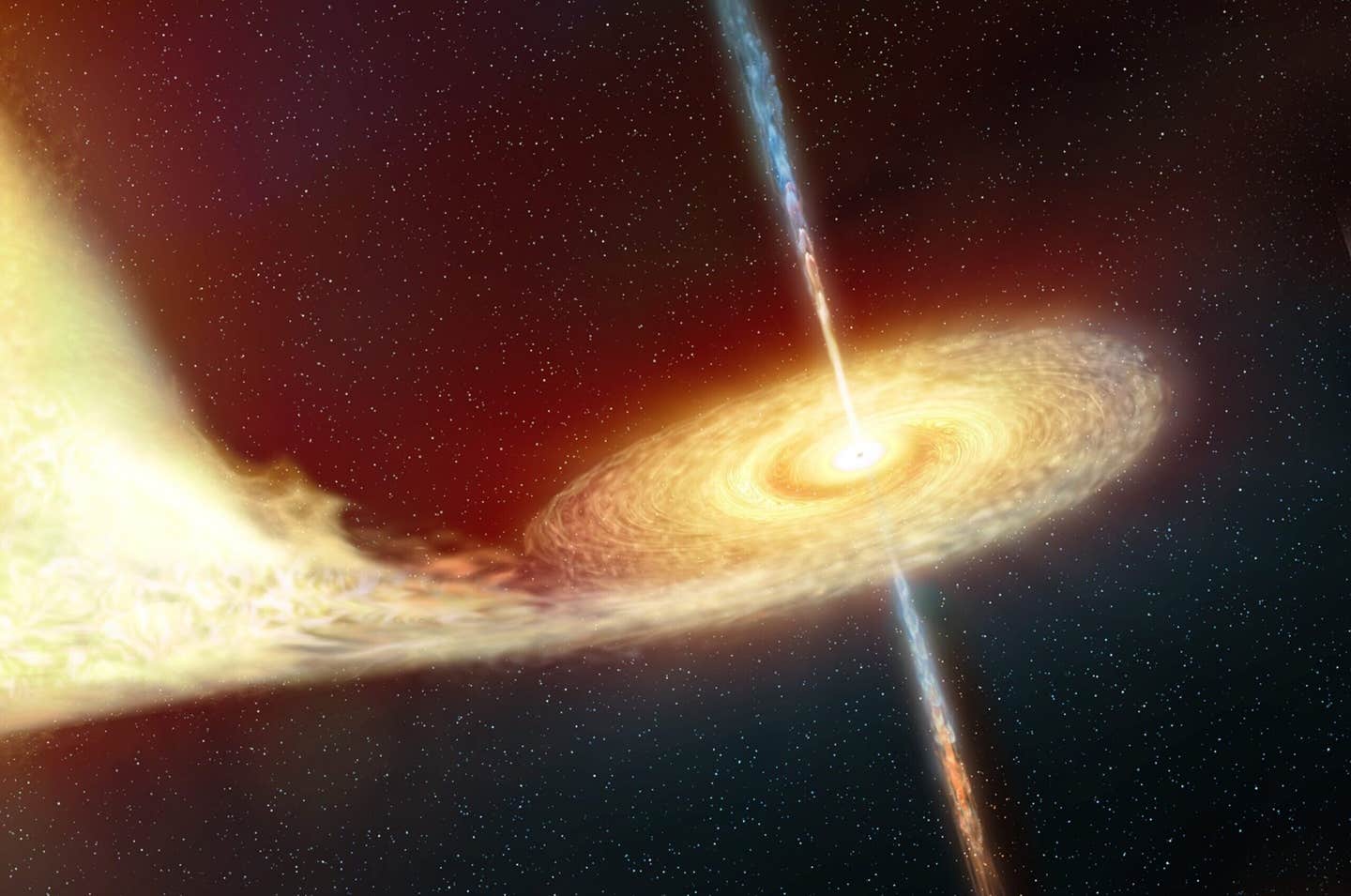
An illustration depicts a black hole pulling matter from a nearby companion star into a swirling accretion disk, a process that can sometimes produce powerful jets of material whose triggering mechanisms remain poorly understood. (CREDIT: Юрий Д.К., Wikimedia Commons)
- Archived observations of four black hole binary systems show shrinking inner disk radii and declining X-ray variability before radio flares.
- The changes began roughly one to ten days before radio activity, suggesting a possible way to schedule observations of jet ejections.
- The proposed forecasting approach still needs prospective testing, and the findings do not establish a universal jet-launching mechanism.
Black holes can launch streams of particles at speeds approaching that of light, but catching the start of an ejection remains difficult. Telescopes often arrive after the crucial changes have occurred. Researchers in Japan have identified a combination of X-ray signals that might help astronomers prepare before the next event.
The study, published in The Astrophysical Journal, examines four black hole binary systems. Toshihiro Kawaguchi of the University of Toyama and Kazutaka Yamaoka of Nagoya University compared changes in hot gas near the black holes with radio activity associated with discrete jet ejections.
Their proposed warning combines a shrinking inner edge of the accretion disk with less erratic X-ray emission. These changes appeared roughly one to ten days before radio activity. The result offers a possible route to anticipating black hole jets, rather than a forecasting service already demonstrated in real time.
The distinction matters because identifying patterns in past events is only the first step toward reliable predictions. The researchers want to turn those patterns into alerts that concentrate observing time around a likely ejection. Studying jet power requires coordinated measurements, and the opening moments can be especially informative.
A shrinking disk edge may signal black hole jets
In these binaries, a black hole draws gas from a companion star. The gas forms a hot accretion disk as it spirals inward, producing X-rays. Jets emerge from the surrounding environment, not from inside the event horizon. The study focuses on discrete, transient ejections associated with changes in X-ray state, rather than continuously replenished compact jets.
The key quantity is the disk’s inferred inner radius, written as Rᵢₙ. Researchers estimate it by fitting models to the X-ray spectrum, rather than directly photographing the disk edge. Its value depends on assumptions about the system, including distance, viewing angle and black hole mass, as well as the radiation model.
That makes the analysis part of a broader effort to understand accretion disks. The relevant reference point is the innermost stable circular orbit, or ISCO. Inside that boundary, circular orbits become unstable. Its location depends on the black hole’s properties, including spin, and is distinct from the event horizon.
Earlier work on XTE J1859+226 suggested that ejections occurred as the disk edge rapidly approached this inner limit. Simply remaining at a small radius was not enough. The changing geometry appeared important, adding a measurable precursor to studies of jet formation, whose physical explanation remains unsettled.
Four systems show related changes before radio flares
The new analysis combined the earlier XTE J1859+226 results with archived observations of XTE J1550−564, GX 339−4 and MAXI J1820+070. The team used X-ray measurements from RXTE, MAXI and NICER, alongside published radio observations. These records allowed comparisons across separate outbursts and instruments.
For XTE J1550−564, the inferred disk radius began shrinking rapidly about ten days before the radio peak. Its X-ray variability declined closer to the event. In GX 339−4, both quantities started falling about ten days beforehand. MAXI J1820+070 showed the decreases around two days before its radio peak.
XTE J1859+226 displayed related changes one to two days ahead of its ejections. Together, these examples suggest a recurring sequence, though not an identical countdown. Radio brightness can peak after material launches, so the intervals measured relative to radio activity should not be treated as exact advance notice of every launch.
Connecting X-ray behavior with radio observations helps trace different parts of an outburst. The former probes conditions close to the black hole, while radio emission can reveal expelled material. Better timing and sharper telescope views could make that connection more precise.
Less flickering does not mean less overall brightness
The second warning sign concerns fractional X-ray variability: how strongly the emission fluctuates compared with its average level. A decline means a smoother signal, not necessarily a fainter source. A relatively steady disk and a more variable hot component can contribute different proportions of the observed radiation.
In two systems, the relationship between radius and variability followed a curved pattern. The radius could begin decreasing before the variability showed a strong decline. Later, both fell together. This gives the disk radius potential value as an earlier indication that astronomers should start watching more closely.
The study also explains why variability alone may be ambiguous. Once the disk edge stays near its minimum radius, different variability levels can occur. No single variability threshold reliably defines an imminent ejection. The proposed approach therefore tracks an evolving combination, rather than labeling every quiet X-ray signal a warning.
Other research into X-ray bursts and black hole simulations underscores how many processes shape the radiation. The present findings identify a candidate observational pattern. They do not establish that moving the disk edge alone physically causes a jet, or explain the magnetic structures that accelerate particles.
Jet ejections did not require a sudden feeding surge
The researchers also estimated how rapidly gas moved inward. Across all four systems, they found no huge jump immediately before jet activity. XTE J1859+226 showed hints of smaller changes, but the available data were insufficient to evaluate them reliably. An absence of a large surge does not mean the flow was perfectly constant.
Two systems, XTE J1859+226 and MAXI J1820+070, produced ejections at estimated sub-Eddington rates. The Eddington luminosity describes a balance between radiation’s outward force and gravity under idealized assumptions. Converting it into an accretion-rate benchmark requires an assumption about how efficiently infalling matter produces radiation.
These results challenge explanations requiring an abrupt accretion increase or above-Eddington flow for the studied ejections. They do not eliminate every model involving rapid accretion. Rates in the other two systems remained uncertain, and different kinds of sources may reach jets through different conditions.
The role of spin also remains open. Spacetime drag and magnetic fields belong to broader jet physics. Testing many more binaries could reveal whether systems sometimes meet the proposed disk conditions without launching detectable jets, and whether black hole properties explain those exceptions.
Practical implications for a future jet forecast
The proposed workflow monitors the disk radius and variability, then circulates an alert when both keep decreasing and the radius approaches its inferred minimum. Astronomers could estimate an arrival time from the shrinking rate. In favorable cases, that might leave hours to days to decide whether to trigger observations.
“The development of a ‘jet forecast’ would enable us to concentrate observing facilities on the expected timing of jet ejections, thereby accelerating our understanding of jet physics,” Kawaguchi said. Coordinating jet observations across wavelengths would help capture both the changing inflow and emerging outflow.
Success will require frequent measurements, reliable spectral estimates and tests that count false alarms and missed ejections. Cooler disks may be harder to measure accurately, limiting transfer to some larger black holes. Future monitoring must show when the warning works, complementing studies of expanding jets with observations of their beginnings.
The immediate advance is therefore a candidate trigger for closer attention. If future observations confirm its usefulness, astronomers could collect the evidence needed to explain why some inward-moving disks produce jets and others do not.
Dig deeper into black hole disks and jet ejections
These studies provide the observational and theoretical background for the proposed forecast. They exclude the featured paper and appear newest first.
X-ray spectral and timing properties of the black hole binary XTE J1859+226 and their relation to jets
The team’s earlier analysis connects repeated ejections with changes in the inferred inner disk radius, X-ray spectrum and variability. (Publications of the Astronomical Society of Japan, February 2025)
A Rapid Change in X-Ray Variability and a Jet Ejection in the Black Hole Transient MAXI J1820+070
Coordinated X-ray and radio observations link a rapid timing transition with an ejection during an outburst. (The Astrophysical Journal Letters, March 2020)
An extremely powerful long-lived superluminal ejection from the black hole MAXI J1820+070
Radio measurements connect an isolated flare with bipolar relativistic ejecta and track their motion after launch. (Nature Astronomy, March 2020)
Jets from black hole X-ray binaries: testing, refining and extending empirical models for the coupling to X-rays
A broader sample tests relationships between radio ejections, X-ray spectral states and variability, providing context for older warning criteria. (Monthly Notices of the Royal Astronomical Society, June 2009)
Towards a unified model for black hole X-ray binary jets
This foundational model links different types of jet activity with changing accretion states in stellar-mass black hole binaries. (Monthly Notices of the Royal Astronomical Society, December 2004)
Research findings are available online in the journal The Astrophysical Journal.
The original story "X-ray warning signs offer advance notice of black hole jet ejections" is published in The Brighter Side of News.
Related Stories
- Scientists find evidence of a solar storm near a supermassive black hole
- Astronomers watch a supermassive black hole X-ray flare ignite an ultra-fast galactic wind
- Astronomers spot a black hole ripping apart a star outside a galaxy’s center
Like these kind of feel good stories? Get The Brighter Side of News' newsletter.
Joseph Shavit
Writer, Editor-At-Large and Publisher
Joseph Shavit, based in Los Angeles, is a seasoned science journalist, editor and co-founder of The Brighter Side of News, where he transforms complex discoveries into clear, engaging stories for general readers. With vast experience at major media companies like The Los Angeles Times, Times Mirror and Tribune Publishing, he writes with both authority and curiosity. His writing focuses on space science, planetary science, quantum mechanics, geology. Known for linking breakthroughs to real-world markets, he highlights how research transitions into products and industries that shape daily life.