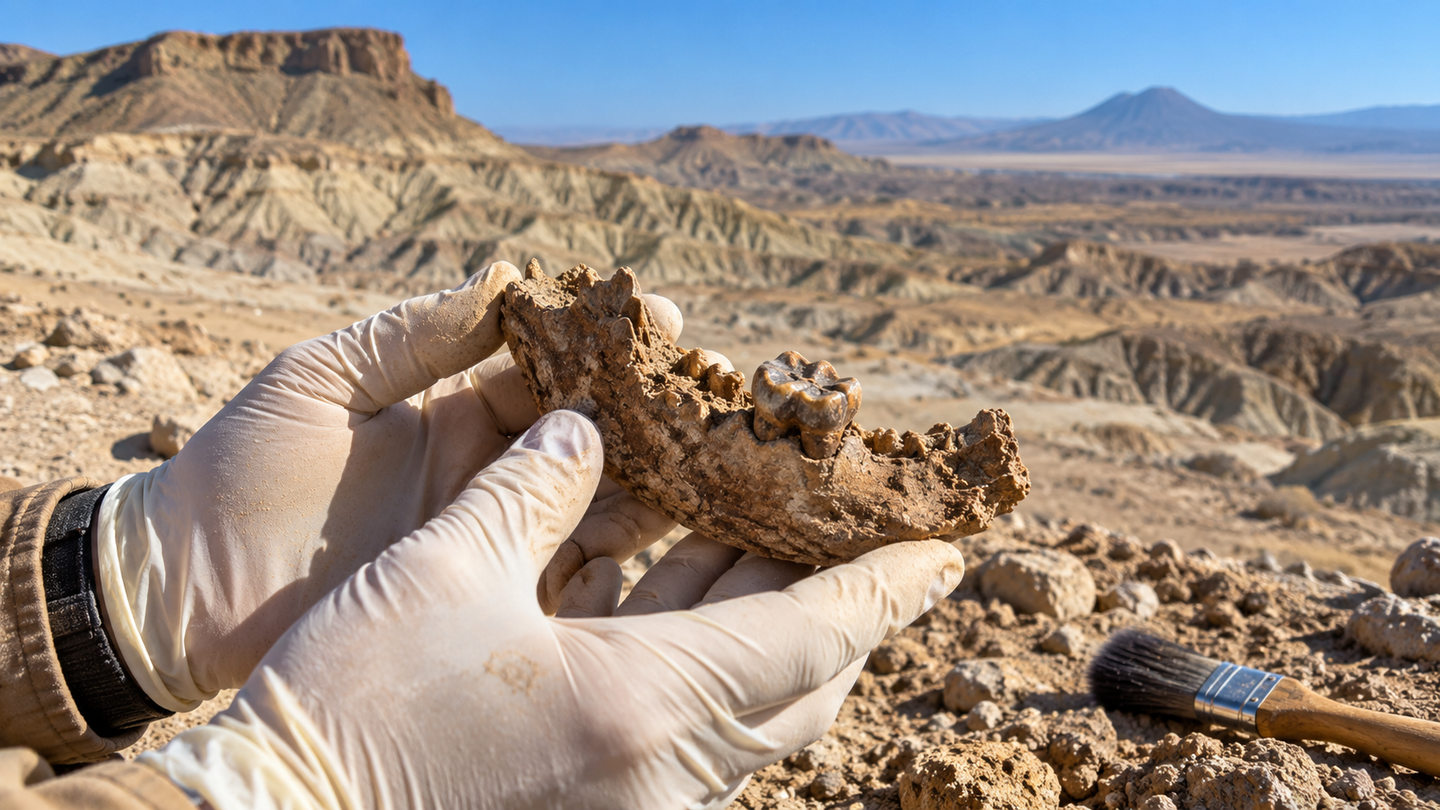
Student discovers new carnivore dinosaur 3x older than T. rex
A crushed skull from New Mexico reveals a late-surviving dinosaur lineage near the end of the Triassic.

 Edited By: Joshua Shavit

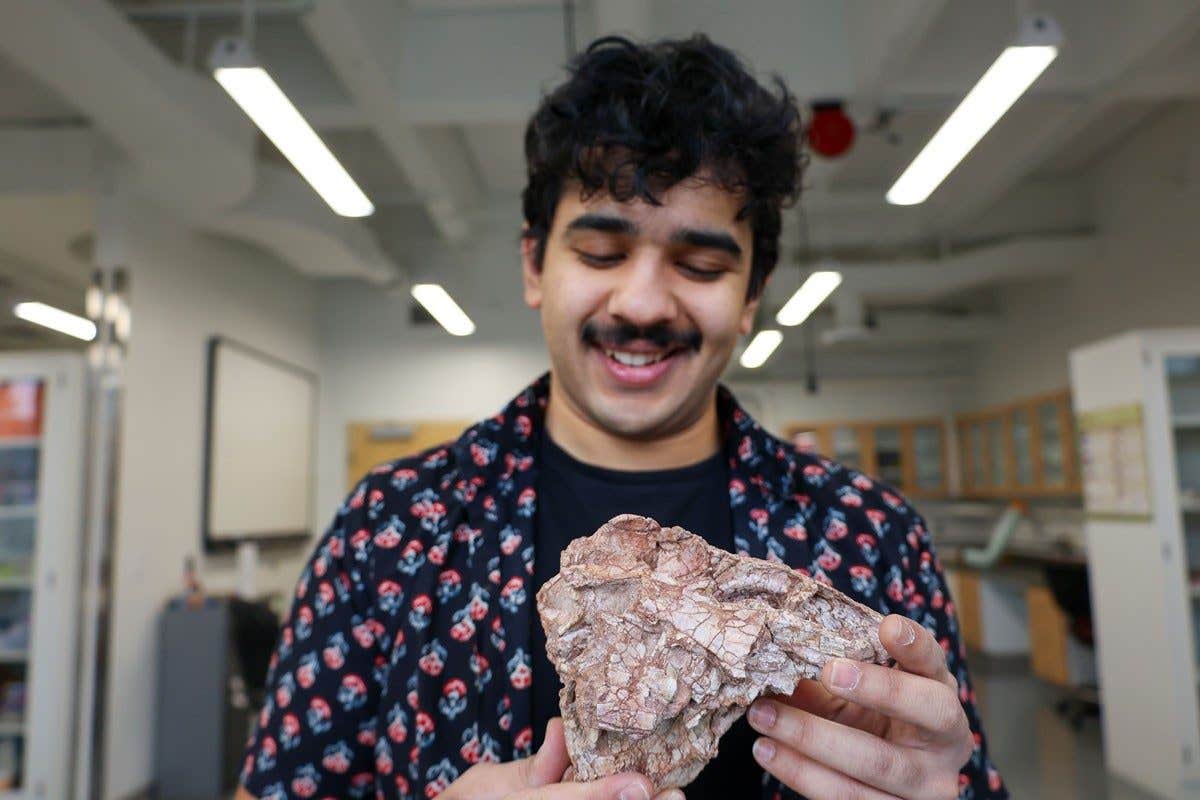
Simba Srivastava is a senior majoring in geosciences. (CREDIT: Spencer Coppage for Virginia Tech)
“You want to stick your finger in a dinosaur brain?”
That was Simba Srivastava’s first reaction to the battered fossil sitting in a paleobiology lab at Virginia Tech, a skull so crushed and twisted that he described it in less-than-flattering terms. “This is a uniquely sucky specimen,” he said. “It's so bad. Like, if you saw a human skull in this way, you'd throw up.”
And yet that same fossil, pulled from a drawer decades after it was unearthed in New Mexico, has turned into something unusually important. After two years of work, Srivastava and his colleagues identified it as a new species of carnivorous dinosaur, one that lived near the end of the Triassic and may mark one of the last appearances of a very old dinosaur lineage before it disappeared.
The animal has been named Ptychotherates bucculentus, a name that means “folded hunter with full cheeks.” The description fits. Its skull was badly distorted before fossilization and then flattened further over time, leaving researchers to digitally sort out a jumble of bones. But once reconstructed, the specimen offered a fresh look at how some early dinosaurs were still evolving just before the Jurassic began.
It also carries a larger message. Dinosaurs did not simply rise while everything else around them vanished. Some dinosaur groups appear to have been wiped out too.
A fossil with a long delay
The skull was first collected in 1982 by a Carnegie Museum of Natural History crew at Ghost Ranch in northern New Mexico. That site is famous for fossils from the Late Triassic, including mass deposits of Coelophysis. For years, this skull remained in storage.
Later, Sterling Nesbitt brought it to Virginia Tech, where Srivastava, then still an undergraduate, took on the challenge. He used CT scan data to separate the bones digitally and build a 3D reconstruction of the skull, even though the fossil’s condition made that difficult. In several parts of the specimen, bone and surrounding rock were so similar in density that the team had to isolate features by hand.
That effort paid off.
The skull belonged to a meat-eating dinosaur from a time more than three times older than Tyrannosaurus rex. It lived near the close of the Triassic, roughly between 252 million and 201 million years ago, when dinosaurs were still sharing ecosystems with other powerful reptiles and early relatives of crocodiles and mammals.
At that point, dinosaurs were not yet the dominant stars they would later become.
“Dinosaurs go from being co-stars to the headliner,” Srivastava said.
Not just another early predator
The new species stood out for its skull shape. It had massive cheekbones, a wide braincase, and likely a short, deep snout. Those traits had not been seen before in such an early dinosaur, adding to evidence that dinosaur body plans were still shifting in surprising ways late into the Triassic.
One feature stood out especially clearly: the jugal, or cheekbone, was proportionally deeper than in any other known Triassic ornithodiran discussed in the study. That gave the skull an odd, stout look.
“We landed on Ptychotherates bucculentus, which means ‘folded hunter with full cheeks’ in Latin,” said Srivastava. “One paleo-artist said that it looked like a murder muppet.”
That nickname may stick more easily than the formal Latin, but the fossil’s scientific value lies in where it fits on the family tree. The team found that Ptychotherates belonged to Morphoraptora, a group that includes Tawa hallae, Chindesaurus bryansmalli, and Daemonosaurus chauliodus. In their analysis, that clade sits close to Herrerasauridae, one of the earliest branches of carnivorous dinosaurs.
This matters because herrerasaurian-type dinosaurs are mostly known from older rocks. By the time the very end of the Triassic arrived, their record had nearly vanished.
Then this skull showed up.
A late survivor in a changing world
Ghost Ranch appears to preserve rocks from the latest Triassic, possibly the Rhaetian stage. That places Ptychotherates very near the end-Triassic extinction event, a major biological crisis that reshaped life on Earth.
Until now, the usual picture has been that this extinction removed many of the non-dinosaur competitors, clearing ecological space for dinosaurs to take over in the Jurassic. But the new fossil complicates that story. It suggests that at least one old dinosaur lineage was still hanging on almost to the end, and may have disappeared in the same extinction event.
“This forces us to reconsider the impact of the end-Triassic extinction as something that wiped out not just the competitors to dinosaurs, but some long-standing dinosaur lineages themselves,” Srivastava said.
That idea grows stronger because no members of this group have been found in Jurassic rocks anywhere in the world. The study argues that Morphoraptora likely survived in the low latitudes of Pangaea longer than elsewhere, especially in what is now the American Southwest. In those environments, the group may have persisted for most of the Late Triassic while remaining absent from higher-latitude regions.
In that sense, the ancient Southwest may have acted as a final refuge.
And then the refuge disappeared.
One skull speaking for billions
There is another reason this fossil matters. It is the only known specimen of its kind.
That leaves paleontologists trying to reconstruct an entire branch of dinosaur history from a single damaged skull, one that can fit in a person’s hands. The fossil preserves enough of the braincase, skull roof, jaws, and teeth to establish that it was distinct. Still, the study notes clear limitations. Some bones could not be reliably segmented, the braincase has not yet been fully described, and the skull’s heavy distortion made parts of the reconstruction uncertain. The specimen also lacks limb bones, which means the team could not determine its developmental stage with confidence.
Even with those constraints, the fossil records something no other specimen does: that these dinosaurs lived this late, in this place, and with this skull shape.
“This specimen, it fits in my hands, but it is the only proof that any of these dinosaurs lived this long, lived in these latitudes, the only proof that they evolved to have this skull shape,” said Srivastava. “All these billions of individuals that existed through time are spoken for by this one specimen.”
That is the strange weight of paleontology. An animal lineage can last for millions of years, spread across landscapes, and vanish almost completely, leaving behind one crumpled head in a block of stone.
From that, a missing piece of dinosaur history comes back into view.
Practical implications of the research
This work sharpens the timeline of dinosaur evolution near one of Earth’s major extinction events. It suggests dinosaur success was not a simple march upward, because some dinosaur groups also seem to have died out at the end of the Triassic.
The fossil also highlights the importance of reexamining old museum specimens with newer tools like CT scanning and digital reconstruction.
A damaged skull that once looked nearly unusable turned out to preserve evidence of a lost lineage, a rare skull design, and a clearer picture of how dinosaur diversity changed just before the Jurassic world took shape.
Research findings are available online in the journal Papers in Palaeontology.
The original story "Student discovers new carnivore dinosaur 3x older than T. rex" is published in The Brighter Side of News.
Related Stories
- Decades old T. rex debate ends with stunning discovery
- New study confirms Nanotyrannus was a grown dinosaur, not a baby T. rex
- How did the T. rex’s bite force compare to the largest carnivorous dinosaurs
Like these kind of feel good stories? Get The Brighter Side of News' newsletter.
Rebecca Shavit
Writer
Based in Los Angeles, Rebecca Shavit is a dedicated science and technology journalist who writes for The Brighter Side of News, an online publication committed to highlighting positive and transformative stories from around the world. Having published articles on MSN, AOL News, and Yahoo News, Rebecca's reporting spans a wide range of topics, from cutting-edge medical breakthroughs to historical discoveries and innovations. With a keen ability to translate complex concepts into engaging and accessible stories, she makes science and innovation relatable to a broad audience.