The harsh physics behind interstellar travel and why Earth may never be visited by aliens
Reports of fast-moving craft, disclosure narratives, and easy assumptions about advanced civilizations arriving here all run straight into the same wall of distance, causality, fuel, biology, and timing

 Edited By: Joshua Shavit

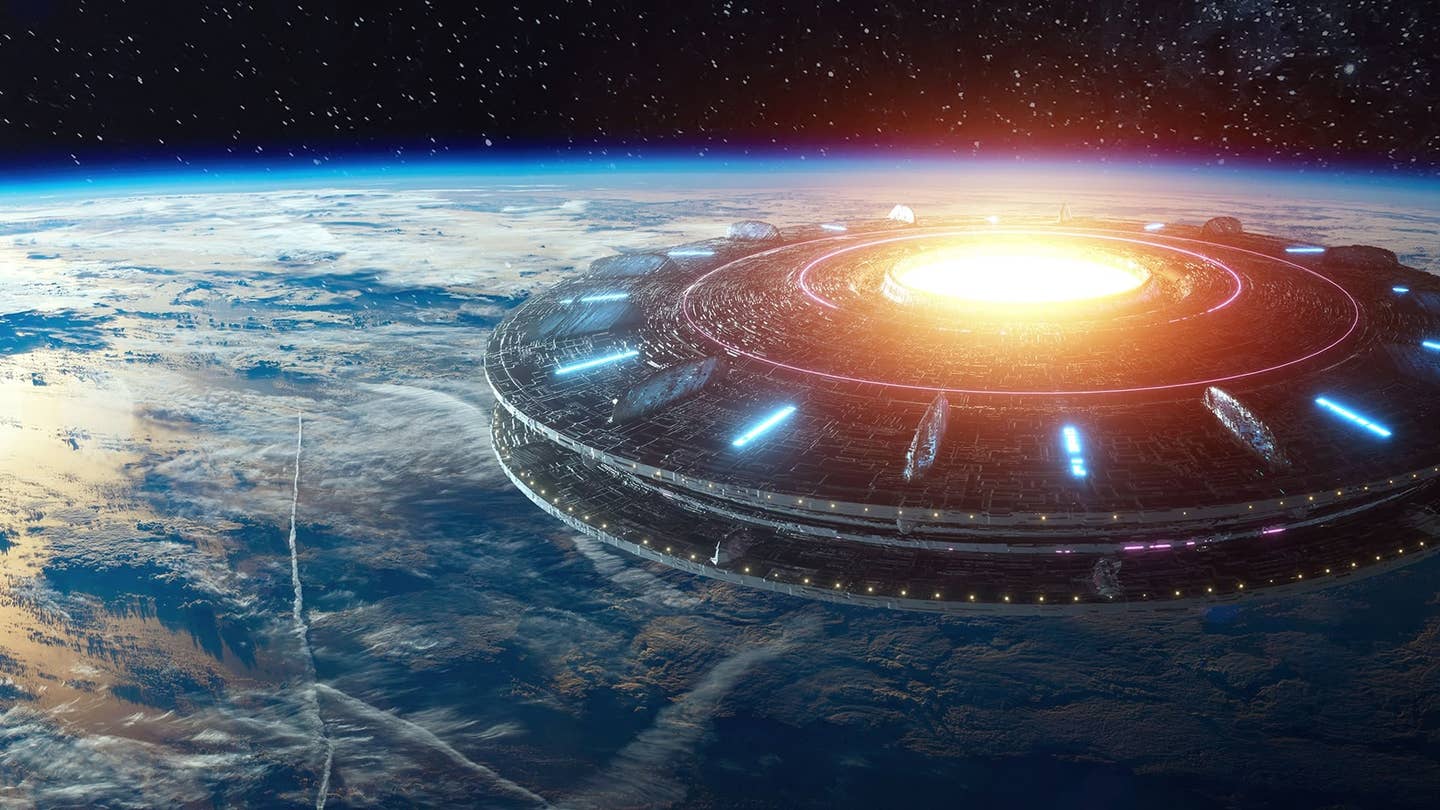
The night sky looks crowded, but physics may keep distant civilizations from ever meeting or even noticing one another. (CREDIT: Peacock TV)
There is something almost offensive about a sky so full of stars and so empty of company.
That is what gives Richard Feynman’s quote its sting: “There is a silence in the night sky that has bothered me for as long as I can remember.” The remark lands because it names a feeling many people recognize at once. Look up on a clear night and the universe does not seem barren. It seems excessive. Stars crowd the dark, galaxies fill the depths beyond them, and the whole scene invites a stubborn conclusion that someone else should be out there, and close enough, or clever enough, to find.
Yet the deeper physics cuts into that hope, the more the silence begins to look less like a temporary puzzle and more like a built-in feature of reality.
Human intuition is poorly suited to the argument. It evolved for ordinary distances, short lifespans, and practical dangers close at hand. It did not evolve for light years, relativistic motion, or travel times that outlast civilizations. Feynman put that mismatch plainly: “When you take that human intuition and apply it to the scale of the universe, it doesn’t just fail. It snaps.”
That snapped intuition may sit at the center of the whole story. The quiet sky is often treated as a mystery needing one dramatic answer, but the harder possibility is that several ordinary facts about the universe all push in the same direction. Distance, the speed of light, propulsion, biology, and timing each make contact difficult. Together, they begin to look like what Feynman called “absolute walls that prevent civilizations from ever meeting.”
The universe is too large for instinct
Size comes first, and size alone is enough to scramble common sense.
Carl Sagan warned that “The size and age of the Cosmos are beyond ordinary human understanding.” Earth feels large at about 12,742 kilometers across. The scale then opens almost immediately into something your mind can repeat but not really picture. The Sun is roughly 150 million kilometers away, and even light, the fastest thing known, takes eight minutes to cross that distance.
The nearest star system lies vastly farther still. Proxima Centauri is 4.24 light years from Earth. The Parker Solar Probe, the fastest human-made object, travels about 692,000 kilometers per hour. At that speed, reaching Proxima Centauri would take about 6,600 years.
That is the kind of number that resists ordinary reading. If a spacecraft had launched when the Great Pyramids were completed, it would only now be nearing arrival.
And that is for the nearest star.
The Milky Way spans about 100,000 light years. With current technology, crossing it would take hundreds of millions of years, longer than mammals have existed. At that point, distance is no longer just a transportation problem. It begins to threaten cultural continuity, biological continuity, even the meaning of a mission. A civilization that sets out might not resemble itself by the time it reaches anywhere worth naming.
Distance, then, does more than stretch a route. It changes what “contact” would even mean.
Light speed is not a technical inconvenience
The natural response is to imagine better engines. But the next barrier is not mechanical.
“The speed of light is not an engineering limit,” Feynman said. “It is a structural limit of reality. It is the speed of causality.” Kip Thorne framed the same point from another angle: “The speed of light is the ultimate speed limit built into the fabric of space and time.”
That sounds abstract until it collides with ordinary expectations. Daily life teaches that if you apply more force, objects go faster. Near light speed, that intuition fails. More and more energy flows into relativistic effects instead of simple acceleration. The closer you get to light speed, the harder each further gain becomes.
Then comes the hard stop.
To push an object with mass all the way to light speed would require infinite energy. Feynman stated it in the kind of language that strips away wishful thinking: “I don’t mean all the energy in the Sun. I mean literally infinite.”
That matters because it closes off one of the most comforting assumptions in discussions of alien life, the belief that some far older civilization must eventually have solved the travel problem. Age does not negotiate with this limit. Intelligence does not soften it. The equations are not waiting to be outgrown.
Einstein’s framework does not apply only to humans. It applies everywhere.
The rocket problem gets worse the harder you push
Even if a civilization gives up on reaching light speed and aims for some lesser but still impressive fraction of it, the arithmetic of propulsion turns hostile.
The rocket equation, written by Konstantin Tsiolkovsky in 1903, captures the trap. A ship needs fuel to accelerate. That fuel adds mass. More mass requires more fuel to move both the ship and the added fuel. That new fuel also adds mass and deepens the problem. The demand does not rise in a neat straight line. It climbs exponentially.
Feynman called it “an exponential curse.”
The point becomes clearer when translated into a human goal. Suppose a civilization wants to send a crewed mission to the nearest star and complete the trip within 40 years. The ship must accelerate to high speed, then decelerate at the destination. It has to carry the fuel for both phases all the way through the journey.
With chemical rockets, the fuel required for a single person would exceed the mass of the observable universe. Freeman J. Dyson’s verdict was blunt: “Chemical fuels are hopeless for interstellar travel.”
More advanced ideas do not erase the problem so much as rearrange it. Fusion systems improve the ratio, but the spacecraft would still be dominated by fuel mass. Antimatter offers much higher energy density, yet useful amounts remain so difficult to produce that humanity would need to devote its entire energy output for millions of years.
At that point the argument shifts. The question is no longer whether someone could imagine a more powerful engine. The real question is whether any civilization, however advanced, would choose to spend such overwhelming resources for a mission with such meager return. Feynman’s phrasing was severe and memorable: “Interstellar travel is the definition of inefficiency.”
Science fiction exits stay trapped on paper
Popular imagination usually escapes this problem by changing the geometry instead of the engine.
In 1994, Miguel Alcubierre proposed a warp-drive model in which a spacecraft could sit inside a bubble while space contracts in front of it and expands behind it. In that setup, the craft would not outrun light in its own local region. Space itself would do the moving.
On paper, the math works.
Reality is less forgiving. The model calls for enormous amounts of negative energy, and no known process can provide it in the required quantities. Early estimates placed the demand above the energy contained in the observable universe. Later refinements reduced the scale, but not into anything remotely reachable.
And the energy problem is not the only one. Tiny instabilities might collapse the bubble. Some analyses suggest radiation could accumulate at the front and burst outward when the drive stops. More recent theoretical work argues that producing such a bubble may violate quantum constraints.
Feynman never addressed Alcubierre’s idea directly because he died before the paper appeared. But the broader skepticism fits his style. He distrusted concepts that drifted too far from experiment and had little patience for ideas that looked elegant on paper but could not be tested in practice.
Wormholes run into similar trouble. The idea is often linked to Albert Einstein and Nathan Rosen’s 1935 work, but the obstacle remains familiar: a natural wormhole would pinch shut too quickly to cross. Keeping one open would require negative energy or exotic matter, both hypothetical. Extra dimensions appear in some versions of string theory, yet no experiment suggests they are accessible or large enough to enter.
So the escape hatches remain where they began, in theory.
Space attacks the body as well as the ship
Even if the physics and propulsion hurdles could somehow be softened, biology still argues against easy interstellar travel.
The human body developed under Earth’s gravity and magnetic shielding. Outside that environment, radiation becomes a serious threat. Cosmic rays carry high-energy particles capable of penetrating hulls and damaging DNA. In the source material’s vivid language, they can tear through tissue and smash DNA “like a shotgun blast to a library.”
Shielding helps, but shielding adds mass, and added mass sends the problem roaring back to the rocket equation.
Microgravity creates a slower, quieter crisis. Bone density drops. Muscles weaken. The cardiovascular system changes in ways that can make a return to gravity difficult. Astronauts already show lasting effects after months in orbit. A mission lasting centuries would not just extend those burdens, it would redefine them.
The backup plans remain unsettled. Cryogenic preservation is unsolved because ice crystals rupture cells. Generation ships avoid freezing but create a different set of hazards, including social instability, genetic risks, and cultural drift across centuries.
“Biology is the software of Earth,” Feynman said. “It does not run on the hardware of space.”
That line was paired with a remark from Dyson: “Biology is more powerful than physics.” In this setting, the point is not that life can override natural law. It is that living systems impose their own hard constraints, and engineering cannot simply wave them away.
Machines are not a full solution either. Radiation damages electronics. Micrometeoroids strike with enormous force because of their speed. Entropy works on every closed system given enough time.
Even robots age.
Civilizations may miss each other by a cosmic instant
Then comes time, which may be the cruelest barrier because it can ruin everything without breaking any law of physics.
Human beings have broadcast radio for roughly a century. That creates a sphere of signals about 100 light years across. Against a galaxy 100,000 light years wide, that is barely a mark. Feynman’s line catches the scale of the mismatch: “We are shouting into a hurricane.”
Contact requires more than life elsewhere. It requires overlap. Another civilization must exist at the right distance, during the right era, using detectable signals on the right frequencies. A society might transmit long before another develops receivers. A signal might arrive after the sender has already disappeared. Civilizations could flare up, become technological, and vanish without ever sharing a common moment.
Humanity itself has been technological for only about 200 years. Even if that phase lasts thousands more, it remains tiny beside the universe’s 13.8-billion-year history.
Feynman compared civilizations to fireflies blinking on different nights in a dark forest. “The tragedy of the universe isn’t that it’s empty,” he said. “It’s that the party guests are arriving at different times.” Jill Tarter of SETI offered a gentler version of the same idea: “If you dip a glass into the ocean, you’re not going to come up with a fish. That doesn’t mean there are no fish in the ocean.”
Silence, in other words, does not prove solitude. It may simply mean the timing never lines up.
Why blurry sightings do not settle the matter
That helps explain why discussions of alien life so often drift toward unidentified flying objects. The temptation is obvious. If interstellar contact looks nearly impossible on paper, then any report of strange craft in Earth’s skies takes on extra weight.
But the physical problem is severe. Some reports describe objects making instantaneous turns or reaching enormous speeds within the atmosphere. Motion like that would create crushing forces, enough to destroy biological occupants and strain the craft itself. Travel through air at such speeds would also be expected to produce intense plasma effects and strong sonic signatures.
Feynman’s response, as presented here, was unsparing: “You don’t see that in the videos. You see a blurry gray blob.”
He then turned to a standard now attached to many extraordinary claims: “Extraordinary claims require extraordinary evidence.”
By that standard, fuzzy footage is not enough to settle the question.
The same logic shadows popular “disclosure” stories, including the film Disclosure Day, which imagines a world where hidden evidence of alien contact finally reaches the public. The appeal is clear because the story converts cosmic silence into something closer and more human, a conspiracy, a cover-up, a locked file.
But the harder physical argument points somewhere else. If the barriers are really this severe, the central mystery may not be what someone is hiding. It may be whether interstellar contact is feasible at all.
Isolation may be part of the design
Taken together, the barriers begin to feel less like scattered inconveniences and more like structure.
Distance keeps worlds apart. Light speed protects cause and effect. Fuel demands punish ambition. Biology ties life to the conditions that formed it. Timing narrows the odds of overlap until they nearly vanish. The result sounds bleak at first, but Feynman saw a kind of order in it.
The same rules that frustrate easy travel also make the universe stable enough for life. Light speed preserves causality. Stable atoms make chemistry possible. Stars build the elements living things need. Remove those constraints and the world that produced the question may never exist.
Silence, then, is not necessarily emptiness. It may be the sound of a lawful universe.
Carl Sagan’s line still hangs over that view: we are made of star-stuff.
Perhaps that is the nearest thing to company most civilizations ever get. They may never meet. They may never exchange a signal, a machine, or a greeting. But if they exist, they are built from the same cosmic fire, shaped by the same physical rules, and separated by those same rules almost perfectly.
That does not erase the loneliness in the question.
It just reframes it.
The original story "The harsh physics behind interstellar travel and why Earth may never be visited by aliens" is published in The Brighter Side of News.
Related Stories
- Space weather near stars may be hiding alien signals from Earth
- Scientists warn we may be missing signs of alien life across the universe
- SETI checked 3I/ATLAS for alien signals — Here’s what they found
Like these kind of feel good stories? Get The Brighter Side of News' newsletter.
Joseph Shavit
Writer, Editor-At-Large and Publisher
Joseph Shavit, based in Los Angeles, is a seasoned science journalist, editor and co-founder of The Brighter Side of News, where he transforms complex discoveries into clear, engaging stories for general readers. With vast experience at major media companies like The Los Angeles Times, Times Mirror and Tribune Publishing, he writes with both authority and curiosity. His writing focuses on space science, planetary science, quantum mechanics, geology. Known for linking breakthroughs to real-world markets, he highlights how research transitions into products and industries that shape daily life.