Ultrathin ruthenium dioxide discovery could enable faster, smaller and more efficient computer devices
New research shows strained ultrathin ruthenium dioxide may display unconventional magnetism useful for future memory devices.

 Edited By: Joshua Shavit

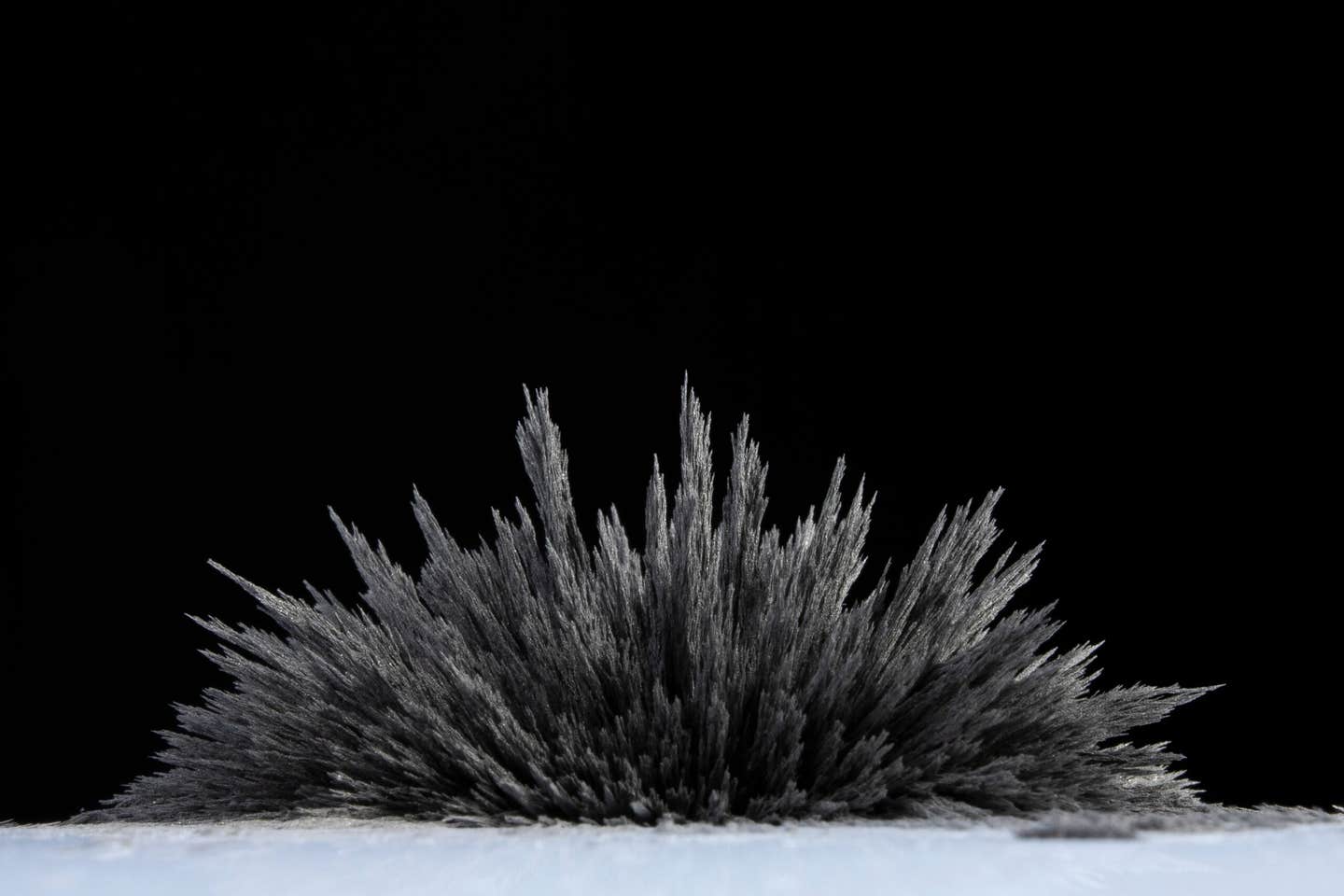
Researchers found that ultrathin ruthenium dioxide can show spin behavior linked to altermagnetism, opening paths for future electronics. (CREDIT: Shutterstock)
- Researchers at Rice University found that ultrathin ruthenium dioxide, or RuO2, can display spin patterns consistent with unconventional magnetism, even though its bulk form has shown little evidence of magnetic behavior.
- The effect appears to be driven by lattice strain created when the roughly 2-nanometer-thick RuO2 film is grown on titanium dioxide, suggesting strain could be used as a way to switch on or control altermagnetism.
- The discovery could help advance spintronics and next-generation computer memory by giving researchers a potential method for creating faster, smaller and more energy-efficient devices based on electron spin.
A material at the center of a major physics debate may have revealed its hidden magnetic side. Researchers at Rice University and their collaborators found that ultrathin ruthenium dioxide films can show spin patterns linked to unconventional magnetism. The finding could open new paths for future computer memory and spin-based electronics.
The study focuses on ruthenium dioxide, also called RuO2. In its bulk form, the material has not shown clear evidence of magnetism. But when prepared as an ultrathin film only a few atomic layers thick, it may behave very differently.
“Ruthenium dioxide was one of the first materials to be proposed as an altermagnetic candidate, but studies on its bulk form didn’t return evidence of magnetism,” said Ming Yi, an associate professor of physics and astronomy at Rice University. “Our research shows that its ultrathin form, on the other hand, may be the key in making it magnetic.”
A New Kind Of Magnetism
Most people think of magnets as objects that stick to refrigerators. In physics, magnetism can take many forms.
In ferromagnets, electron spins mostly point in the same direction. This creates a strong overall magnetic field. In antiferromagnets, opposite spins cancel each other out.
Altermagnetism is different. It has no large net magnetism, but its electrons can still split by spin in patterned ways. That could make altermagnets useful for devices that store and move information using spin.
This field matters because modern electronics face limits. Engineers want faster, smaller and more energy-efficient memory systems. Materials with stable and controllable spin behavior could help improve future RAM architecture.
Ruthenium dioxide attracted attention because theory suggested it could display altermagnetism. Yet many studies of its bulk form found no clear magnetic order.
Why Thin Films Matter
The new study suggests thickness and strain may change the story. Researchers studied ruthenium dioxide grown as a film only about 2 nanometers thick. That places it close to the scale of a few atomic layers.
The film was grown on titanium dioxide, or TiO2. This base layer forced the RuO2 film to stretch or compress slightly. Scientists call this lattice strain.
That strain changed the material’s electronic structure. Without it, the electron spins did not show signs linked to altermagnetism. Under strain, the team found spin textures consistent with unconventional magnetism.
“The strain-dependent nature suggests that we may be able to use lattice strain as a tuning knob to induce or control altermagnetism,” said Yichen Zhang, first author of the paper and a recent Rice graduate.
Measuring Electron Spins
To test the material, the team used a method called spin-resolved angle-resolved photoemission spectroscopy. The name is long, but the idea is direct. It lets scientists measure how electrons move and how their spins arrange themselves.
Electron spin is a quantum property that acts somewhat like a tiny compass needle. The pattern of these spins can reveal whether a material has magnetic behavior.
The researchers measured the spin texture of the ultrathin film. Spin texture shows how electron spins are arranged across momentum space.
“After analyzing our measurements, including informing our interpretation with theoretical calculations, we found that, in our experimental conditions, the ruthenium dioxide shows spin textures consistent with unconventional magnetism,” Zhang said.
The result suggests that bulk and ultrathin forms may not share the same magnetic properties.
A Debate Over Ruthenium Dioxide
Ruthenium dioxide has drawn intense interest because of its possible role in altermagnetism. Earlier reports suggested it might show useful spin behavior at room temperature. Other experiments found no clear magnetism in larger crystals or thicker films.
This created a scientific puzzle. Was RuO2 magnetic, nonmagnetic or dependent on how it was prepared?
The new work points toward the third answer. Under the right conditions, the material may enter a state that does not appear in bulk form.
That distinction matters. Scientists often treat a material’s bulk form as a guide to its behavior. But quantum materials can change dramatically when made extremely thin.
Surfaces, interfaces and strain can all shift electronic behavior. In ultrathin films, these factors become especially powerful.
Strain As A Control Knob
The idea of using strain to control magnetism is especially important. If scientists can tune a material by stretching or compressing its atomic lattice, they may gain a practical way to control spin behavior.
This could be useful for spintronics. In spintronic devices, information is carried not only by electric charge but also by electron spin.
Current computer memory relies heavily on charge-based systems. Spin-based systems could offer faster operation, lower energy use and better stability. They could also help miniaturize future memory devices.
“This could be extremely useful when thinking about next-generation spintronics and RAM architectures,” Zhang said.
The study does not mean RuO2 devices are ready for use. But it offers a possible route toward controllable magnetic states in quantum materials.
The Importance Of Careful Preparation
The researchers emphasized that the observation depended on high-quality materials and precise measurements. Producing clean ultrathin films is difficult. Small defects can change the result.
The team prepared the material as a thin, strained slice and studied it under controlled conditions. They also used theoretical calculations to guide their interpretation.
“This work shows just how complex these questions can be,” Yi said. “The high quality material prep and the careful measurement protocol were critical to our observation of the correct electron spin properties.”
That careful approach matters because some spin signals can arise from the measurement process itself. Researchers had to separate true material behavior from possible artifacts.
Through detailed analysis, they identified spin patterns linked to broken time-reversal symmetry. This is a key feature of magnetic behavior.
A Material With Two Faces
The findings suggest that ruthenium dioxide has at least two faces. In bulk form, it may remain nonmagnetic. In ultrathin, strained form, it may show unconventional spin behavior.
That contrast reveals how sensitive quantum materials can be. A small change in thickness or atomic spacing can unlock entirely new properties.
For scientists, this creates both challenge and opportunity. It means results can vary depending on sample preparation. It also means researchers may be able to design materials with chosen properties.
In this case, strain may allow scientists to switch on or control altermagnetism-like behavior.
A Step Toward Future Electronics
The work adds to a growing effort to find materials for next-generation computing. As electronic devices shrink, controlling quantum properties becomes more important.
Altermagnets are attractive because they may combine benefits of different magnetic systems. They could offer fast spin behavior without producing large stray magnetic fields.
That combination could help make memory devices denser and more efficient. It could also improve how spin signals move through circuits.
Still, much remains unknown. Researchers must confirm how stable the effect is, how it behaves at different temperatures and how it can be controlled in devices.
Practical Implications Of The Research
This research could help guide the design of future memory and spintronic technologies. By showing that strain can influence magnetic behavior in ultrathin ruthenium dioxide, the study gives engineers a possible tool for controlling quantum materials.
The findings may also help resolve debates about altermagnetism. They suggest that a material can appear nonmagnetic in bulk form while showing unusual spin behavior when made extremely thin. This could encourage scientists to revisit other materials under different strain and thickness conditions.
For computing, the long-term promise lies in faster and more efficient information storage. Spin-based memory could reduce energy use and support smaller device architectures. That would benefit everything from personal electronics to large data centers.
The study also deepens understanding of quantum materials. It shows that surfaces, interfaces and atomic strain can create behavior that does not appear in ordinary samples. That knowledge may help researchers discover new phases of matter and new ways to control them.
Research findings are available online in the journal Science Advances.
The original story "Ultrathin ruthenium dioxide discovery could enable faster, smaller and more efficient computer devices" is published in The Brighter Side of News.
Related Stories
- Chang’e-6 samples reveal how Earth's magnetosphere changed the solar wind reaching the Moon
- Scientists use AI to search for the next generation of ultra-powerful magnets
- Pigeons may use magnetic immune cells to find their way home
Like these kind of feel good stories? Get The Brighter Side of News' newsletter.
Shy Cohen
Writer