Wild orangutans repeatedly combine and consume plants linked to healing and inflammation
Wild Bornean orangutans ate certain medicinal plants together more often than chance would predict.
 University of Exeter Writer: Louise Vennells

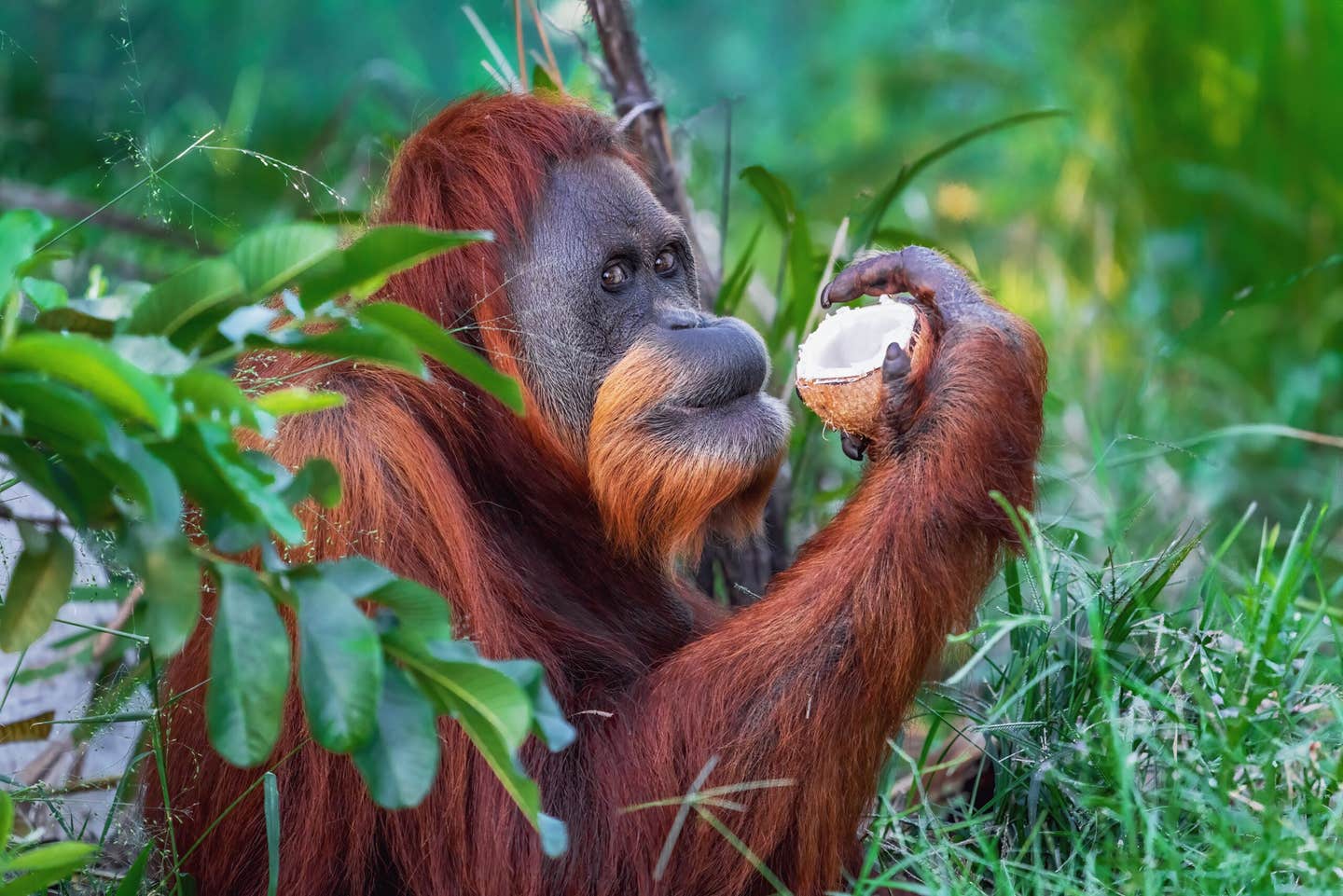
Wild Bornean orangutans ate certain medicinal plants together more often than chance would predict. (CREDIT: Shutterstock)
- Twenty years of feeding records from wild Bornean orangutans revealed plant combinations that occurred together significantly more often than chance would predict.
- Several repeatedly paired plants have documented medicinal or pharmacological properties, with Fibraurea tinctoria emerging as one of the most prominent resources.
- The patterns are consistent with possible self-medication, but they do not prove that orangutans deliberately diagnose illness or combine plants for therapeutic purposes.
“What makes the findings interesting is that some plant species appeared together in the orangutan diet far more often than we would expect by chance.”
That observation sits at the center of a 20-year study of wild orangutans in Indonesian Borneo.
The animals did not simply eat plants with known medicinal properties. They consumed certain plants together, sometimes in repeated sequences.
Those patterns may point to a form of self-medication.
Researchers remain cautious. They cannot say that orangutans diagnose illness as humans do, or that every plant pairing serves a medical purpose.
Still, the combinations appeared too often to dismiss as random feeding.
The work drew on long-term observations from a peat-swamp forest in Central Kalimantan. Scientists examined how often orangutans ate plants linked to antimicrobial, anti-inflammatory, and wound-healing effects.
Two Decades Hidden in Feeding Records
Georgia Allen led the study during her master’s work in Conservation and Biodiversity at the University of Exeter.
Dr. Kimberley Hockings supervised the project, with support from Dr. Elodie Freymann.
Dr. Helen Morrogh-Bernard initiated the research. She is an honorary research fellow at Exeter and founder of the Borneo Nature Foundation.
The team used records collected through the Orangutan Behaviour Project. The work involved collaboration with the University of Palangka Raya and CIMTROP.
The broader dataset covered more than 100 orangutans and over 20,000 observation hours. For this study, researchers analyzed 12,236 feeding events involving 55 animals across 2,419 days. The orangutans ate 202 plant species during those observations.
That scale gave the team something rare.
Most evidence for animal medicine comes from isolated moments. A sick animal eats an unusual plant, applies leaves to a wound, or changes its diet.
Those cases can be striking, but they are difficult to compare. A long feeding record allows researchers to search for quieter patterns that repeat across years.
Looking for More Than One Medicinal Plant
The study did not focus only on single plants.
Researchers tested the idea that orangutans may combine several resources with related or complementary properties.
They compared the feeding database with knowledge about medicinal plants used by local Indigenous Dayak communities.
From that overlap, the team identified 64 plant species with documented medicinal uses.
They narrowed the group to 19 resources of interest. Each had repeated medicinal use, confirmed oral consumption, and reliable plant identification.
The researchers then searched for plant pairings that appeared more often than chance would predict. One analysis examined foods eaten close together in a sequence.
Another looked for larger combinations found within an orangutan’s daily diet.
The first method produced 16,569 plant pairings involving at least one medicinal resource. Among those, 324 occurred significantly more often than expected.
The strongest association involved Mezzettia parviflora and Fibraurea tinctoria.
One Plant Appears Again and Again
Fibraurea tinctoria became the most noticeable plant in the analysis.
It appeared in every significant multi-plant combination identified by one statistical method. The plant also occurred in 72% of the top 25 non-random pairings.
That repeated presence drew attention because Fibraurea tinctoria already has a link to orangutan wound care.
A previous observation documented a wild Sumatran orangutan applying its leaves directly to a facial wound. The current study examined eating, not topical treatment.
Even so, the same plant appearing in both kinds of behavior made it difficult to ignore.
Other recurring plants included species from Alyxia, Willughbeia, and Gnetum, along with Mezzettia parviflora. Some contain compounds linked to antimicrobial or anti-inflammatory activity.
Fibraurea tinctoria contains berberine, an alkaloid associated with both properties.
The researchers suggest that these combinations deserve chemical testing. They may provide overlapping effects. They might also work together in ways that a single plant cannot.
Patterns are not Proof
The study does not establish deliberate medical treatment. Plants can appear together in a diet for many reasons.
Several may fruit during the same season. They may grow near one another or become available during the same weather conditions.
Orangutans could also choose them for taste or nutrition.
The team considered those alternatives. Thirteen of the 19 plants in the strongest combinations were important seasonal foods.
Yet several frequently paired species were not major seasonal resources.
Ten were not among the orangutans’ dominant foods. Only three overlapped with the highest-density plants in the habitat. Availability alone did not fully explain the pattern.
“At this stage, we cannot say that orangutans are consciously ‘diagnosing’ themselves in the same way humans would,” Allen said.
“However, our findings suggest they selectively consume certain plants with medicinal properties in ways that go beyond simple nutrition.”
That distinction is central. The statistics identify candidates for self-medication. They do not reveal an orangutan’s intention.
An Older Pattern in Great Apes
Other primates already provide evidence of medicinal behavior. Chimpanzees sometimes eat plants that reduce internal parasite infections.
Similar actions have appeared in bonobos, gibbons, and gorillas. Orangutans have their own record. Earlier observations found them building nests from trees with insect-repelling properties during periods of heavy mosquito activity.
Others chewed Dracaena cantleyi leaves, mixed them with saliva, and rubbed the foam onto their bodies.
Laboratory work later confirmed anti-inflammatory properties in that plant.
Local Indigenous communities also use it for pain relief. Researchers have seen an injured juvenile orangutan selectively eat ginger-family pith after severe injuries.
The facial-wound case involving Fibraurea tinctoria added another example.
The new study differs because it does not depend on one dramatic event. It searches thousands of ordinary feeding choices for repeated structure.
Learning Without a Clear Teacher
The research leaves an obvious question unanswered.
How do orangutans learn which plants to eat together? The team suggests instinct may play a role. Behavior could also pass through generations.
Young orangutans spend years observing their mothers, but the study does not identify a specific learning pathway.
No experiment tested whether individuals copied one another. Researchers also lacked direct health records for every feeding sequence.
They could not confirm that an animal felt ill before consuming a plant combination or improved afterward.
That makes future work essential.
Chemical studies could test whether the paired plants interact. Closer health monitoring might connect feeding patterns with wounds, infections, or other conditions.
Behavioral observations could also determine whether combinations appear more often during illness.
Indigenous Knowledge Inside the Research
The study relied partly on medicinal plant knowledge held by Dayak communities. That contribution did more than supply a list of candidate plants.
It helped researchers recognize feeding choices that might otherwise look ordinary.
A plant eaten rarely may seem unimportant in a general diet analysis. Its significance changes when local knowledge identifies it as a wound treatment or anti-inflammatory resource.
The findings therefore connect animal behavior, conservation, and ethnobotany.
They also support preserving Indigenous knowledge as part of biodiversity research. Plants known locally for healing may hold compounds worth examining.
Orangutan feeding choices may offer another clue about where to look.
Practical Implications of the Research
The study gives scientists a new way to investigate animal medicine without waiting for rare, visible treatment events. Long-term feeding records can uncover repeated plant combinations that deserve closer attention.
That method may help researchers build shortlists for laboratory testing. It could also guide field teams toward animals, plants, and seasons most relevant to health behavior.
For conservation, the work adds another reason to protect peat-swamp forests.
Losing plant diversity may remove resources tied to orangutan health, even when those plants form only a small part of the diet. The study also strengthens the case for preserving Indigenous medicinal knowledge.
Traditional plant use helped researchers identify patterns hidden in thousands of feeding records.
The results stop short of proving deliberate treatment.
They do, however, suggest that orangutan diets may contain a level of organization that ordinary nutrition cannot fully explain. Some meals may be doing more than feeding the animal.
Dig deeper into animal self-medication
These studies provide additional evidence and context for medicinal behavior among orangutans and other animals.
Active self-treatment of a facial wound with a biologically active plant by a male Sumatran orangutan: Researchers documented a wild orangutan chewing Fibraurea tinctoria and applying the plant directly to a facial wound. (Scientific Reports, 2024)
Self-medication by orang-utans (Pongo pygmaeus) using bioactive properties of Dracaena cantleyi: Bornean orangutans rubbed chewed leaves onto their bodies, while laboratory tests confirmed anti-inflammatory activity in the plant. (Scientific Reports, 2017)
New evidence for self-medication in bonobos: Manniophyton fulvum leaf- and stemstrip-swallowing from LuiKotale, Salonga National Park, DR Congo: Field observations documented unusual plant-swallowing behavior in bonobos and evaluated its possible therapeutic significance. (American Journal of Primatology, 2014)
Ecology. Self-medication in animals: This overview examines how animals use behavioral and dietary strategies that can reduce disease and parasite burdens. (Science, 2013)
Orangutan cultures and the evolution of material culture: Geographic differences in orangutan behavior provided evidence that some behaviors can spread through social learning rather than ecology alone. (Science, 2003)
Research findings are available online in the journal Nature.
The original story "Wild orangutans repeatedly combine and consume plants linked to healing and inflammation" is published in The Brighter Side of News.
Related Stories
- Apes and humans share an ancient laughter rhythm dating back 15 million years
- Great apes show mental differences that do not follow human rules
- Why apes eating fruit is key to human love for alcohol consumption
Like these kind of feel good stories? Get The Brighter Side of News' newsletter.
Joseph Shavit
Writer, Editor-At-Large and Publisher
Joseph Shavit, based in Los Angeles, is a seasoned science journalist, editor and co-founder of The Brighter Side of News, where he transforms complex discoveries into clear, engaging stories for general readers. With vast experience at major media companies like The Los Angeles Times, Times Mirror and Tribune Publishing, he writes with both authority and curiosity. His writing focuses on space science, planetary science, quantum mechanics, geology. Known for linking breakthroughs to real-world markets, he highlights how research transitions into products and industries that shape daily life.