New computer simulation reveals exactly how gas giants form
Icy particles drifting inward may pile up into planetesimals that let giant-planet cores grow before their gas disks disappear.

 Edited By: Joshua Shavit

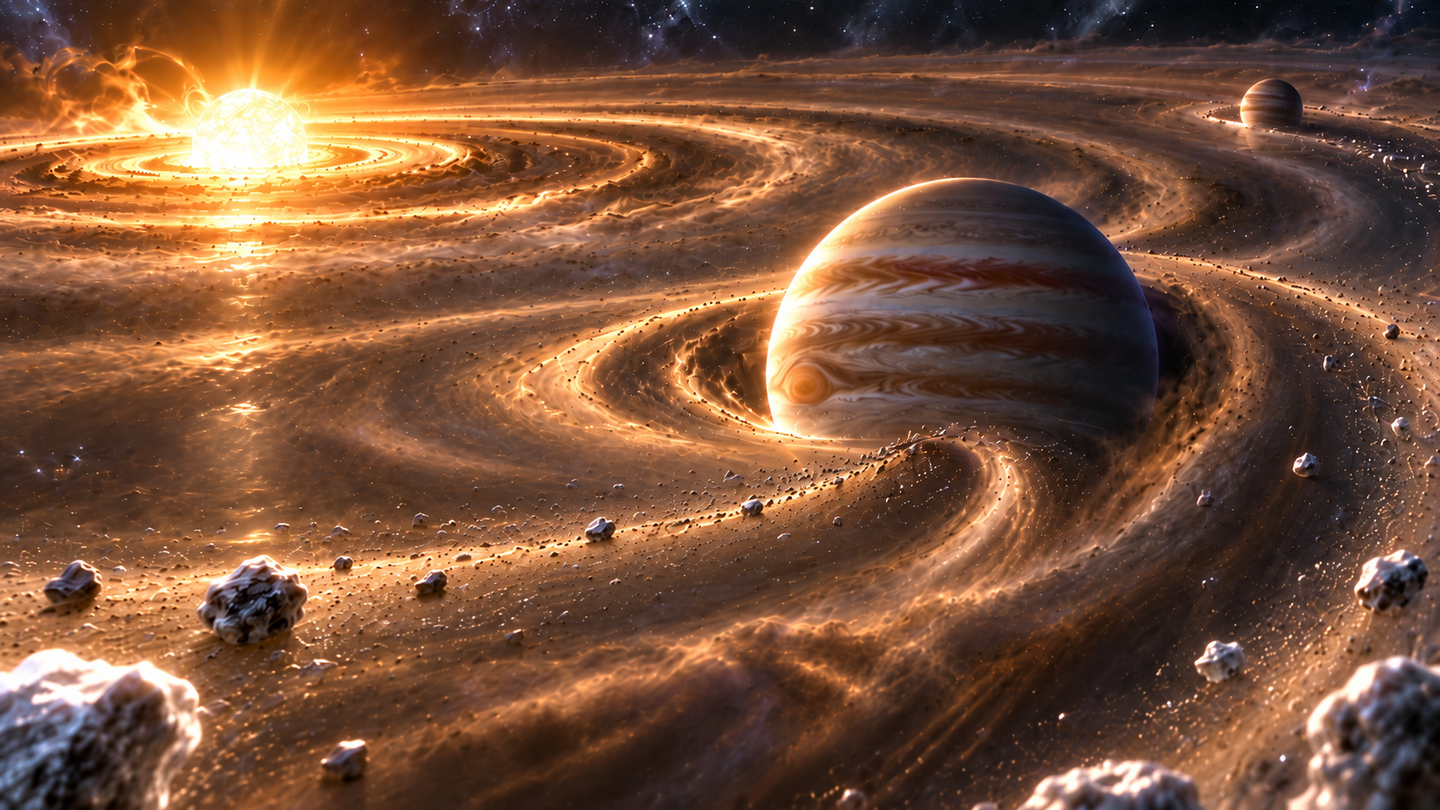
Simulations show drifting icy pebbles can build 10-Earth-mass cores for Jupiter-like planets in only about 200,000 years. (CREDIT: Shutterstock)
- New simulations suggest gas giants can build roughly 10-Earth-mass solid cores in about 200,000 years when icy pebbles drifting inward from the outer disk grow into planetesimals before being swept up by embryos.
- Instead of relying mainly on inefficient direct pebble capture, the process concentrates solid material between roughly 6 and 9 astronomical units, where relatively small planetesimals can feed planetary cores rapidly.
- The model offers a possible solution to the long-standing problem of forming Jupiter-like planets before their gas disks disappear or their growing cores migrate too close to their stars.
Building something as massive as Jupiter presents planetary scientists with a timing problem. A giant planet must assemble a large solid core while plenty of hydrogen and helium still surrounds its young star, yet conventional planet-building processes can take too long.
Computer simulations now suggest a possible shortcut.
Icy particles born far from a young star can drift inward, collide and grow into larger bodies that pile up in a relatively narrow region of the protoplanetary disk. Planetary embryos there can then consume the concentrated material quickly enough to reach approximately 10 Earth masses in around 200,000 years.
The research by Hiroshi Kobayashi of Nagoya University and Hidekazu Tanaka of Tohoku University was published in The Astrophysical Journal. Their model follows material continuously from microscopic dust through pebbles and planetesimals to planetary cores, rather than treating those stages separately.
“We already know quite a bit about how planets are made,” Kobayashi told The Brighter Side of News. “Despite everything we know, the formation of gas giants, like Jupiter and Saturn, has long baffled scientists.”
Giant planets face a race against time
Jupiter and Saturn contain enormous amounts of hydrogen and helium, but the standard core-accretion picture begins with something much smaller.
A rocky and icy core first has to grow massive enough for its gravity to begin rapidly accumulating gas. The critical core is commonly estimated at around 10 Earth masses.
The problem is getting there quickly.
Growing such a core by collecting planetesimals roughly 10 kilometers across can require around 10 million years in the Jupiter-Saturn region. Protoplanetary gas disks typically survive only several million years, meaning the raw material needed to create a giant atmosphere may disappear first.
Growing planets face another clock. Gravitational interactions with the surrounding disk can drive Type I migration, pulling massive planetary embryos toward their star on timescales that can approach 100,000 years.
A core therefore needs to become massive enough for rapid gas accretion before migration carries it away from the region where a cold gas giant can form.
Pebbles help, but most escape
Pebble accretion has offered one solution.
Tiny dust particles collide in the outer disk and gradually produce pebble-sized objects. Gas drag causes these pebbles to lose orbital energy and spiral toward the star.
A planetary embryo can capture some of that flow much more efficiently than it could collect widely separated large planetesimals. Models have therefore shown that pebble accretion can dramatically accelerate planetary growth.
But Kobayashi and Tanaka identified an efficiency problem.
A single planetary core may capture less than 10% of the pebbles passing its orbit. Building one 10-Earth-mass core through direct pebble accretion could therefore require several hundred Earth masses of solid material flowing through the disk.
Disks containing that much solid material appear uncommon.
Instead of assuming the pebbles stay small until a growing planet captures them, the new model follows what happens as the drifting particles continue colliding with one another.
Drifting ice becomes a reservoir of planetesimals
The researchers developed what they call a dust-to-planet simulation that can follow collisional evolution across an enormous range of sizes.
The simulated disk extended from roughly 3 to 108 astronomical units, or au. One au equals the average Earth-Sun distance. Jupiter currently orbits at about 5.2 au, while Saturn lies near 9.5 au.
Dust first coagulated into porous aggregates. As these objects grew, gas drag caused pebble-sized material from the outer disk to drift inward.
Once those icy pebbles entered the inner portion of the simulated disk, something important happened: collisions converted them into larger planetesimal precursors and planetesimals before they could continue spiraling inward.
The process was especially effective inside roughly 10 au.
Because planetesimals respond much less strongly to gas drag than pebbles, their inward migration slowed dramatically. Material that had traveled inward from across the outer disk therefore began piling up.
Between approximately 6 and 9 au, the solid surface density increased by about a factor of 10.
Small planetesimals fueled exceptionally fast growth
The resulting cores did not grow primarily by swallowing intact drifting pebbles.
Instead, objects roughly 100 meters to 10 kilometers across supplied much of the mass. Their concentration around the developing embryos created an unusually efficient feeding environment.
At approximately 7 au, the simulated solid surface density eventually climbed to about 20 grams per square centimeter. The researchers estimated that only roughly 3 grams per square centimeter were necessary to build a 10-Earth-mass core under those conditions.
Planetary embryos exceeding 10 Earth masses appeared near 6 to 7 au after approximately 200,000 years.
The researchers estimated that once the concentration of smaller planetesimals had developed, the immediate core-growth timescale could fall to roughly 20,000 years, much shorter than the expected Type I migration timescale.
This distinction is important. The mechanism does not simply make pebble accretion more efficient. It converts a drifting pebble supply into a reservoir of larger objects that growing cores can capture effectively.
The formation zone resembles Jupiter’s birthplace
The location produced by the simulation also attracted the researchers' attention.
Cores reached giant-planet size near 6 to 7 au. After rapid gas accretion and subsequent orbital migration, a Jupiter-mass planet could potentially move somewhat inward from that starting location.
That places the outcome surprisingly close to Jupiter's present 5.2-au orbit.
“We expect our research will help lead to the full elucidation of the origin of habitable planets, not only in the solar system, but also in other planetary systems around stars,” Kobayashi said.
The simulations also showed that disk composition matters. With a lower solid-to-gas ratio, giant-planet cores appeared closer to the star, around 3 to 4 au, and required approximately 300,000 years.
Disks containing less than about 100 Earth masses of solids had greater difficulty forming giant planets quickly enough.
Giant planets could shape where habitable worlds emerge
The results remain a theoretical model rather than a direct reconstruction of Jupiter's birth.
The calculations make assumptions about collisions, turbulence, disk structure and how growing solids behave. For example, the simulation largely neglected fragmentation, a process that could alter the size distribution and availability of material.
Even so, the work shows why treating dust, pebbles and planetesimals as one connected system can change the outcome.
Gas giants profoundly reshape young planetary systems. Their gravity scatters smaller bodies, influences planet migration and affects the delivery or removal of volatile-rich material from rocky worlds.
Understanding how quickly and where they form is therefore connected to a broader question: what conditions ultimately allow Earth-like planets to emerge and remain in stable environments?
The simulations suggest the answer may begin with microscopic grains of ice formed tens of billions of kilometers from a young star. As those grains drift inward, their collisions can turn them into the building blocks of worlds hundreds of times more massive than Earth.
Dig deeper into giant planet formation
These resources explore how dust, pebbles, planetesimals, migration and gas accretion combine to produce Jupiter-like planets in young planetary systems.
Formation of Giant Planets: A comprehensive review of modern giant-planet formation theory, including core-growth timescales, planetesimal and pebble accretion, gas capture and constraints from Jupiter, Saturn and exoplanets. (Annual Review of Astronomy and Astrophysics, 2025)
Giant planet formation in the Solar System: Uses N-body simulations to test how planetesimal populations, pebble accretion and disk properties influence whether systems resembling the Solar System's giant planets can emerge. (Icarus, 2024)
Sequential giant planet formation initiated by disc substructure: Connects dust coagulation, radial drift, planetesimal formation, pebble accretion, migration and gas growth in a unified model that rapidly produces multiple giant planets. (Astronomy & Astrophysics, 2024)
Research findings are available online in the journal The Astrophysical Journal.
The original story "New computer simulation reveals exactly how gas giants form" is published in The Brighter Side of News.
Related Stories
- From gas giants to rocky worlds: Why planets in our solar system differ
- JWST detects phosphine gas in the atmosphere of brown dwarf star, stunning astronomers
- Rethinking the “Ice Giants”: Uranus and Neptune may be rockier than we thought
Like these kind of feel good stories? Get The Brighter Side of News' newsletter.
Joseph Shavit
Writer, Editor-At-Large and Publisher
Joseph Shavit, based in Los Angeles, is a seasoned science journalist, editor and co-founder of The Brighter Side of News, where he transforms complex discoveries into clear, engaging stories for general readers. With vast experience at major media companies like The Los Angeles Times, Times Mirror and Tribune Publishing, he writes with both authority and curiosity. His writing focuses on space science, planetary science, quantum mechanics, geology. Known for linking breakthroughs to real-world markets, he highlights how research transitions into products and industries that shape daily life.