Scientists develop a greener, catalyst-free, rocket thruster to power the next generation of spacecraft
A new electric ignition system fired an ADN thruster in 0.64 seconds while an arc helped suppress unstable pressure swings.

 Edited By: Joshua Shavit

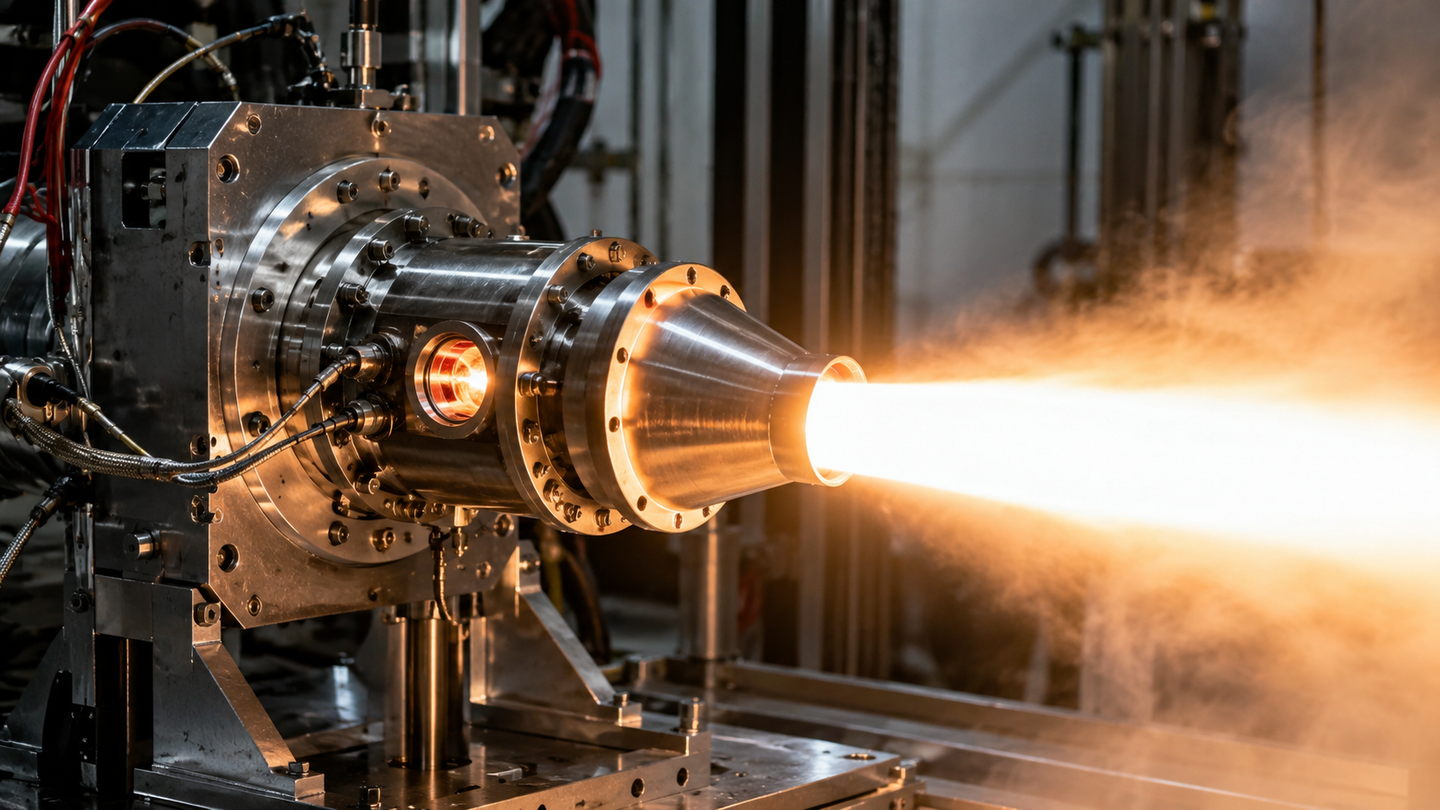
An ADN green rocket thruster ignited electrically at room temperature, eliminating the need for a preheated catalyst bed. (CREDIT: Wikimedia / AI-Generated / CC BY-SA 4.0)
- An experimental green rocket thruster successfully ignited at room temperature using electricity instead of a preheated catalyst.
- The system passed current directly through an ammonium dinitramide fuel, while an electric arc helped reduce unstable pressure swings.
- The design avoids long catalyst preheating, but high electrical demand and combustion instability remain major challenges.
An experimental “green” rocket thruster has fired successfully using ammonium dinitramide fuel without the catalyst bed normally required to ignite it, offering a possible way around long preheating times and catalyst durability problems.
The thruster still burns ammonium dinitramide, or ADN, a high-energy oxidizer used in liquid monopropellants. The difference is how ignition occurs: electrical current heats the conductive propellant directly instead of relying on a preheated catalyst.
The design combines resistive ignition with arc-assisted combustion. Instead of preheating a catalyst, electric current passes directly through the conductive propellant. That current generates Joule heat, which drives decomposition and ignition.
The work, reported in Space: Science & Technology, marks the first successful use of electrical ignition for an ADN-based liquid propellant inside a thruster.
Replacing a hot catalyst bed with electricity
Catalytic ignition has helped ADN propulsion reach space, but it comes with difficult tradeoffs. A catalyst must decompose the propellant at low temperature while surviving combustion temperatures above 1,500 K in an acidic, oxidizing environment.
Existing systems also need substantial preheating. During the Prisma flight demonstration, a catalyst bed took about 600 to 720 seconds to reach 613 K. Engineers conservatively allowed 30 minutes before ignition, and each preheating cycle consumed about 25 kilojoules.
Insufficient heating can also cause a hard start. Propellant may accumulate before ignition, creating a sharp pressure rise and, in the worst case, an explosion.
The experimental thruster targeted 5 newtons of thrust and used a propellant flow rate of about 2.5 grams per second. Its fuel contained 61.43% ADN, 12.24% methanol and 26.33% water by weight. The same formulation was used on China’s Shijian 17 satellite in 2016.
Inside the thruster, propellant passes through a decomposition area fitted with metal electrodes. Once enough liquid bridges the positive and negative electrodes, current flows through the propellant itself and heating begins.
A second pair of electrodes creates an arc inside the combustion chamber. That plasma can further ignite decomposition products before hot gases leave through a de Laval nozzle.
A cold start at room temperature
The thruster was tested without preheating at 298 ± 2 K. During a 30-second hot-fire run at 80 volts, it reached a mean combustion chamber pressure of 0.93 megapascals.
The ignition delay was 0.64 seconds, while chamber pressure reached 90% of its steady value after 1.02 seconds. Characteristic velocity, a measure tied to propellant energy and combustion efficiency, reached 1,168.7 meters per second.
During steady operation, the decomposition circuit carried an average current of 3.3 amperes and drew about 263 watts.
That power demand is a clear weakness. The researchers noted that 263 watts places a substantial load on the power system. Future work could improve the ignition system or develop fuel formulations that sustain combustion with less electrical input.
Voltage strongly affected startup speed. Raising ignition voltage from 60 to 100 volts reduced ignition delay from 0.93 to 0.47 seconds.
Yet the highest voltage did not produce the best overall startup. At 100 volts, increased bubble formation near the electrodes raised electrical resistance and could interrupt heating. The team found 80 volts produced the best balance between Joule heating and bubble formation.
The arc steadied an unstable flame
The arc was helpful, but not essential.
The thruster could still ignite and establish chamber pressure without it. Mean chamber pressure, ignition delay, pressure establishment time and characteristic velocity changed only slightly as arc loading time varied.
Pressure oscillations changed far more dramatically.
Without the arc, the maximum pressure fluctuation reached about 0.5 megapascals. With arc combustion, the maximum amplitude fell to about 0.12 megapascals. When the arc was switched off after three seconds, pressure fluctuations rose again.
The researchers concluded that plasma from the arc stabilized combustion rather than serving as the primary ignition source.
Electrode geometry also mattered. Reducing the gap between decomposition electrodes shortened ignition delay and pressure establishment time while increasing chamber pressure and characteristic velocity.
A 0.8-millimeter electrode aperture performed best. When the aperture increased from 0.3 to 0.8 millimeters, mean chamber pressure rose from 0.70 to 0.94 megapascals. Ignition delay fell from 1.70 to 0.59 seconds, and pressure establishment time dropped from 4.80 to 0.89 seconds.
Increasing the aperture further to 1.2 millimeters hurt performance. The propellant moved through the decomposition area too quickly, reducing the time available for electrical heating.
Pressure swings trace back to fuel decomposition
The 30-second firing revealed a persistent weakness: low-frequency combustion instability.
Fast Fourier transform analysis showed chamber-pressure oscillations concentrated below 10 hertz, with a dominant frequency around 2 to 4 hertz. Current through the decomposition electrodes oscillated at nearly the same frequency, but in the opposite phase.
That close match linked unstable propellant decomposition directly to unstable combustion.
The fuel undergoes evaporation, bubble growth, decomposition, microexplosions and oxidation while current heats it. Those processes can change droplet behavior and electrical resistance, producing uneven decomposition before the gases reach the chamber.
Spray measurements did not show a direct match between droplet-size fluctuations and pressure oscillations. Droplet-size changes occurred mainly above 50 hertz, much faster than chamber-pressure disturbances. The researchers therefore concluded that atomization plays an indirect role.
Practical implications of the research
The electrical design removes the catalyst bed and its long preheating requirement, allowing room-temperature ignition while avoiding problems caused by catalyst aging and insufficient warmup.
It also gives engineers new variables to optimize. Ignition voltage, electrode spacing, aperture size and arc operation all changed startup or stability in measurable ways.
The remaining obstacles are substantial. Electrical ignition requires high power, and the thruster still experiences low-frequency combustion instability. The work points toward two priorities: reducing electrical demand and stabilizing propellant decomposition.
If those problems can be controlled, catalyst-free ADN thrusters could offer a more flexible route to high-performance green propulsion while preserving the cold-start advantage demonstrated in these first hot-fire tests.
Dig deeper into green rocket propellants and ADN combustion
These resources explore how ADN propellants ignite and burn, why electrical ignition is attracting interest, and the catalyst and combustion challenges facing greener spacecraft propulsion.
Insights into combustion characteristics and mechanisms of green liquid propellant under electric ignition
Using high-speed imaging, spectroscopy and chemical analysis, researchers found that electrical ignition of ADN propellant depends on competition between resistive heating and bubble formation, with about 80 volts producing the best ignition behavior. (Aerospace Science and Technology, 2026)
Electrical ignition characteristics and combustion emission spectra of continuous-flow ADN-based liquid propellant
This continuous-flow experiment examined how voltage and propellant flow affect ignition, energy use and combustion chemistry, finding that higher voltage can accelerate decomposition but excessive voltage can contribute to unstable combustion. (Fuel, 2026)
Electrical ignition of ADN-based green liquid propellant in constant volume combustion chamber and continuous flow
Researchers demonstrated electrical ignition of ADN propellant in both a combustion chamber and continuous flow, showing how voltage and pressure affect ignition time, energy consumption, combustion pressure and exhaust composition. (Advances in Space Research, 2025)
Performance Evaluation of Ammonium Dinitramide-Based Monopropellant in a 1N Thruster
A 1-newton ADN thruster achieved combustion efficiency as high as 91% during catalytic hot-fire testing, providing a useful comparison with emerging catalyst-free electrical ignition approaches. (Aerospace, 2024)
Research progress on the catalytic and thermal decomposition of ammonium dinitramide (ADN)
This review examines ADN’s thermal and catalytic decomposition pathways and explains why developing catalysts that work at low temperatures while surviving harsh thruster conditions remains difficult. (RSC Advances, 2024)
Research findings are available online in the journal Space: Science & Technology.
The original story "Scientists develop a greener, catalyst-free, rocket thruster to power the next generation of spacecraft" is published in The Brighter Side of News.
Related Stories
- Can rockets ride on a microwave beam? A radical launch idea is moving beyond the lab
- NASA's lithium-fed electric thruster could carry humans to Mars and beyond
- Pulsar Fusion’s Sunbird fusion rocket could get us to Mars in half the time
Like these kind of feel good stories? Get The Brighter Side of News' newsletter.
Joseph Shavit
Writer, Editor-At-Large and Publisher
Joseph Shavit, based in Los Angeles, is a seasoned science journalist, editor and co-founder of The Brighter Side of News, where he transforms complex discoveries into clear, engaging stories for general readers. With vast experience at major media companies like The Los Angeles Times, Times Mirror and Tribune Publishing, he writes with both authority and curiosity. His writing focuses on space science, planetary science, quantum mechanics, geology. Known for linking breakthroughs to real-world markets, he highlights how research transitions into products and industries that shape daily life.