An atom-and-photon network just found a new way to store AI memories
Ultracold atoms and photons turned a frustrated spin glass into an unusual memory network with unexpectedly high storage capacity.
 Stanford University Writer: Sara Zaske

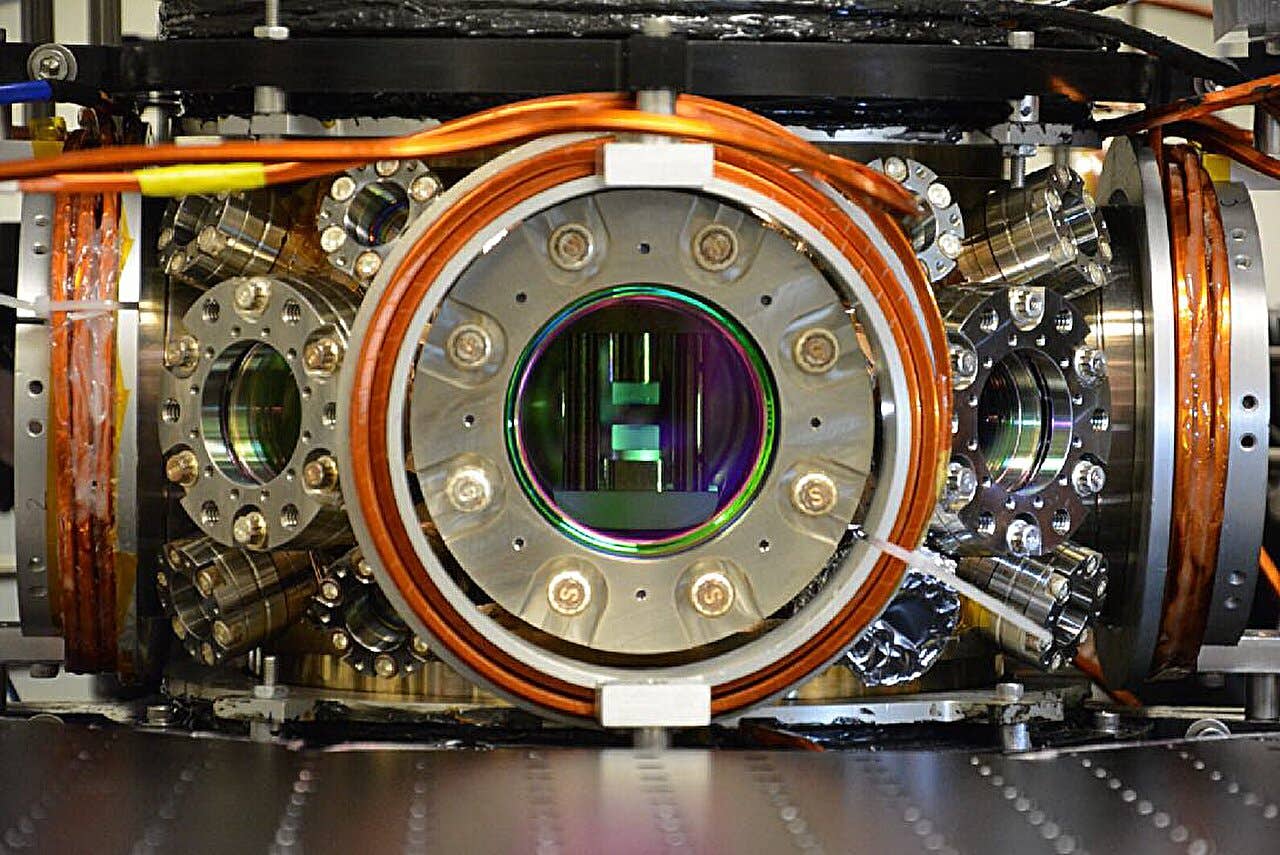
Quantum-optical spin glass apparatus: The curved mirrors (green-tinted cylinders at center) form an optical cavity to trap photons inside a stainless-steel vacuum chamber. The windows allow lasers to create and trap quantum gases (not present in this photo) between the mirrors. (CREDIT: Benjamin Lev/Stanford University)
- A network made from ultracold atoms and photons functioned as an associative memory, recovering stored patterns even when researchers supplied incomplete or corrupted information.
- The quantum-optical spin glass stored substantially more useful memories than a comparable Hopfield network, reaching 25 memories in one 16-spin configuration.
- Motion of the atomic ensembles temporarily changed the network’s connections and improved recall, producing behavior the researchers compare with short-term synaptic plasticity.
A tangled state of matter that once represented failure for an influential type of artificial neural network has been turned into a working memory system.
Researchers led by Stanford University physicist Benjamin Lev created a network from ultracold atomic gases and photons that can recover complete stored patterns from incomplete information. The ability, known as associative memory, resembles recognizing a familiar face despite seeing only a blurred or damaged image.
The work appears in Science under the title “High-capacity associative memory in a quantum-optical spin glass.” The experiment demonstrated that a spin glass can function as an associative memory and, under the conditions tested, hold considerably more useful memories than a traditional Hopfield network of the same size.
“We can now make neural networks at the atomic level, and they adjust themselves in a way that is somewhat similar to how we believe our brains learn,” Lev said.
The experiment remains a small laboratory demonstration. It used networks containing no more than about 20 effective spins and required ultracold atoms inside an optical cavity. It does not provide a practical replacement for conventional AI processors.
Instead, it shows that physical systems can exploit dynamics normally viewed as undesirable to perform computation differently.
The problem hidden inside Hopfield networks
The idea reaches back to physicist John Hopfield’s landmark work on neural networks.
In a Hopfield network, artificial neurons can be represented as binary spins pointing in one of two directions. The interactions among those spins create an energy landscape filled with valleys.
Each desired memory occupies one of those valleys.
Give the network a damaged version of a stored pattern, and the spins evolve toward a low-energy configuration. If everything works properly, the network falls into the valley representing the original memory and reconstructs the missing information.
The difficulty comes when too many memories are added.
Their interactions make the landscape increasingly complicated. Eventually the system enters a spin-glass state filled with large numbers of competing minima. Traditional Hopfield dynamics can then become trapped in unintended configurations, destroying reliable recall.
Spin glasses were therefore traditionally treated as a problem for associative memory.
The Stanford-led team essentially reversed that logic. Instead of avoiding the glassy landscape, it found a way to use many of those additional valleys as memories.
Building neurons from ultracold atoms
The researchers constructed their network using rubidium Bose-Einstein condensates held in place with optical tweezers.
Each condensate contained thousands of atoms occupying a collective quantum state. Rather than controlling every atom separately, the researchers treated each cloud as an effective spin that could occupy one of two density-wave states.
These atomic ensembles sat inside an optical cavity formed by mirrors.
Photons bounced through thousands of nearly degenerate cavity modes, allowing the atomic spins to interact across the entire network. The resulting connections could be positive or negative, producing the frustration needed to create a spin glass.
To test memory recall, the team gave the network corrupted input patterns and allowed the atoms and cavity light to evolve.
The system moved toward lower-energy arrangements until it settled into one of its stable configurations. Researchers then measured light emitted from the cavity to determine the final spin pattern.
Networks contained up to 20 spins, although the most detailed memory-capacity measurements focused on smaller systems.
Seven times the Hopfield capacity
The largest improvement appeared in a 16-spin network.
Under one set of conditions, the researchers measured 25 useful memories. That was about seven times the capacity of the comparable Hopfield model using conventional Hebbian learning.
Across five different 16-spin networks under the standard experimental conditions, average memory capacity reached 11.9, compared with 3.6 memories for the Hopfield comparison.
There was a trade-off.
The average memory basin, a measure of how much corruption an input can tolerate before recall fails, was smaller in the spin glass. Its average basin size was 2.1 spin flips, compared with 3.9 for the Hopfield model.
The result therefore does not mean the new system beats Hopfield networks in every measure. It stores more attractor memories, but individual memories can be less resistant to errors.
What makes the experiment unusual is how those memories become stable.
The system operates with driven, dissipative dynamics that encourage particularly strong movement toward lower-energy states. Minima that would have behaved like unreliable interference in an ordinary spin glass can instead become usable destinations for memory recall.
Connections that move while remembering
The atoms themselves provided another advantage.
The optical tweezers holding the atomic clouds were not perfectly rigid. Forces generated by the cavity light could shift individual condensates slightly from their original positions.
Those movements changed how strongly different spins interacted.
In effect, the network temporarily modified its own connections while attempting to recall a memory. The changing connectivity could deepen the energy valley surrounding the emerging pattern, reinforcing the network’s movement toward that memory.
The researchers call the effect polaronic because the motion resembles how particles can distort a surrounding crystal lattice and then interact with the deformation they created.
It also bears a loose resemblance to short-term synaptic plasticity in biological nervous systems, where connections between neurons temporarily strengthen or weaken.
The comparison has limits. These atomic clouds are not neurons, and the experiment does not reproduce biological learning.
The team also found that the positional shifts disappeared when the optical drive was removed, making the present effect elastic rather than a persistent learned change.
From physics experiment to possible computing hardware
Future versions could attempt to create longer-lasting changes in connectivity and expand the number of spins.
The authors suggest that larger optical-tweezer arrays could eventually support photonic denoisers, amplifiers or quantum associative memories. They are also interested in adding genuinely quantum spin-1/2 degrees of freedom and entanglement.
Whether such systems can become useful AI hardware remains unanswered.
Maintaining Bose-Einstein condensates, precision optical cavities and ultracold conditions is far more demanding than operating conventional silicon processors. Scaling from tens of spins to the enormous networks used in modern AI would require major technological advances.
Yet the experiment demonstrates a different principle.
A physical system does not necessarily need to imitate digital neural-network hardware to perform neural-network-like computation. Its own light, motion, disorder and energy landscape can become part of the calculation.
“It’s great to shoot for these applications,” Lev said, “but we're also doing this because we want to know more about how nature works.”
Dig deeper into quantum-optical networks and associative memory
These five studies explore the spin-glass physics, optical neural networks and associative-memory concepts behind the new experiment.
A multimode cavity QED Ising spin glass: This earlier experiment created the driven-dissipative Ising spin glass used as the physical foundation for the new associative-memory system, with ultracold atomic ensembles connected through a multimode optical cavity. (Physical Review Letters, 2025)
Directly observing replica symmetry breaking in a vector quantum-optical spin glass: Researchers directly observed signatures of replica symmetry breaking and ultrametric organization in a controllable quantum-optical spin glass, revealing the complex energy landscape that can later be exploited for memory. (Science, 2025)
Dense associative memory in a nonlinear-optical Hopfield neural network: This optical implementation explores how nonlinear interactions can substantially increase the storage capacity of Hopfield-style associative memories, providing a complementary photonic route to higher-capacity physical neural networks. (Physical Review Applied, 2026)
Physical Considerations in Memory and Information Storage: This review examines associative memory through statistical mechanics and energy landscapes, including the Hopfield model, physical implementations and connections with modern machine-learning systems. (Annual Review of Physical Chemistry, 2025)
Optimal storage capacity of quantum Hopfield neural networks: The study investigates how quantum versions of Hopfield networks store and retrieve corrupted patterns and analyzes fundamental limits on their associative-memory capacity. (Physical Review Research, 2023)
Research findings are available online in the journal Science.
The original story "An atom-and-photon network just found a new way to store AI memories" is published in The Brighter Side of News.
Related Stories
- New material tackles one of the biggest barriers to scaling artificial intelligence
- How artificial intelligence can reduce selfish behavior and reshape society
- The unprecedented link between quantum physics and artificial intelligence
Like these kind of feel good stories? Get The Brighter Side of News' newsletter.
Shy Cohen
Writer