Amateur astronomer leads scientists to a massive 390-million-year-old impact crater in Quebec
Shatter cones and fieldwork transformed a strange circle on satellite maps into strong evidence for a major ancient impact crater.

 Edited By: Joseph Shavit

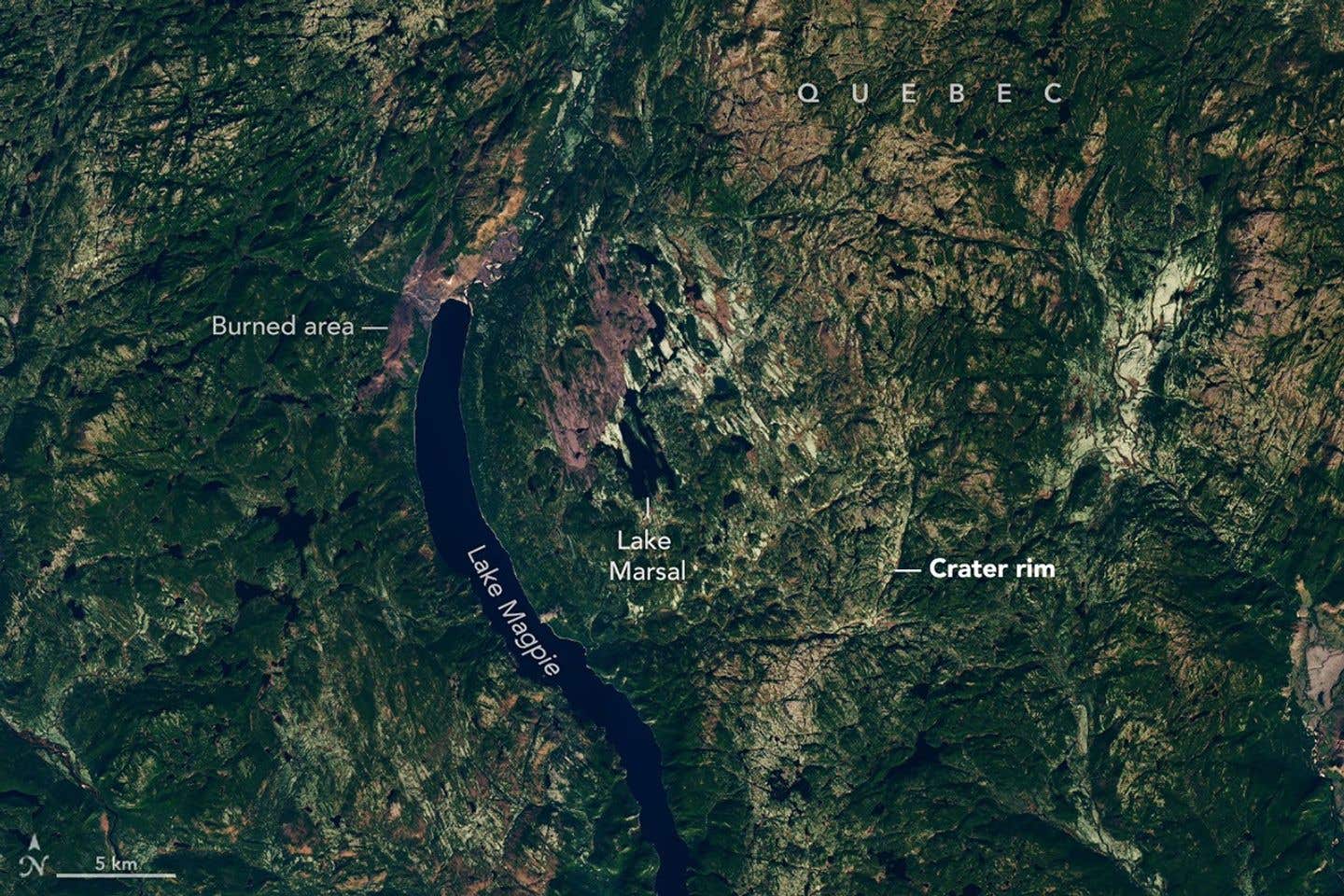
A camper’s map search led scientists to a likely 25-kilometer impact crater in Quebec, with evidence pointing to a 390-million-year-old strike. (CREDIT: NASA Earth Observatory / Lauren Dauphin)
- A circular feature first noticed by an amateur astronomer planning a camping trip in Quebec has turned out to be strong evidence of a previously unrecognized impact crater about 25 kilometers wide.
- Fieldwork in 2025 uncovered shatter cones, the clearest visible sign of an impact event, and rock samples suggest the structure formed roughly 390 million years ago.
- The site, named Uhackatik after consultation with the Innu Council of Ekuanitshit, would become one of Quebec’s known impact structures if formally recognized by the Meteoritical Society.
A remote lake in Quebec has gone from a possible campsite marker to one of the most intriguing geological finds in recent years.
The discovery began when amateur astronomer Joël Lapointe noticed a striking circular feature near Lake Marsal while planning a camping trip to Quebec’s Côte-Nord region in 2024. The feature looked unusual enough on satellite imagery that he contacted specialists in North America and Europe to ask whether it might be an impact crater.
That tip has now led to strong evidence for a previously unrecognized meteorite impact structure about 25 kilometers, or 16 miles, across. Researchers say the crater likely formed around 390 million years ago, making it an ancient scar from a collision powerful enough to reshape the landscape on a regional scale.
The emerging find was described by researchers working with planetary geologist Gordon Osinski of Western University, who also directs the Impact Earth database. Formal recognition by the Meteoritical Society is still pending, but the team now considers the impact origin essentially established.
A suspicious circle caught one camper’s eye
Earth has only about 200 confirmed impact structures, even though geologists have long suspected that hundreds more remain hidden by erosion, burial, vegetation, or simple remoteness. That is why the circular feature near Lake Marsal stood out.
Lapointe was not conducting a formal geological survey. He was looking at online maps for outdoor travel when he noticed the unusual shape. Instead of dismissing it, he asked experts whether it could be something significant.
His observation helped prompt French researchers to list the area as the center of a possible impact structure at a 2024 Meteoritical Society meeting. That possibility eventually reached Osinski, whose work focuses on impact craters on Earth and other planetary bodies.
At first, he was doubtful. Circular landforms can form in many ways, and previous mapping had suggested a volcanic explanation. But the feature was compelling enough that he organized an expedition to the isolated site in October 2025.
Reaching the site was a challenge of its own
Getting there was not simple.
Osinski and his colleagues traveled by floatplane, but the aircraft could not make it all the way to shore. The team had to carry their equipment and wade through about 50 meters, or 165 feet, of water before reaching land.
The difficulties continued once they arrived. The terrain was swampy, rugged, buggy, and packed with what Osinski described as “deep, twisty, gnarly vegetation.” Despite years of geological fieldwork on six continents, he said the site ranked among the most physically challenging he had encountered.
That difficult access helps explain why the feature escaped close study for so long.
Earlier geologic work had interpreted local breccia, a rock made of broken fragments cemented together, as part of a diatreme. A diatreme is a pipe-like volcanic structure formed by explosive eruptions, and it can resemble the chaotic rock patterns seen in impact zones.
That volcanic interpretation began to unravel almost immediately once the team started examining the outcrops directly.
Shatter cones changed the picture
By the second day of fieldwork, researchers found shatter cones in multiple rock exposures.
These distinctive conical fractures form under the extreme shock pressures generated by a meteorite impact. They are widely regarded as the most reliable impact feature visible in the field without laboratory testing.
“It’s the only unequivocal evidence of an impact event that you can see in the field with the naked eye,” Osinski said.
That discovery transformed the interpretation of the site. Instead of a volcanic pipe, the structure appears to be a large complex impact crater with a central uplift, meaning the crust rebounded upward after the collision. Researchers also described high cliffs showing columnar jointing within the crater landscape.
Taken together, the landform and the shock evidence indicate that the object that struck the region was large enough to excavate a crater comparable in size to some of Quebec’s major lakes.
The impact happened about 390 million years ago
Rock samples suggest the crater formed roughly 390 million years ago.
That date places the impact in the Devonian Period, long before the rise of dinosaurs and about 100 million years before a proposed increase in impact activity on Earth that some researchers have linked to collisions in the asteroid belt.
If the age estimate holds, Uhackatik would join a small but important group of terrestrial craters that help scientists reconstruct Earth’s impact history. Every newly identified crater matters because Earth’s active geology erases evidence far more effectively than the Moon or Mars does.
The size also makes the site notable. At about 25 kilometers across, it is the largest impact crater discovered since the 31-kilometer Hiawatha structure beneath Greenland’s ice was announced in 2018.
A similar impact striking populated Quebec today would be catastrophic. Osinski said it would cause “regional devastation on a scale that would wipe out major cities and have global climate impacts.”
A new name and a pending formal decision
Following discussions with the Innu Council of Ekuanitshit, the team is calling the crater Uhackatik.
Formal recognition still rests with the Meteoritical Society’s impact-cratering committee, which evaluates evidence before adding sites to the official list of confirmed impact structures. That step remains pending, but the field evidence has already convinced the researchers involved.
The site’s remoteness means it is unlikely to become a routine training ground, even though Osinski is part of NASA’s first Artemis Geology Team and helps train astronauts in planetary geology. He has said the much more accessible Mistastin Lake impact structure in Labrador remains a better candidate for that purpose.
A reminder that discovery is not reserved for professionals
One of the most striking parts of the story is how it began.
Lapointe was not part of a university expedition or a government geological survey. He simply noticed something odd, trusted his observation, and asked questions. After scientists confirmed the significance of the feature, he told CityNews he was “over the Moon.”
He offered a broader lesson as well: “I encourage everyone to not ignore intuition or an observation, even if it isn’t part of your field of expertise.”
That advice fits a larger truth in Earth and planetary science. Many discoveries begin not with a complex instrument, but with someone noticing a pattern others missed.
In a world where satellite imagery is widely available and many landscapes remain poorly studied, citizen observations can still lead to major scientific advances. Uhackatik appears to be a powerful example of that, an ancient crater brought back into view because one camper took a second look at a circle on a map.
The original story "Amateur astronomer leads scientists to a massive 390-million-year-old impact crater in Quebec" is published in The Brighter Side of News.
Related Stories
- 10,000-year-old impact crater in China reveals meteorite strike equal to 40 atomic bombs
- Scientists discover America's largest impact crater from 35 million years ago
- Silverpit Crater mystery solved: Asteroid crashed into the North Sea 43 million years ago
Like these kind of feel good stories? Get The Brighter Side of News' newsletter.
Joshua Shavit
Writer and Editor
Joshua Shavit is a NorCal-based science and technology writer with a passion for exploring the breakthroughs shaping the future. As a co-founder of The Brighter Side of News, he focuses on positive and transformative advancements in technology, physics, engineering, robotics, and astronomy. Having published articles on AOL.com, MSN, Yahoo News, and Ground News, Joshua's work highlights the innovators behind the ideas, bringing readers closer to the people driving progress.