Which came first, the chicken or the egg? Evolution has a surprisingly clear answer
Eggs existed long before chickens, but gradual evolution makes the idea of one genetically distinct “first chicken” surprisingly difficult.

 Edited By: Joshua Shavit

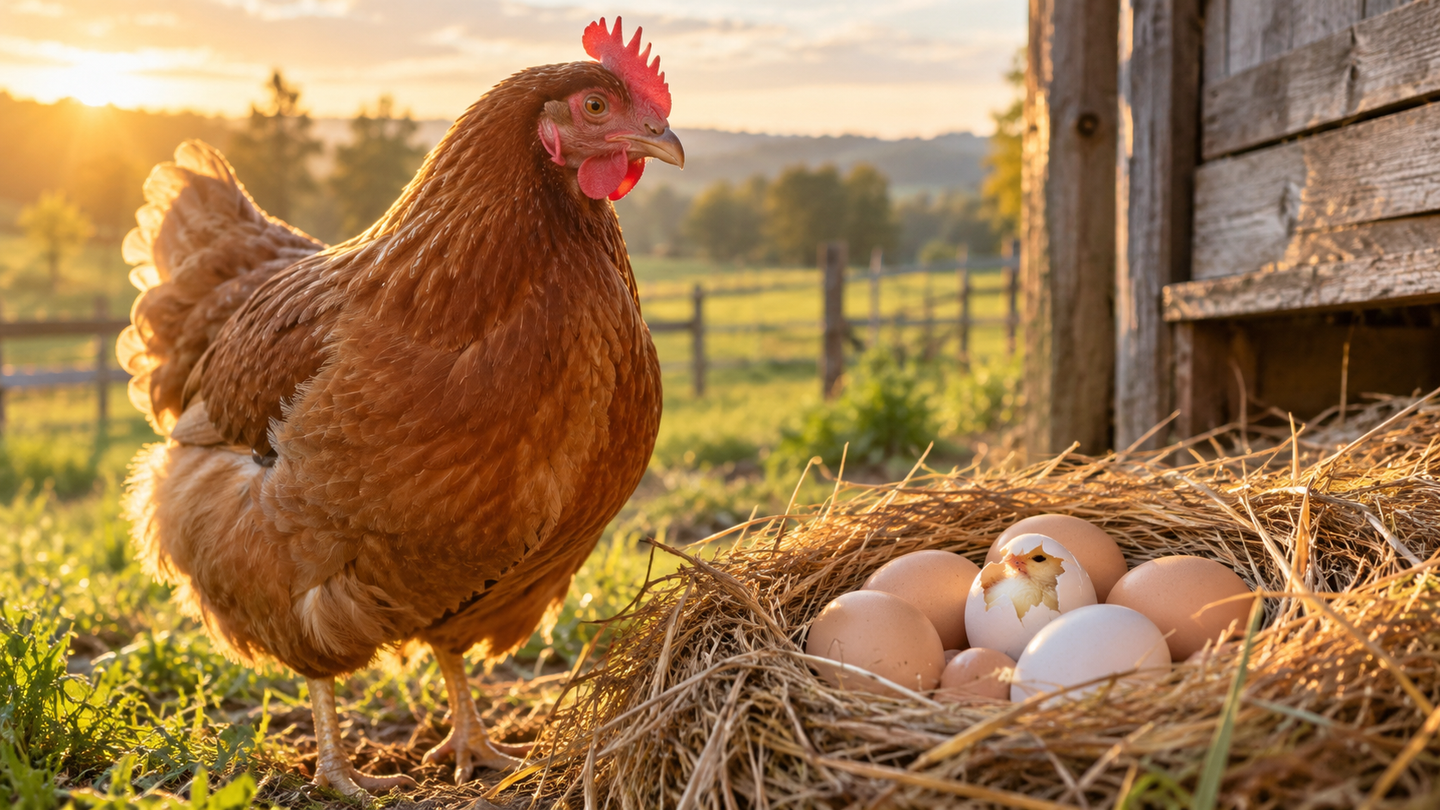
Evolution gives the chicken-and-egg paradox a clear answer, but defining the first true chicken makes the story far more complicated. (CREDIT: Shutterstock)
- From an evolutionary perspective, eggs existed hundreds of millions of years before chickens, appearing in animal lineages long before birds evolved.
- The idea of a single “first chicken” is misleading because species emerge gradually as genetic differences accumulate across populations and generations.
- If the question specifically means the first egg containing an animal we would classify as a chicken, that egg would have been produced by parents that were almost, but not quite, modern chickens.
The question sounds like an impossible loop. Chickens hatch from eggs, but chicken eggs come from chickens, leaving no obvious place for the cycle to begin.
Evolutionary biology breaks that loop by changing the timescale. Egg-laying animals existed vastly earlier than chickens, and even bird-like eggs appeared long before anything resembling a domesticated chicken walked the Earth.
That makes the broad scientific answer straightforward: the egg came first. The more interesting question is what counts as a “chicken egg” and whether evolution ever produced a single identifiable first chicken.
Those questions lead from dinosaurs and ancient reproduction to genetics, domestication and the blurry boundaries scientists encounter when defining species.
Eggs are vastly older than chickens
Animals were reproducing through eggs long before birds evolved. Fish, amphibians, reptiles and numerous extinct lineages all relied on egg-based reproduction, making the biological egg far older than either chickens or dinosaurs.
Birds eventually emerged from theropod dinosaurs, and fossil evidence shows that non-avian dinosaurs already laid eggs and built nests. Some theropods also displayed reproductive characteristics later inherited by birds, including organized clutches and forms of brooding behavior.
Fossils of the dinosaur Troodon, for example, revealed nests containing relatively large eggs arranged in ways that combined reptile-like and bird-like reproductive characteristics. Such discoveries document evolutionary transitions in reproduction long before modern birds appeared.
If “egg” means any biological egg, there is therefore little scientific mystery. Eggs preceded chickens by an enormous span of evolutionary time.
There probably was no single first chicken
The familiar version of the story imagines two almost-chickens reproducing and producing an egg containing a genetic mutation that created the first true chicken.
It is an appealing explanation, but evolution rarely provides such a clean boundary.
New species generally develop as populations change over many generations. Mutations, recombination, natural selection, genetic drift and population separation gradually alter gene frequencies until populations become sufficiently different that biologists may eventually classify them separately.
Parents and offspring remain extraordinarily similar during that process. There was probably no generation in which two animals that were unquestionably “not chickens” suddenly produced an offspring that was unquestionably a chicken.
Instead, a population of ancestral junglefowl gradually acquired the genetic and physical characteristics associated with later domestic chickens. The original debate therefore partly depends on humans drawing a boundary across a continuous evolutionary process.
Domestication makes the boundary even blurrier
Modern domestic chickens descended primarily from red junglefowl, particularly populations related to Gallus gallus spadiceus found today around southwestern China, northern Thailand and Myanmar.
Genomic research involving hundreds of wild and domestic birds indicates that chicken domestication involved a complicated history rather than one isolated genetic event. After initial domestication, chickens spread with people and continued exchanging genes with wild junglefowl populations.
That means the modern chicken did not suddenly appear when one crucial mutation occurred. Humans gradually altered chicken populations by favoring traits involving behavior, reproduction, growth, appearance and eventually specialized meat or egg production.
Domestic chickens are generally classified as Gallus gallus domesticus, reflecting their close relationship with red junglefowl rather than their emergence as an instantly distinct evolutionary creation.
The question becomes even harder if “first chicken” means the first domesticated chicken. Domestication itself unfolded gradually as relationships between humans and junglefowl changed.
What about the protein that makes chicken eggshells?
One popular version of the chicken-and-egg debate focuses on ovocleidin-17, or OC-17, a protein associated with chicken eggshell formation.
Researchers have shown that OC-17 occurs within the calcified layer of the chicken eggshell and can influence calcium carbonate crystal growth. It is therefore part of the biological machinery involved in producing a strong mineralized shell.
That discovery has sometimes been presented as evidence that the chicken must have come first because a chicken protein is required to make a chicken eggshell.
The logic does not resolve the evolutionary puzzle. Hard-shelled eggs evolved long before domestic chickens, and eggshell mineralization involves numerous proteins and biochemical processes that themselves evolved over time.
OC-17 can help scientists understand how chicken eggshells form, but it does not demonstrate that a fully modern chicken had to precede the evolutionary lineage that produced chicken eggs.
The answer changes with the definition of “egg”
Much of the apparent paradox comes from language rather than biology.
If an egg means any reproductive egg, the egg unquestionably came first. Egg-laying organisms preceded chickens by hundreds of millions of years.
If “chicken egg” means an egg laid by a chicken, someone could define the chicken as coming first because an ancestral bird's egg would not qualify until the animal laying it had already become a chicken.
But if a chicken egg means an egg containing a chicken embryo, then the egg again comes first. The developing bird would acquire its genome at fertilization and emerge from that egg later.
Neither definition reveals a sudden event in evolutionary history. It only changes where people decide to place a linguistic boundary.
An ancient paradox becomes an evolution lesson
The chicken-and-egg question has survived for centuries because it appears to demand a single starting point for a repeating biological cycle. Evolution shows why that intuition can be misleading.
Life is built through descent with modification. Every generation comes from an earlier one, with populations gradually accumulating differences over immense periods.
Chickens belong to that uninterrupted history. Their ancestors reproduced through eggs before chickens existed, just as dinosaur ancestors laid eggs long before the first recognizable birds evolved.
So science can provide a strong answer to the traditional question while adding an important qualification. The egg came first, but there was almost certainly no magical egg containing a radically new creature that everyone would have recognized as the world's first chicken.
Evolution does not usually cross such boundaries in one leap. Humans create the labels afterward.
Dig deeper into chicken evolution and the history of eggs
These studies provide additional scientific context on dinosaur reproduction, chicken genetics, domestication and eggshell biology.
Nest and egg clutches of the dinosaur Troodon formosus and the evolution of avian reproductive traits: Fossil nests reveal a mixture of reptilian and bird-like reproductive features in a non-avian theropod, illuminating how avian reproduction evolved. (Nature, 1997)
Sequence and comparative analysis of the chicken genome provide unique perspectives on vertebrate evolution: The first chicken genome sequence helped establish the species as an important bridge for understanding vertebrate and avian evolution. (Nature, 2004)
Whole-genome resequencing reveals loci under selection during chicken domestication: Genomic comparisons between domestic chickens and red junglefowl identified regions strongly shaped by domestication and selective breeding. (Nature, 2010)
863 genomes reveal the origin and domestication of chicken: Genome-wide evidence traces the principal ancestry of domestic chickens to a red junglefowl lineage centered in parts of Southeast Asia. (Cell Research, 2020)
Crystal Structure of Ovocleidin-17, a Major Protein of the Calcified Gallus gallus Eggshell: Implications in the Calcite Mineral Growth Pattern: Structural experiments showed how an important chicken eggshell protein can influence calcium carbonate crystal growth. (Journal of Biological Chemistry, 2004)
The original story "Which came first, the chicken or the egg? Evolution has a surprisingly clear answer" is published in The Brighter Side of News.
Related Stories
- 240 million-year-old tusked herbivore fossil upends the timeline of early dinosaur evolution
- Beetles across Japan took different evolutionary paths to solve the same feeding problem
- A six-inch fossil just rewrote a major chapter of mammal evolution
Like these kind of feel good stories? Get The Brighter Side of News' newsletter.
Joseph Shavit
Writer, Editor-At-Large and Publisher
Joseph Shavit, based in Los Angeles, is a seasoned science journalist, editor and co-founder of The Brighter Side of News, where he transforms complex discoveries into clear, engaging stories for general readers. With vast experience at major media companies like The Los Angeles Times, Times Mirror and Tribune Publishing, he writes with both authority and curiosity. His writing focuses on space science, planetary science, quantum mechanics, geology. Known for linking breakthroughs to real-world markets, he highlights how research transitions into products and industries that shape daily life.