Creating a digital copy of the human brain faces a bigger problem than simulating 86 billion neurons
Simulating billions of neurons is becoming possible. Measuring one living human brain well enough to copy it remains the harder problem.
 University of Warwick Writer: Matt Higgs

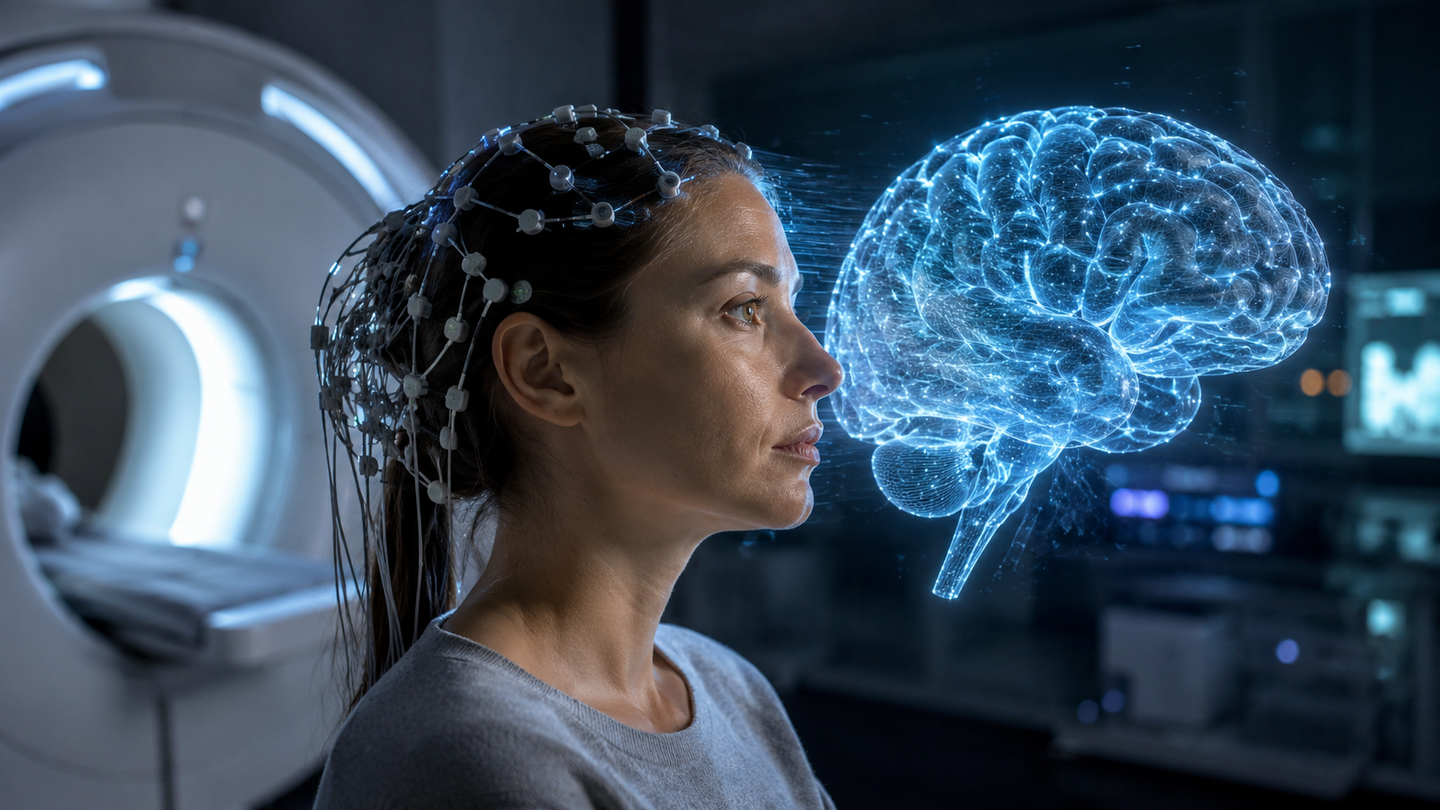
Digital brain twins may depend less on raw computing power than on how precisely scientists can measure and continually update a living brain. (CREDIT: Shutterstock)
- A true digital twin brain would need to represent one specific living person and continue changing as new measurements from that brain arrive.
- A new review argues that the biggest barrier is not simply computing power, but how completely and repeatedly scientists can measure the human brain across scales.
- Human brain twins will probably rely on hybrid models combining sparse microscopic maps, broader circuit statistics and whole-brain imaging rather than an exhaustive map of every synapse.
Building a digital copy of a human brain sounds at first like a computing problem. Give scientists enough processors, enough memory and a sufficiently detailed neural model, and perhaps the machinery could reproduce the activity of tens of billions of neurons.
A new review argues that this framing misses the harder problem.
A genuine digital twin brain would have to represent one particular living person, remain connected to that biological brain through measurements and change as the person changes. Computing an enormous neural network is not enough if scientists cannot observe the real brain closely enough to determine what should go into the model.
Researchers led by Ruohan Zhang of the University of Warwick make that distinction in the review “Building digital twin brains at the limits of measurement,” published in Nature Reviews Electrical Engineering. The authors propose that the achievable fidelity of a digital twin is governed by the resolution, completeness and ability to update the biological measurements used to constrain it.
“A digital twin brain is more than a large-scale simulation of the brain,” Zhang said. “The key distinction is that it represents a specific individual and remains connected to the biological brain through data.”
The human brain creates a measurement problem
The difference becomes obvious when researchers compare humans with much simpler nervous systems.
The roundworm Caenorhabditis elegans has only 302 neurons in the adult hermaphrodite nervous system, and scientists have mapped its connections in extraordinary detail. At that scale, an anatomical reconstruction can approach the resolution needed to describe individual neurons and synapses.
A human brain contains roughly 86 billion neurons and vastly more connections. Even recent technical advances have only made synaptic-resolution mapping possible for tiny portions of human tissue.
One landmark 2024 project reconstructed about one cubic millimeter of human cerebral cortex at nanoscale resolution. That microscopic sample alone generated a petavoxel-scale dataset and revealed tens of thousands of cells and an extraordinary density of neural wiring.
Scaling the same approach across an entire living human brain is not presently realistic. Electron microscopy also generally requires fixed tissue, making it poorly suited to repeatedly mapping a living person's changing brain.
The Warwick review therefore introduces what the authors call a “measurement-defined emulation scale.” Instead of asking how many neurons a computer can simulate, the framework asks how much biological information is actually available to constrain those neurons and their interactions.
Building a brain from several imperfect views
The practical solution may be to stop waiting for one technology capable of measuring everything.
The review envisions human digital twins constructed from several levels of information. Electron microscopy could provide extremely detailed structural ground truth in limited regions. Statistical maps could estimate cell types and connectivity patterns across larger areas. MRI and related noninvasive techniques could then provide individualized whole-brain anatomy and connectivity.
Each layer would trade detail for coverage.
The approach resembles a map that becomes less precise as the territory grows. A microscopic neural circuit might be reconstructed synapse by synapse, while an entire human brain would necessarily contain increasingly coarse or statistically inferred representations.
Recent work shows both the promise and limitation of that approach. In 2024, researchers created a Digital Brain platform capable of simulating networks with as many as 86 billion neurons and 47.8 trillion synapses using personalized MRI information and biological constraints. The system reproduced aspects of resting-state brain activity and responded to visual input.
That was an enormous computational achievement, but it did not amount to a complete living twin of a particular brain. The new review classifies current systems more cautiously as partial, simulation-based counterparts that can reproduce selected structure or dynamics without continuously tracking the biological brain they represent.
A brain twin would have to keep changing
A static copy creates another fundamental problem: brains do not remain static.
Learning changes neural circuits. Ageing alters tissue and connectivity. Disease can progressively reorganize brain activity. Medication, injury, sleep, experience and other factors can change how networks behave.
A useful digital twin would therefore need repeated measurements that update the computational model over time.
Researchers have begun testing pieces of that idea. A 2025 study created a digital twin brain simulator using electrocorticography recordings from macaques. The system assimilated incoming neural data in real time and updated internal states while distinguishing awake and anesthetized conditions.
The longer-term goal is a closed loop. The twin would make a prediction about the biological brain, scientists would compare that prediction with new measurements, and discrepancies would modify the twin.
(CREDIT: Ruohan Zhang et al, Nature Reviews Electrical Engineering)
“It is important to distinguish what digital twin brains can do today from the longer-term vision,” said Jianfeng Feng of the University of Warwick and Fudan University. “The next challenge is to make these models increasingly adaptive.”
From virtual experiments to personalized medicine
If those hurdles can be overcome, the authors see three broad uses.
In neuroscience, researchers could perform virtual experiments that would be impractical or unethical in living people. A sufficiently validated twin could help researchers test how particular circuit changes affect behavior before designing real experiments.
Healthcare presents a more ambitious possibility. Patient-specific models could potentially predict disease progression, compare treatments or simulate interventions before they are given. Current human digital twins across medicine remain far from uniformly meeting that ideal. A 2025 review found that only 18 of 149 studies it examined satisfied criteria requiring personalization, dynamic updating and predictive capability.
Brain-inspired artificial intelligence provides a third direction, using increasingly detailed models to investigate how biological systems perceive, learn and adapt.
Yet the review emphasizes that computation alone cannot deliver those outcomes. Validation, data integration, privacy and governance become more important as a model grows more individualized.
The central obstacle may therefore be surprisingly physical. Scientists can simulate ever larger brains. The harder challenge is repeatedly looking inside one living brain closely enough to know whether its digital counterpart is truly the same one.
Dig deeper into digital brain models, connectomics and living brain twins
These studies show how researchers are moving from massive brain simulations and detailed wiring maps toward individualized, continuously updated models of living nervous systems.
Synaptic-resolution connectomics: towards large brains and connectomic screening: This review charts the rapid expansion of three-dimensional electron microscopy and AI-assisted reconstruction, while explaining why synapse-level mapping becomes extraordinarily difficult as researchers move from tiny circuits toward mammalian and human brains. (Nature Reviews Neuroscience, 2026)
Digital Twin Brain: Generating Multitask Behavior from Connectomes for Personalized Therapy: Researchers developed a framework that uses an individual's brain connectome to generate personalized predictions across multiple behavioral tasks and explore virtual functional interventions, illustrating a move toward patient-specific brain models. (BME Frontiers, 2026)
Digital twin brain simulator for real-time consciousness monitoring and virtual intervention using primate electrocorticogram data: This study used real-time neural recordings from macaques to continually update a computational brain model, demonstrating data assimilation and virtual interventions across awake and anesthetized states. (npj Digital Medicine, 2025)
Simulation and assimilation of the digital human brain: The Digital Brain platform simulated networks containing as many as 86 billion neurons and 47.8 trillion synapses using personalized MRI constraints, showing that human-scale computation is becoming possible even though measurement fidelity remains limited. (Nature Computational Science, 2024)
A petavoxel fragment of human cerebral cortex reconstructed at nanoscale resolution: Scientists reconstructed roughly a cubic millimeter of human cerebral cortex with electron microscopy at nanoscale detail, demonstrating both the extraordinary information available at synaptic resolution and the enormous data challenge of scaling such maps to an entire human brain. (Science, 2024)
Research findings are available online in the journal Nature Reviews Electrical Engineering.
The original story "Creating a digital copy of the human brain faces a bigger problem than simulating 86 billion neurons" is published in The Brighter Side of News.
Related Stories
- Stanford researchers discover a language-specific network hidden in the human brain
- MIT study finds hidden language network in the human brain
- SNew light-sensing device acts like a neuron in the human brain
Like these kind of feel good stories? Get The Brighter Side of News' newsletter.
Joshua Shavit
Writer and Editor
Joshua Shavit is a NorCal-based science and technology writer with a passion for exploring the breakthroughs shaping the future. As a co-founder of The Brighter Side of News, he focuses on positive and transformative advancements in technology, physics, engineering, robotics, and astronomy. Having published articles on AOL.com, MSN, Yahoo News, and Ground News, Joshua's work highlights the innovators behind the ideas, bringing readers closer to the people driving progress.