Ancient Saudi Arabian lakeshore preserves an unusually green and detailed record of human activity
Thousands of tools and rare organic residues reveal repeated activity beside ancient Lake Mundafan. Toxic-plant compounds on some weapon tips suggest possible poison use, although its preparation and effectiveness remain unknown.
 Writer: Nour ali (KAUST)

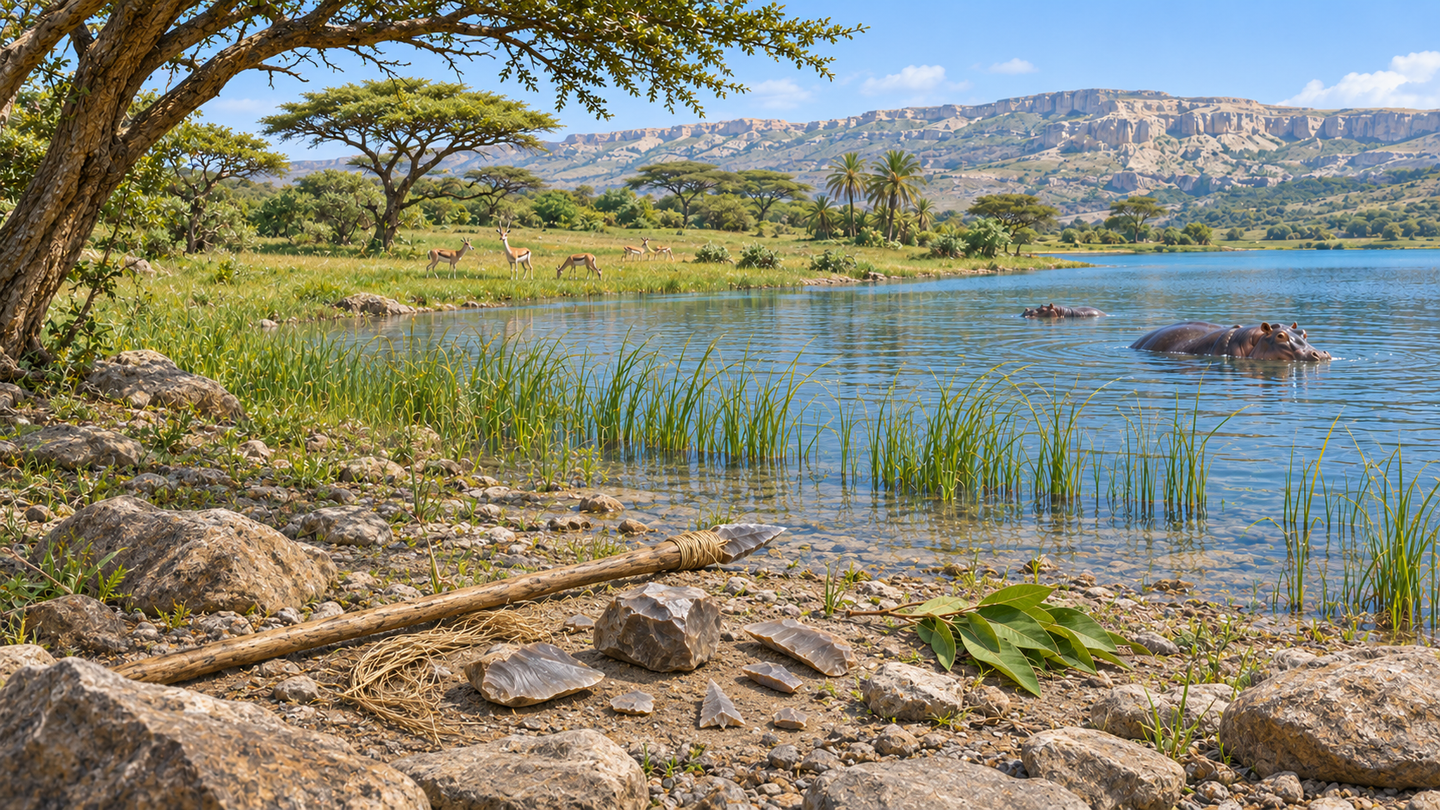
A 125,000-year-old Green Arabia lakeshore preserves stone tools, hippo fossils and plant residues linked to possible poisoned weapons. (CREDIT: The Brighter Side of News)
Stone points, hippo remains and traces of toxic plants have survived together beside a vanished lake in southern Saudi Arabia. The approximately 125,000-year-old site offers an unusually detailed view of people making tools and using plants in Green Arabia. Freshwater and grassland supported wildlife where desert surrounds the basin today.
The study in Science brought together the Saudi Heritage Commission, King Abdullah University of Science and Technology, Griffith University and international collaborators. At Uruq al-Julaybah, also called ‘Uruq Aljelibah in the paper, they combined landscape reconstruction with dating, fossil surveys and microscopic examinations of stone tools.
“This site gives us a rare and richly detailed view of how people lived in a landscape that looks nothing like Arabia today,” said Chris Clarkson of Griffith University. Clarkson co-led the research with KAUST geologist Frans van Buchem and colleagues.
Earlier research on Arabian lakes has shown how dramatically the peninsula’s environment changed. Mundafan adds evidence of the activities those wet intervals supported.
Discoveries of prehistoric woodworking demonstrate how perishable materials can reveal parts of technology that stone alone leaves unexplained. At Mundafan, the researchers examined the surfaces of tools for small remnants of those materials.
Reconstructing a lake in Green Arabia
Satellite terrain data and field mapping suggest that ancient Lake Mundafan covered about 340 square kilometers. The researchers estimated a maximum depth of roughly 29 meters after accounting for younger sediments that later filled the basin. A former outlet at the highest shoreline helped constrain how full the lake could become.
Freshwater mollusks and tiny crustaceans called ostracods supported the reconstruction. Their remains, along with shoreline deposits and lake-bottom sediments, indicate persistent water with relatively low salinity. The surrounding habitat combined vegetated margins with open ground. This distinction matters because the term Green Arabia covers locally varied landscapes, with freshwater habitats surrounded by terrain that could remain comparatively dry.
Such landscapes could concentrate drinking water, food and stone suitable for tools. Evidence of much later desert occupations also shows why reconstructing local water availability matters. At Mundafan, the lake’s size and aquatic community helped establish the setting in which the artifacts accumulated.
The researchers dated sediments using optically stimulated luminescence, which estimates when mineral grains last saw sunlight. Combined uranium-series and electron spin resonance dating of hippo teeth provided an independent comparison. As with other efforts to reconstruct early human journeys, multiple dating approaches helped assess whether the archaeological and environmental evidence belonged together.
Thousands of tools beside large animals
The team documented more than 500 plant and animal fossil specimens at over 130 locations. They included hippos, extinct long-horned buffaloes, camels, Arabian oryx, gazelles and ostriches. Water-dependent animals and species suited to open country reinforce the picture of varied habitats around the lake.
Researchers systematically collected 5,511 stone artifacts larger than two centimeters from the main survey area. More than 98% consisted of chert, a fine-grained rock category that includes flint. Many showed Levallois production, a method in which toolmakers shape a stone core before removing flakes with planned forms.
Refitting flakes allowed the researchers to reconstruct parts of the manufacturing sequence. Such work builds on questions explored through early toolmaking discoveries elsewhere. At Mundafan, matching pieces demonstrated that people carried out multiple stages of stoneworking along the shore.
Some concentrations of points and other tools overlapped with fossil-rich areas more often than random placement would predict. That association suggests related activities, but fossil proximity alone cannot establish hunting. Other hippo-associated tools likewise require careful attention to damage, context and use before researchers can reconstruct what people did.
Weapon tips preserve more than stone
Several points had fractures consistent with impacts. One particularly damaged example also carried resin and plant material near its base, together with animal-derived lipids and collagen farther along the tool. The combined evidence supports its use as a stone weapon tip attached to a handle or shaft.
That attachment process is called hafting. Resins could help secure the stone, while plant fibers could provide bindings. Comparisons with later hunting weapons underline why a point’s history involves manufacture, attachment, use and maintenance, as well as its shape.
Chemical analyses identified compounds associated with toxic plants, including the arrow poison tree, Acokanthera schimperi. On at least one impact-damaged point, toxic-plant compounds occurred alongside animal residues. Their presence on weapon forms makes deliberate incorporation into hunting equipment more plausible than incidental contact, although the researchers could not establish how a preparation worked.
The study also found evidence of much broader plant use. Microscopy revealed fibers, wood, resin and palm-like leaf tissues, while serrated tools showed wear compatible with working fibrous material. Those traces suggest tasks involving food resources and materials for bindings or other objects, without preserving finished examples of every proposed product.
Reading repeated visits in an eroding site
The site is an exposed, eroding archaeological deposit. Wind and other surface processes have moved some material, while repeated visits contributed remains over time. The researchers therefore interpret it as a record of recurring lakeshore activity whose original arrangement survives in part.
Refitting stones, clustered fossils and fragile organic traces helped them assess that disturbance. Research on ancient wooden tools illustrates how unusual preservation can recover activities otherwise missing from archaeology. At Mundafan, the surviving residues make the stone assemblage more informative than tool shapes alone.
Residues survived on 75 of 89 examined tools, and 44 had evidence consistent with hafting. The team checked chemical results against control samples and compared some analyses between laboratories. Their functional interpretations combined chemistry, residue position, tool form and wear, reducing reliance on a single clue.
No human fossils establish who made the tools. Evidence of overlapping human populations elsewhere also cautions against assigning an identity from technology alone. The Mundafan finds reveal activities in southern Arabia without determining a specific population origin or migration route.
Practical implications
The discoveries give archaeologists a richer set of materials to compare across Arabian sites. Green Arabia research can examine how people combined stone, plants and animal resources at particular freshwater locations. The region’s humid periods created places where groups could return and carry out several kinds of work.
Further residue studies could test whether similar plant compounds occur on weapon tips elsewhere. Experiments could also assess which actions produce comparable impact fractures, helping distinguish possible uses. Work on ancient charcoal shows how small material traces can expand investigations of plant selection and technological knowledge.
For researchers tracing human movement, Mundafan provides evidence of a usable habitat deep inside Arabia. Findings from other early occupation sites gain meaning from the resources available around them. Here, the combination of water, stone and diverse vegetation helps explain why people repeatedly used the shore.
The proposed poison use remains a question about preparation and performance. The firmer result is the breadth of activity preserved together: stone manufacture, hafted weapons, animal contact and plant processing. Those connections turn an ancient lakeshore into evidence of how people organized life during a wetter interval in a changing landscape.
Dig deeper into Green Arabia and early humans
These studies place Mundafan within the wider history of Arabian climate, occupation and human movement.
Arabian hydroclimate and hominin population dynamics over the last 500,000 years: An ocean dust record helps researchers investigate how rainfall changes shaped opportunities for human populations in Arabia. (Nature Communications, 2026)
Recurrent humid phases in Arabia over the past 8 million years: Cave deposits reveal repeated wet intervals and provide a longer climatic context for movements across the peninsula. (Nature, 2025)
Multiple hominin dispersals into Southwest Asia over the past 400,000 years: Lake deposits, fossils and stone tools document repeated occupations of northern Arabia during different humid phases. (Nature, 2021)
Human footprints provide snapshot of last interglacial ecology in the Arabian interior: Human and animal tracks record a brief episode beside a northern Arabian lake during the same broad interglacial period. (Science Advances, 2020)
Homo sapiens in Arabia by 85,000 years ago: A finger bone from Al Wusta provides fossil evidence of modern humans in Arabia during a later wet interval. (Nature Ecology & Evolution, 2018)
Research findings are available online in the journal Science.
The original story "Ancient Saudi Arabian lakeshore preserves an unusually green and detailed record of human activity" is published in The Brighter Side of News.
Related Stories
- 2.6-million-year-old jaw fossil challenges long-held ideas about early hominins
- Ancient charcoal from Israel reveals how early humans used fire
- New fossil evidence places early humans in Eurasia 2 million years ago
Like these kind of feel good stories? Get The Brighter Side of News' newsletter.
Joshua Shavit
Writer and Editor
Joshua Shavit is a NorCal-based science and technology writer with a passion for exploring the breakthroughs shaping the future. As a co-founder of The Brighter Side of News, he focuses on positive and transformative advancements in technology, physics, engineering, robotics, and astronomy. Having published articles on AOL.com, MSN, Yahoo News, and Ground News, Joshua's work highlights the innovators behind the ideas, bringing readers closer to the people driving progress.