Curiosity’s atmospheric measurements suggest chemically active water exists on Mars
Thirteen years of atmospheric measurements reveal seasonal oxygen isotope changes. Modeling suggests microscopic water could help explain them, but its location remains uncertain.

 Editor: Joshua Shavit

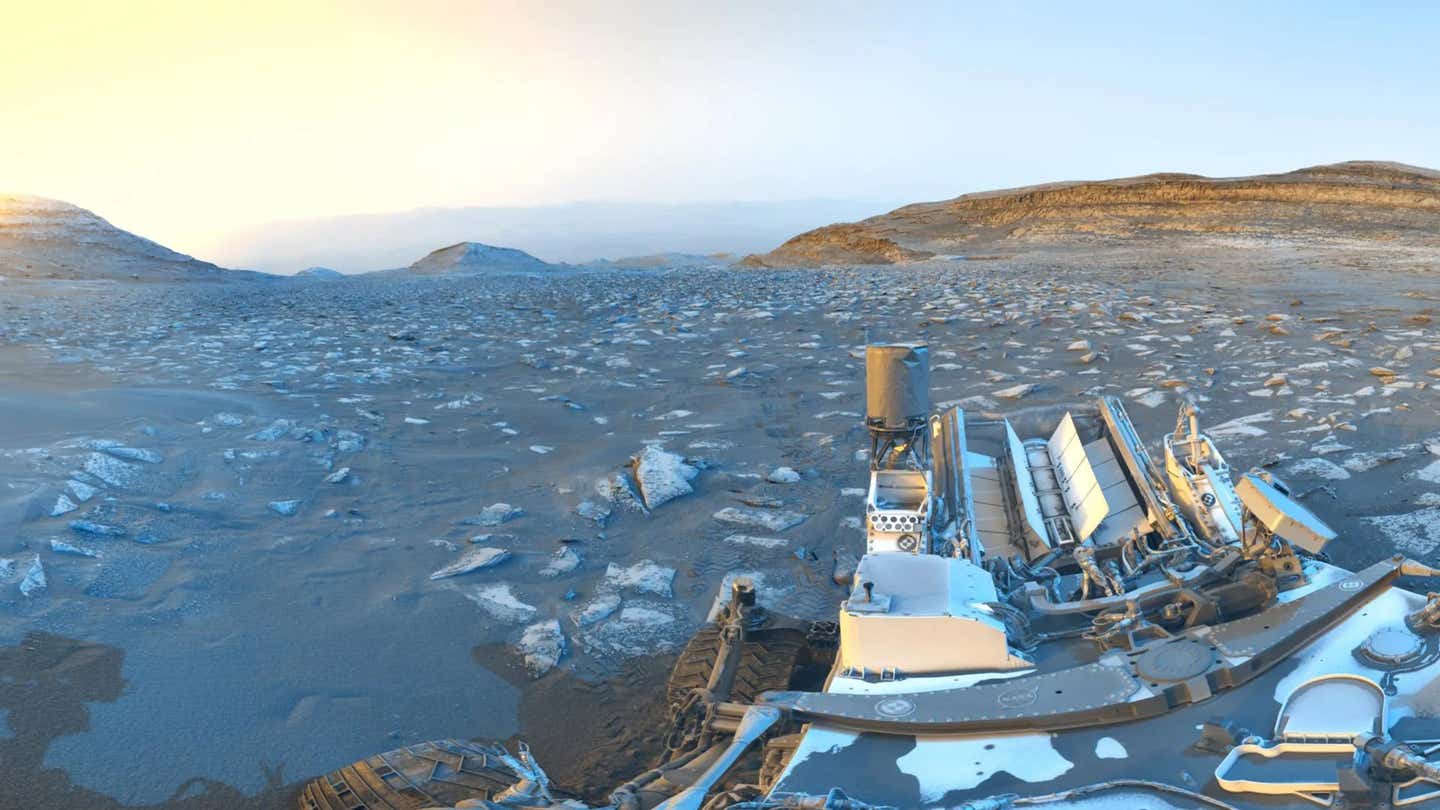
Curiosity’s seasonal isotope measurements suggest microscopic water films on Mars may exchange oxygen with atmospheric carbon dioxide. (CREDIT: NASA/JPL-Caltech/MSSS)
Mars may hold chemically active water in layers far too thin for a rover camera to see. A new analysis of Curiosity’s atmospheric measurements suggests that carbon dioxide exchanges oxygen with microscopic water films during part of the Martian year. The films could occur at the surface or cling to grains beneath it.
Heather Franz, an isotope geochemist at NASA’s Goddard Space Flight Center, led the study, published in Proceedings of the National Academy of Sciences. Her team examined observations gathered at Gale crater between 2012 and 2025. Curiosity landed there in August 2012, beginning what has become more than 14 years of exploration.
The rover has documented water-shaped terrain and investigated an ancient carbon cycle. Those findings concern the planet’s past. The new atmospheric record gives researchers a way to investigate water that may still participate in chemical reactions today, although it leaves the location and physical state of that water unresolved.
Reading water films on Mars through the air
Curiosity repeatedly samples the atmosphere using its Sample Analysis at Mars instrument suite, known as SAM. Two instruments measured the isotopic composition of carbon dioxide. Isotopes are versions of an element with different numbers of neutrons, particles in the atom’s nucleus. Oxygen-18 has two more neutrons than the more common oxygen-16.
Chemical and physical processes can change the proportions of those isotopes. Evaporation, freezing and chemical exchange can leave different materials with different isotopic signatures. This makes isotope measurements useful for investigating how gases, water and minerals interact. The task is to work backward from a measured pattern to the processes capable of producing it.
Previous research has used isotope evidence to examine Mars’ lost water and water-related changes in a Martian meteorite. For this study, the researchers had something different: repeated measurements of the air at one location across several Martian years. That allowed them to look for patterns that would be invisible in a single sample.
The record spans parts of eight numbered Martian years, each nearly twice as long as an Earth year. Repeated sampling helps distinguish a seasonal pattern from differences between individual years. It also lets scientists revisit early measurements as later observations reveal which features recur and which change over the mission.
A seasonal pattern across thirteen years
The record includes 34 atmospheric experiments with SAM’s Tunable Laser Spectrometer and 38 with its Quadrupole Mass Spectrometer. Both instruments showed broadly similar seasonal patterns in oxygen isotopes. The team focused on the laser instrument’s results because background gases and changes in performance made the mass spectrometer’s record more complicated to interpret.
Paired daytime and nighttime measurements showed no statistically distinguishable isotope differences within instrument uncertainties. Seasonal comparisons told a different story. Carbon dioxide became more enriched in oxygen-18 during spring and summer in both hemispheres, with stronger enrichment during southern spring and summer. Carbon isotopes changed less markedly.
The contrast matters because a successful explanation has to account for oxygen changing more than carbon. Researchers already know that Martian weather varies with the seasons and that dust storms can affect atmospheric conditions. The isotope record added a specific chemical pattern for models to explain. It also showed that the size of the oxygen enrichment differed between earlier and later parts of the mission.
Testing where the extra heavy oxygen came from
The team considered several processes that could alter atmospheric carbon dioxide. At the poles, carbon dioxide freezes onto the surface during winter and returns to the atmosphere as temperatures rise. Sunlight can also break apart carbon dioxide molecules. Both processes can change isotope ratios, making them plausible contributors to the measured cycle.
The calculations showed that those processes alone could not produce the observed oxygen enrichment. A global circulation model tested how a polar isotope signal would travel toward Gale crater. Atmospheric mixing weakened the signal substantially before it arrived. Allowing carbon dioxide to exchange oxygen with oxygen-18-enriched water could reproduce the larger changes in the observations.
This possibility adds another interaction to research on Martian clays and carbonate minerals. Water molecules attached to mineral surfaces could exchange oxygen with carbon dioxide before the gas returned to the air. The result depends on assumptions about water abundance, temperature and starting isotope composition. The models establish that the proposed mechanism is feasible under particular conditions.
The timing provides another constraint. The stronger enrichment coincides with the part of the orbit when Mars approaches its closest point to the Sun. Rising temperatures could promote exchange or release gas that had previously interacted with water. Changes in winds could then determine when that gas reaches the rover.
What microscopic water would mean
Water films on Mars could consist of layers only a few molecules thick. Water can attach to a surface through adsorption, a process in which molecules cling to the outside of a material. At that scale, interactions with mineral grains or ice can change water’s behavior. The study discusses liquid-like layers as well as water adsorbed within the regolith, the loose material covering the ground.
The measurements do not determine the films’ thickness or identify a wet patch beneath Curiosity. They also cannot separate local contributions from gas transported across a wider region. Water attached to grains near Gale crater offered a feasible explanation in the modeling. Other scenarios involved water and carbon dioxide interacting farther away before atmospheric circulation carried an altered signal into the crater.
That uncertainty matters when comparing the result with observations of buried glaciers or assessments of possible liquid-water activity. These studies examine different forms of water with different methods. The atmospheric record points to a chemical exchange that microscopic water could support. It cannot establish whether that water would provide conditions suitable for organisms.
Investigating water films on Mars therefore requires attention to how the molecules behave. Water held tightly against a grain may participate in a reaction while remaining difficult for an organism to use. The isotope signal tells researchers about a possible chemical pathway, leaving the water’s availability for biological processes unresolved.
Practical implications
The work gives mission scientists a seasonal pattern to investigate with future measurements. Continued sampling could show whether the oxygen enrichment strengthens again or keeps declining. Those outcomes could help researchers evaluate explanations involving changing air circulation, dust-covered surfaces or the release of gas from reservoirs whose isotope composition changes over time.
Measurements elsewhere would be especially valuable. Curiosity’s discoveries of organic compounds and Perseverance’s work on water-altered rocks show how much local geology varies. A second long atmospheric isotope record could reveal whether Gale crater shares its seasonal pattern with other regions or reflects a distinctive local exchange between soil and air.
Laboratory experiments could also test how quickly carbon dioxide exchanges oxygen with tiny amounts of water under Martian conditions. Better constraints would reduce the range of water properties needed to explain the rover’s measurements. For now, the finding gives researchers a chemical clue they can follow from the air toward the ground, where microscopic water may still help shape Mars’ atmosphere.
Dig deeper into water films and Martian chemistry
These resources examine water attached to Martian soil, isotope evidence and Curiosity’s discoveries in Gale crater.
Oxygen isotopic evidence that Gale crater, Mars, was home to an Early Hesperian water reservoir that underwent significant evaporation: Researchers analyze water released from minerals to reconstruct an ancient reservoir and its evaporation history. (Proceedings of the National Academy of Sciences, 2025)
Large Water Inventory in Highly Adsorptive Regolith Simulated With a Mars Global Climate Model: Modeling investigates how soil properties could retain water on grain surfaces, including near the equator. (Journal of Geophysical Research: Planets, 2025)
NASA: New Insights Into How Mars Became Uninhabitable: NASA explains how carbon and oxygen isotopes in Gale crater’s carbonates reveal clues about ancient drying conditions. (NASA Jet Propulsion Laboratory, 2024)
NASA’s Curiosity Finds Surprise Clues to Mars’ Watery Past: Rippled rock textures provide geological evidence of waves in an ancient lake. (NASA, 2023)
Curiosity’s SAM Instrument Finds Water and More in Surface Sample: Early SAM results show how heating a soil sample releases water and other substances for analysis. (NASA, 2013)
Research findings are available online in the journal PNAS.
The original story "Curiosity’s atmospheric measurements suggest chemically active water exists on Mars" is published in The Brighter Side of News.
Related Stories
- NASA finds a surprisingly complex history of water on ancient Mars
- Tardigrades and water reveal potential for food growth on Mars
- NASA orbiter data challenges the idea that liquid water exists on Mars
Like these kind of feel good stories? Get The Brighter Side of News' newsletter.
Joseph Shavit
Writer, Editor-At-Large and Publisher
Joseph Shavit, based in Los Angeles, is a seasoned science journalist, editor and co-founder of The Brighter Side of News, where he transforms complex discoveries into clear, engaging stories for general readers. With vast experience at major media companies like The Los Angeles Times, Times Mirror and Tribune Publishing, he writes with both authority and curiosity. His writing focuses on space science, planetary science, quantum mechanics, geology. Known for linking breakthroughs to real-world markets, he highlights how research transitions into products and industries that shape daily life.