The Sun, Earth, Jupiter and white dwarfs offer another way to test dark matter
Researchers combined capture calculations with neutrino searches and heat measurements to test dark matter’s possible electromagnetic properties. The study found no signal but narrowed some possibilities.
 Writer: Federica Sgorbissa (Sissa Medialab)

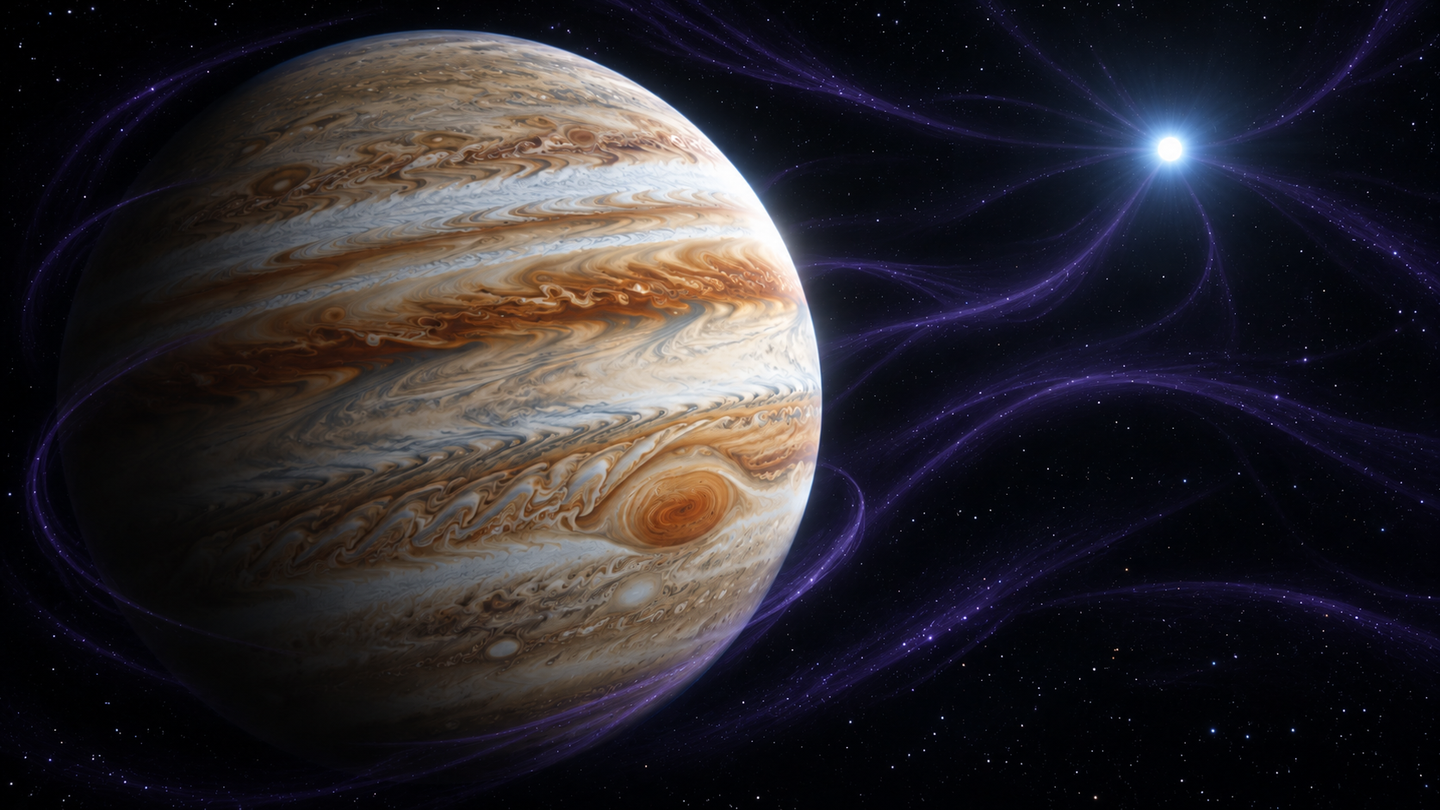
Earth, the Sun, Jupiter and white dwarfs could act as dark matter traps, helping researchers rule out some particle scenarios. (CREDIT: The Brighter Side of News)
Earth and distant dead stars could help researchers investigate particles that laboratory detectors struggle to register. A new study treats these bodies as possible dark matter traps, calculating how captured particles might produce neutrinos or heat. Comparing those predictions with existing observations narrowed some of the possibilities for what dark matter could be.
Alejandro Ibarra, Merlin Reichard and Gaurav Tomar carried out the analysis, reported in Journal of Cosmology and Astroparticle Physics. Tomar works at the Center for Quantum Spacetime at Sogang University in South Korea. The researchers examined hypothetical particles with extremely weak electromagnetic interactions.
Most evidence for dark matter comes from its gravitational effects. Under the standard cosmological picture, it accounts for about 85% of matter, while ordinary atoms make up the remainder. Experiments such as LUX-ZEPLIN search for interactions that could reveal its particle nature.
Other teams develop quantum detectors to pursue different possibilities. The new work examines what existing astronomical observations can contribute, using objects that have had billions of years to collect passing particles.
How dark matter traps capture slower particles
A dark matter particle passing through a detector might strike an atomic nucleus and transfer energy to it. If the transferred energy falls below the instrument’s threshold, the interaction can escape notice. Slower incoming particles can therefore be difficult targets for searches that depend on measuring nuclear recoils.
A celestial body presents a different opportunity. As a particle approaches, gravity accelerates it, but a collision inside the body can remove energy. If it loses enough to become gravitationally bound, it can remain trapped. A particle moving slowly before its approach generally has less excess energy to shed.
This helps make capture searches complementary to underground experiments. Their sensitivities depend differently on the incoming particles’ speeds, their masses and the material they encounter. A scenario that leaves a faint laboratory signal might still produce substantial capture over astronomical timescales.
The authors considered a tiny electric charge and other electromagnetic properties, including magnetic and electric dipole moments. A magnetic dipole would let a particle interact somewhat like a miniature magnet. Their calculations test a particular set of possibilities alongside approaches such as sensor networks.
Looking for particles escaping Earth and the Sun
Captured particles could collect near a body’s center after losing energy through further interactions. If the particles can annihilate, encounters between them could transform their mass into other particles. Which products emerge depends on the assumed dark matter model.
For Earth and the Sun, the researchers used existing searches for neutrinos from possible annihilations. Neutrinos interact weakly with ordinary matter, so some could escape from deep inside these bodies. Instruments such as IceCube, embedded in Antarctic ice, can look for the secondary light signals produced when neutrinos eventually interact.
IceCube has also produced a Milky Way map using neutrino observations. A dark matter search asks a more specific question about the number and energies of particles arriving from a target. The calculation predicts what an annihilation scenario would add to the expected background.
Other neutrino telescopes illustrate the wider effort to study these elusive particles. In this analysis, the absence of a qualifying excess allowed researchers to limit how efficiently hypothetical dark matter could be captured and annihilate. The results depend on the annihilation products assumed in the calculation.
Using Jupiter and white dwarfs as heat tests
The researchers pursued heat for Jupiter and massive white dwarfs. A white dwarf is the dense remnant left after a star like the Sun exhausts its main fuel supply. As studies of dying stars explain, these remnants retain heat and cool over time.
Jupiter also emits internal energy, but it does not sustain the hydrogen fusion that powers the Sun. Both kinds of object offer an opportunity to test an additional energy source. If captured dark matter annihilates and its products deposit energy, the object could become warmer or cool more slowly.
The heating calculation depends on how much annihilation energy stays inside the object. Products that escape carry energy away, so assumptions about the particles produced and their interactions affect how a predicted annihilation rate translates into observable heat. For Jupiter, the authors assumed all the annihilation energy remained in the planet.
The team calculated the heat expected under different particle assumptions. They then compared it with measured emission, ruling out scenarios in which the predicted dark matter heating alone would exceed that output. This comparison places a ceiling on an additional heat source while allowing ordinary processes to explain some or all of the observed emission.
The white dwarfs in the analysis belong to M4, a globular cluster of densely packed stars. Research on white dwarf atmospheres shows how observations can reveal their properties. Here, the useful measurements were luminosities, which describe how much energy the objects emit.
What the new limits depend on
Earth proved particularly informative for hypothetical dark matter carrying a minute electric charge. Massive white dwarfs constrained other electromagnetic properties in regions where competing searches lose sensitivity. For their individual limits, the authors varied one electromagnetic property at a time. These results extend the set of possibilities examined by direct searches.
The comparisons depend on several inputs. Capture rates change with the local dark matter density, its speed distribution and the composition of the target body. The fate of captured particles also matters, including whether they settle into the assumed distribution and annihilate efficiently enough to produce a measurable effect. The analysis also restricts its mass ranges to avoid cases where captured particles could readily gain enough energy to escape again.
M4 introduces a particularly consequential uncertainty because its dark matter density is unknown. The authors used a modeled estimate at the white dwarfs’ location. A smaller density would generally mean fewer captured particles and weaker limits; a larger density could strengthen them.
Measurements of dark matter structure elsewhere demonstrate why location matters to such calculations. For M4, the adopted density should remain visible alongside the resulting particle limits. The study constrains conditional scenarios rather than measuring the cluster’s dark matter content.
Practical implications
The work gives particle physicists another way to compare proposed dark matter properties with observations. Different bodies probe different combinations of mass, speed and interaction strength. Combining those tests with laboratory sensors can help identify which possibilities deserve closer examination.
Colder, massive white dwarfs in regions with well-supported higher dark matter densities would offer promising targets. Less ordinary heat could make an additional source easier to distinguish. Stronger estimates of the surrounding dark matter would also make the interpretation more secure.
Tomar also points to exoplanets as possible dark matter traps. Other research has explored planetary capture, although the observable consequences differ between models. Future observations could test whether distant planets are warmer than expected after accounting for their ages, environments and ordinary sources of energy.
For now, the result is a more detailed map of which particle scenarios remain possible. Earth, the Sun, Jupiter and white dwarfs contribute different constraints to that map. Their value lies in exposing predictions that can be checked, while keeping the uncertainties in each astronomical target attached to the answer.
Dig deeper into dark matter capture
These resources explain how celestial bodies can test dark matter and where the main uncertainties arise.
Dark matter annihilation with the IceCube Upgrade: IceCube describes how upgraded observations could improve searches for neutrinos from dark matter annihilations in the Sun. (IceCube Collaboration, 2026)
Optimal Celestial Bodies for Dark Matter Detection: Researchers compare planets, stars and stellar remnants as dark matter detectors while examining the assumptions behind their sensitivities. (Journal of Cosmology and Astroparticle Physics, 2024)
Could compact stars in globular clusters constrain dark matter?: A study of M4’s stellar motions examines how uncertainty in its dark matter content affects proposed compact-star tests. (Journal of Cosmology and Astroparticle Physics, 2023)
Search for GeV-scale dark matter annihilation in the Sun with IceCube DeepCore: IceCube observations set limits on hypothetical dark matter annihilations that could produce solar neutrinos. (Physical Review D, 2022)
Exoplanets as Sub-GeV Dark Matter Detectors: This proposal examines how annihilating dark matter could heat distant planets and brown dwarfs. (Physical Review Letters, 2021)
Research findings are available online in the Journal of Cosmology and Astroparticle Physics.
The original story "The Sun, Earth, Jupiter and white dwarfs offer another way to test dark matter" is published in The Brighter Side of News.
Related Stories
- Big Bang afterglow rules out giant black holes as a major dark matter source
- Five-dimensional black holes offer a possible explanation for dark matter and neutrinos
- Scientists build ultra-sensitive quantum detectors to search for invisible dark matter
Like these kind of feel good stories? Get The Brighter Side of News' newsletter.
Joshua Shavit
Writer and Editor
Joshua Shavit is a NorCal-based science and technology writer with a passion for exploring the breakthroughs shaping the future. As a co-founder of The Brighter Side of News, he focuses on positive and transformative advancements in technology, physics, engineering, robotics, and astronomy. Having published articles on AOL.com, MSN, Yahoo News, and Ground News, Joshua's work highlights the innovators behind the ideas, bringing readers closer to the people driving progress.