Feynman, Einstein and Darwin’s views on science may surprise you
Feynman’s 1955 essay asks what science gives humanity beyond inventions. His answer connects useful knowledge, curiosity and doubt, with supporting insights from Einstein, Darwin, Marie Curie and Carl Sagan.
 Editor: Joshua Shavit

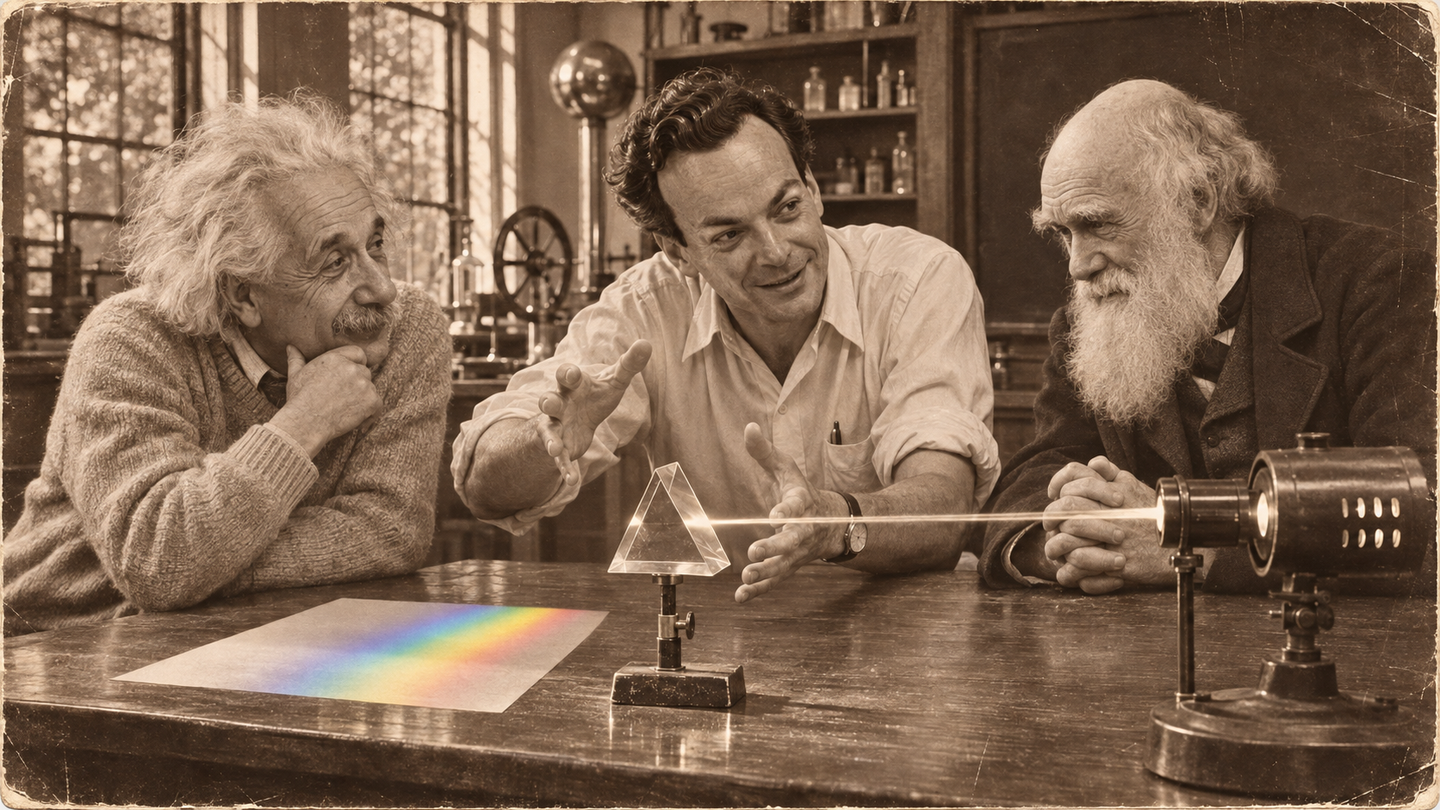
Illustration imagines Albert Einstein, Richard Feynman and Charles Darwin sharing a prism demonstration, reflecting the essay’s themes of curiosity, evidence and discovery. (CREDIT: The Brighter Side of News)
A glass of water looks like something the world has finished explaining. It sits on the table, clear and quiet, until a little sunlight makes it sparkle. Then consider what must be happening inside it. Countless molecules move, collide and change neighbors while the glass appears perfectly still.
Richard Feynman thought this change in perspective belonged among the great rewards of being alive. In his 1955 essay “The Value of Science,” published in Engineering and Science, the Caltech physicist considered what scientific knowledge gives us. Useful inventions were part of his answer, alongside intellectual pleasure and the freedom to doubt.
That last freedom helps explain why scientists can disagree about science itself while still investigating the same world. Their disagreements can reveal assumptions that would otherwise remain hidden.
AI systems can now propose and run experiments, but interpreting the results still requires judgment. Researchers must check whether the evidence supports a conclusion and consider what other explanations could fit the same findings.
The value of science begins with what it makes possible
Suppose a discovery makes it possible to release energy from matter. The discovery establishes a capability. Deciding who controls it, what risks are acceptable and whose lives it should improve requires additional judgments. A calculation can estimate consequences, but choosing which consequences to pursue involves human values.
Feynman put this plainly: “Scientific knowledge is an enabling power to do either good or bad.” Understanding the rules gives us more choices. It also increases the importance of choosing carefully, because an efficient method can serve a terrible purpose as readily as a generous one.
Expertise helps a scientist estimate what a technology can do. Deciding whether its use is fair also requires listening to the people who bear its costs, whose experience may reveal important consequences the scientist has failed to consider.
The route from understanding to usefulness can be difficult to predict. Work on quantum technology shows how questions about the behavior of matter can eventually change the instruments available to us. The first investigator need not know the final application for the question to deserve attention.
Marie Curie made that point in her 1921 Vassar address: “We must not forget that when radium was discovered no one knew that it would prove useful in hospitals.” Her words resist demanding an immediate product from every experiment. The possible benefits can exceed what the investigator originally knew how to imagine.
Today's quantum networks also depend on ideas whose practical reach took time to develop. Funding that work involves decisions about resources and priorities. Feynman's argument adds an obligation to those decisions: consider what an unanswered question might teach, even when its eventual application remains obscure.
Understanding can be a pleasure in itself
Now return to the glass. Knowing that water consists of moving molecules gives the stillness another meaning. The scene has acquired an invisible activity, and the light adds questions of its own. An ordinary object can become more interesting as an explanation reveals what lies beyond appearances.
Feynman carried this feeling to the seashore, where waves prompted him to think about molecules, deep time and conscious matter. His point extends to the dark night sky. Something familiar becomes startling when its explanation requires thinking about the history of the universe.
Carl Sagan described science as “a way of thinking at once imaginative and disciplined” in a draft of The Demon-Haunted World preserved by the Library of Congress. Those qualities belong together. Imagination supplies possibilities, while discipline makes us ask whether those possibilities survive contact with observation.
Even an unfamiliar molecule can become part of that pleasure. Research on cosmic buckyballs asks how carbon atoms assemble into intricate cages far from Earth. Understanding the process adds something to our experience of the sky, whether or not it produces an invention.
There is no requirement that an explanation remove every mystery. Explaining a wave can raise questions about the wind that drove it, the currents beneath it and the shore it strikes. Each answer changes the questions we can ask. The pleasure grows because the familiar scene has more to reveal.
Doubt gives an answer somewhere to grow
The third value of science is harder to package as a product. It is the ability to hold an answer with enough confidence to use it and enough openness to examine it again. Feynman understood uncertainty through practice, encountering problems he could solve, partly solve or barely begin.
Charles Darwin warned in the introduction to The Descent of Man that “ignorance more frequently begets confidence than does knowledge.” He was responding to confident declarations that science could never explain human origins. His warning applies whenever certainty arrives before the difficult work of investigation.
Testing a well-supported theory is part of that investigation. A neutrino experiment can look for departures from relativity even when previous tests have supported it. Agreement strengthens confidence within the conditions examined and helps define where the next experiment should look.
Similarly, an experiment involving a falling quantum object can explore how established ideas apply in another setting. Doubt becomes productive when it leads to a discriminating test. Simply refusing every answer would leave us unable to learn from the tests already performed.
Confidence should reflect the strength and reach of the evidence. A measurement repeated by independent groups deserves more weight than a promising result from one apparatus. An unanswered question about the deeper explanation need not erase a reliable prediction. This allows researchers to build useful knowledge while continuing to examine its foundations.
A beautiful explanation still has to meet the world
Imagine two explanations that both fit an observation. One is elegant, memorable and easy to picture. The other is awkward. Elegance may help an investigator develop an idea, but an experiment must eventually find a consequence that distinguishes the two explanations.
Albert Einstein addressed that obligation in his 1933 Oxford lecture, later published in Philosophy of Science. He wrote that “all knowledge about reality begins with experience and terminates in it.” Mathematical creativity could guide a theory, while experience determined whether its consequences described the physical world.
That distinction matters when interpreting Martian carbonates. Instruments measure properties of minerals, and researchers compare processes that might have produced them. An explanation gains strength when it accounts for additional observations and when plausible competing explanations encounter difficulties.
The same reasoning applies to reconstructions from ancient rocks. An investigator must identify what survived, what can be measured and which assumptions connect the measurement to the past. Explaining those steps lets readers judge the inference instead of relying entirely on the reputation behind it.
A useful habit is to ask what observation would make an explanation less convincing. If every possible outcome can be made to support it, the explanation gives the experiment little work to do. A claim becomes more informative when it risks a prediction that the world could fail to meet.
Children deserve the question behind the answer
Feynman wanted children to encounter the ideas that make science exciting. A child can memorize that water contains hydrogen and oxygen without seeing why anyone investigated it. The scientific experience begins to open when a familiar thing produces a question that can be pursued.
A museum experiment can provide one opening. So can a conversation about why a shadow changes as an object moves. The adult's role includes helping a child notice a pattern, suggest an explanation and work out what another observation might reveal.
Research on children's attention examines how exploration can draw them beyond the information a task requires. In teaching, the challenge is to give that exploration a direction without making the answer feel predetermined. A surprising result should invite another look.
Feynman offered an essential permission: “it is possible to live and not know.” A teacher who admits uncertainty can then demonstrate how to investigate it. The child sees that lacking an answer need not end the conversation, and that adults can learn alongside the people they teach.
Suppose two people disagree about why the shadow changed. They can move the lamp, move the object or measure the distance to the wall. Each choice changes something they can observe. A disagreement that began as an exchange of opinions has become an invitation to investigate together.
Practical implications
The value of science becomes visible in how findings are explained. A report can state what researchers measured, which explanation they favor and what would change their minds. Studies of public expectations suggest that readers and scientists may approach those distinctions with different assumptions.
Researchers can make uncertainty concrete by identifying the next useful comparison. A model that predicts qubit behavior invites questions about the conditions under which its predictions hold. A better result should help establish both what has improved and where further testing remains necessary.
Feynman's essay also asks something of institutions. They must preserve opportunities to challenge assumptions, discuss unwelcome results and revise explanations. Practical knowledge and intellectual pleasure depend on that freedom, because both require room to find something the investigator did not expect.
The glass remains on the table. Its molecules were moving before anyone understood them, and our explanation will never exhaust everything worth asking about them. We can use what we have learned while leaving the next question open. That is a responsibility one generation can pass to another.
The original story "Feynman, Einstein and Darwin's views on science may surprise you" is published in The Brighter Side of News.
Related Stories
- Scientists and the general public define science very differently
- AI is flooding peer review, and editors say it’s making science harder to judge
- Penn engineers use AI to solve some of science's most difficult math problems
Like these kind of feel good stories? Get The Brighter Side of News' newsletter.
Joseph Shavit
Writer, Editor-At-Large and Publisher
Joseph Shavit, based in Los Angeles, is a seasoned science journalist, editor and co-founder of The Brighter Side of News, where he transforms complex discoveries into clear, engaging stories for general readers. With vast experience at major media companies like The Los Angeles Times, Times Mirror and Tribune Publishing, he writes with both authority and curiosity. His writing focuses on space science, planetary science, quantum mechanics, geology. Known for linking breakthroughs to real-world markets, he highlights how research transitions into products and industries that shape daily life.