Wyoming bone fossils reveal 156-million-year-old reptile unlike any known species
A museum visit helped launch an investigation into a mysterious Wyoming fossil. Neutron and X-ray scans revealed a 156-million-year-old reptile with dragon-like skull projections and an almost complete braincase.
 Paul Scherrer Institute Writer: Christian Heid

A digital reconstruction reveals the fossilized skeleton of Meilynodraco amonamarthi, a 156-million-year-old reptile discovered in Wyoming. Researchers combined neutron and X-ray computed tomography scans to visualize bones concealed within sandstone, including parts of the skull, neck, limbs, and pelvis. The images show the assembled fossil blocks, a three-dimensional view of the preserved remains, and an anatomical reconstruction. (CREDIT: Aathal Dinosaur Museum)
Ten days after Pavel Trtik left his business card at a dinosaur museum, an unusual request arrived. The museum had brought a mysterious fossil back from Wyoming. Could his expertise help identify the animal still largely hidden inside its sandstone surroundings?
The answer eventually emerged through neutron imaging and painstaking digital reconstruction. The hidden fossil belonged to a small reptile that lived about 156 million years ago. Researchers named it Meilynodraco amonamarthi, combining its Wyoming birthplace with a tribute to a Swedish death metal band.
The study, published in Royal Society Open Science, describes a new member of the choristoderes, an extinct group of freshwater reptiles. An international team jointly led by Trtik at the Paul Scherrer Institute and Torsten Scheyer at the University of Zurich uncovered its identity. This Jurassic reptile adds unusually detailed anatomy to a group whose early history remains poorly understood. The researchers recognized both a new species and a new genus, the broader classification immediately above species.
A small mystery among the giants
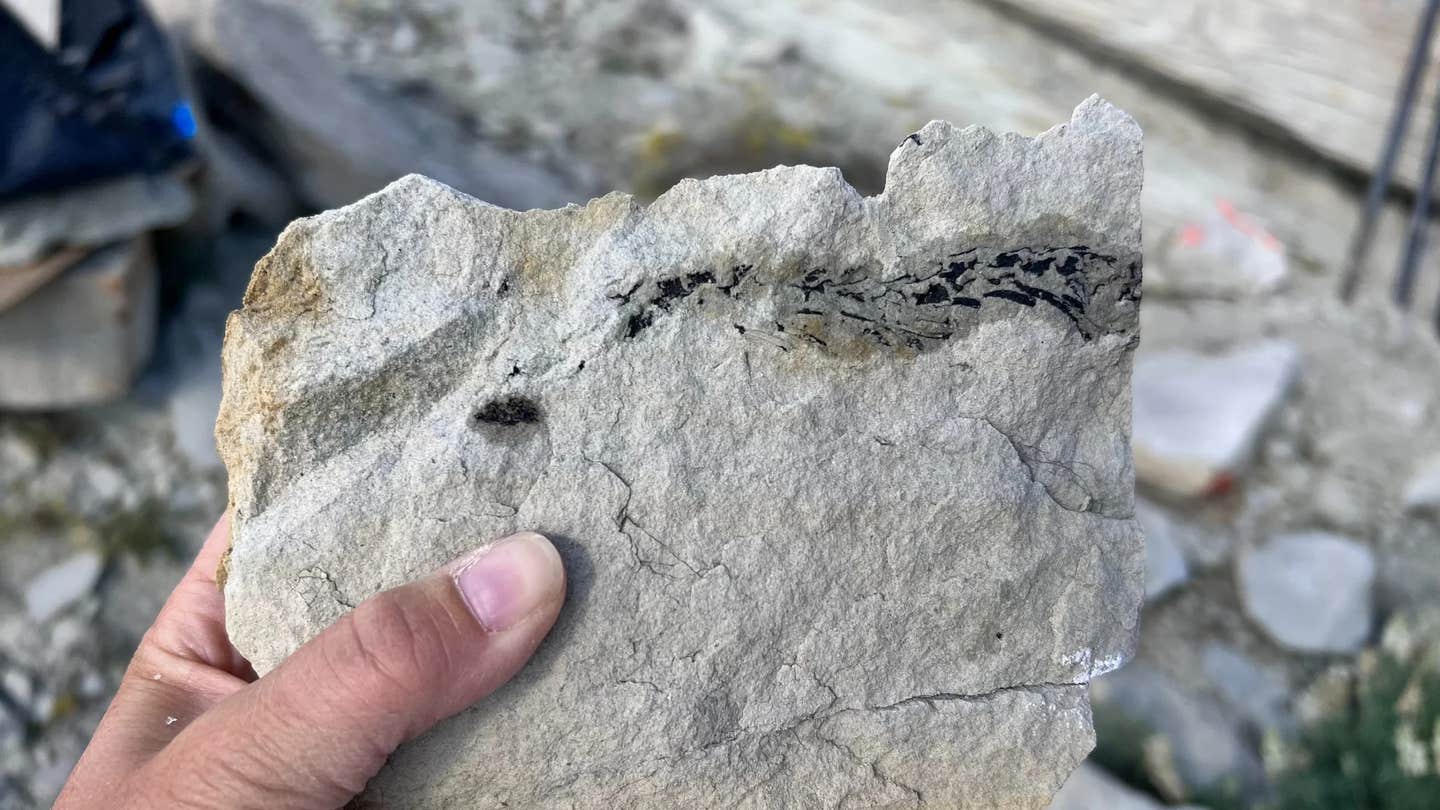
The fossil surfaced during an August 2022 excavation at Meilyn Quarry in Wyoming. A team from Switzerland’s Aathal Dinosaur Museum noticed a small vertebral column in sandstone. Only part of the fossil skeleton was visible, leaving too little information for a confident identification.
The possibilities ranged from a prehistoric snake to a crocodile relative or a hatchling dinosaur. The surrounding Morrison Formation is famous for giants such as Diplodocus, Stegosaurus and Allosaurus. Yet its Jurassic wildlife also included smaller animals, whose delicate remains can be much harder to interpret.
The museum brought the specimen to Switzerland, where it remained a puzzle. Then, in January 2023, Trtik visited with his three sons. While the boys explored the prehistoric creatures, their father saw a possible connection to his work studying materials with neutrons.
“If you ever have something you want investigated, just get in touch,” he offered, leaving his card. The resulting collaboration brought the fossil to PSI. Museum director Yolanda Schicker-Siber and two undergraduate students from Worcester Polytechnic Institute also joined the research team.
Two ways to look through stone
Seeing bones on a rock’s surface is different from understanding their shapes inside it. Initial X-ray scans of the larger pieces provided insufficient contrast for a useful reconstruction. The bones and their surroundings were simply too difficult to distinguish clearly.
Neutrons supplied another view. “Neutrons are particularly sensitive to hydrogen,” Trtik explained. Hydrogen occurs in hydroxyapatite, a mineral component of bone, allowing neutron scans to help separate fossil material from sandstone. This three-dimensional imaging provided information that the initial X-ray images lacked.
The techniques work differently: X-rays interact with electrons, while neutrons interact with atomic nuclei. A material that looks indistinct in one scan may stand out in the other. Combining them helped researchers distinguish bone, rock and material used to hold the fragile specimen together.
X-ray imaging at PSI, Empa in Dübendorf and the University of Zurich complemented the neutron work. The team examined tens of thousands of cross-sectional images, then identified individual bones for digital reconstruction. The scans supplied the views, but interpreting them still required careful anatomical work. Researchers manually traced structures through the image sequences and assembled separate digital bones, gradually recovering relationships that were difficult to see in the rock.
The answer lay in smaller pieces
As the reconstruction progressed, the animal acquired a pelvis, hindlimb elements and a recognizable body plan. Comparisons with other reptiles suggested a small, lizard-like creature about 45 centimeters long. Its anatomy also supported a likely semiaquatic lifestyle, rather than establishing exactly how it behaved.
The decisive clues came from smaller pieces of rock trimmed from the main slabs. Researchers screened 15 promising blocks with X-ray scans; seven contained additional identifiable bones. Those pieces revealed skull anatomy that the exposed backbone could never have supplied.
Among the scattered skull remains was an almost complete braincase less than two centimeters across. This is the bony structure surrounding the brain, rather than preserved brain tissue. Together with features of the vertebrae and pelvis, it distinguished the animal from other prehistoric reptiles.
The skull also carried backward-pointing, dragon-like projections. Its separation from the torso prompted questions about the animal’s death, but the fossil does not establish a predator attack. “It’s difficult to determine why the skull became detached from the torso,” Scheyer said. “But we cannot rule out the possibility that a larger predator was involved.”
A new clue to an old family-tree problem
Identifying the species opened a larger question: where do choristoderes belong among reptiles? Their unusual skulls have long complicated efforts to work out their relationships. Different studies have placed the group in different positions, making well-preserved early representatives especially valuable. Choristoderes occupied freshwater environments over a long interval, from at least the Jurassic until about ten million years ago, with varied skull and body shapes.
Here, a bone around the inner ear, called the prootic, proved important. Its shape resembles that found in crown reptiles, the group containing the common ancestor of living reptiles and all its descendants. Such details can inform reptile relationships more reliably than an animal’s general resemblance to a lizard or crocodile.
The researchers compared 119 anatomical characters across 38 taxa. Their analysis placed Meilynodraco near the base of the choristodere family tree and supported possible crown-group affinities. Its position early in the branching history does not make it a demonstrated direct ancestor of later species in the fossil record.
The authors keep that broader placement tentative. Their dataset primarily examines relationships within choristoderes, several branches have weak support, and parts of the new animal remain unknown. Missing information includes much of the front of the skull and jaws, the shoulder girdle and substantial portions of the limbs. Nevertheless, the specimen supplies the oldest North American record of the group and its most complete Jurassic skeleton yet found on that continent.
A little dragon with a metal name
Once the animal had an identity, Scheyer gave it a name reflecting both geography and personal enthusiasm. Meilynodraco roughly means “dragon of Meilyn,” referring to the quarry and its skull projections. The species name honors Amon Amarth, joining other animals named after musicians.
Scheyer shares the band’s enthusiasm for Tolkien. Amon Amarth takes its name from the Elvish name for Mount Doom in The Lord of the Rings. The fossil is scheduled to appear in the traveling exhibition “Rock Fossils on Tour” at the Aathal museum in early 2027.
Its story also shows why museum collections and imaging specialists make useful partners. At PSI, a proposed facility called UFO, considered within a potential SINQ++ upgrade, could accommodate objects up to one meter long. That remains a possibility for future work, rather than an operating facility.
For this discovery, the crucial object was much smaller. A braincase hidden in overlooked pieces of sandstone turned an unidentified backbone into a new species. The family outing started the conversation; complementary scans and anatomical comparisons supplied the answer.
Dig deeper into fossil imaging and reptile evolution
These studies explain how scans reveal hidden fossils and help reconstruct the relationships of extinct reptiles.
- Neutron Computed Tomography: A Novel High-Resolution, Non-Destructive Method for Screening Fossil Coral for Diagenetic Alteration for Geochronologic and Paleoclimatic Reconstructions: Demonstrates how neutron scans distinguish preserved coral minerals from later alterations, helping researchers select material for dating and climate reconstruction. (Geochemistry, Geophysics, Geosystems, October 2025)
- High-resolution high-throughput thermal neutron tomographic imaging of fossiliferous cave breccias from Sumatra: Uses neutron tomography to survey fossil-bearing cave rocks and identify internal anatomical features without first removing the surrounding material. (Scientific Reports, October 2021)
- Computed tomography analysis of the cranium of Champsosaurus lindoei and implications for the choristoderan neomorphic ossification: Reconstructs the skull of a later choristodere in three dimensions, examining an unusual bone central to debates about the group’s anatomy. (Journal of Anatomy, January 2020)
- The first record of a nearly complete choristodere (Reptilia: Diapsida) from the Upper Jurassic of Hebei Province, People’s Republic of China: Describes Coeruleodraco jurassicus, an articulated Jurassic skeleton that provides an important anatomical comparison for early choristoderes. (Journal of Systematic Palaeontology, January 2019)
- Anatomy of the Enigmatic Reptile Elachistosuchus huenei Janensch, 1949 (Reptilia: Diapsida) from the Upper Triassic of Germany and Its Relevance for the Origin of Sauria: Uses micro-CT scans to redescribe a puzzling reptile whose anatomy also features in discussions of choristodere relationships. (PLOS ONE, September 2015)
Research findings are available online in the journal Royal Society Open Science.
The original story "Wyoming bone fossils reveal 156-million-year-old reptile unlike any known species" is published in The Brighter Side of News.
Related Stories
- Rare prehistoric 'Sword Dragon' reptile unearthed in the UK
- New Thai lizard named after Syrax, Queen Rhaenyra's dragon from House of the Dragon
- Paleontologists unearth 240-million-year-old dragon in China
Like these kind of feel good stories? Get The Brighter Side of News' newsletter.
Rebecca Shavit
Writer
Based in Los Angeles, Rebecca Shavit is a dedicated science and technology journalist who writes for The Brighter Side of News, an online publication committed to highlighting positive and transformative stories from around the world. Having published articles on MSN, AOL News, and Yahoo News, Rebecca's reporting spans a wide range of topics, from cutting-edge medical breakthroughs to historical discoveries and innovations. With a keen ability to translate complex concepts into engaging and accessible stories, she makes science and innovation relatable to a broad audience.