A cosmic ‘leaf blower’ could expose the universe’s earliest galaxies
Light from young stars could push away gas and dust, exposing bright early galaxies. New calculations show why dense stellar nurseries may keep forming stars.
 Simons Foundation Writer: Mara Johnson-Groh

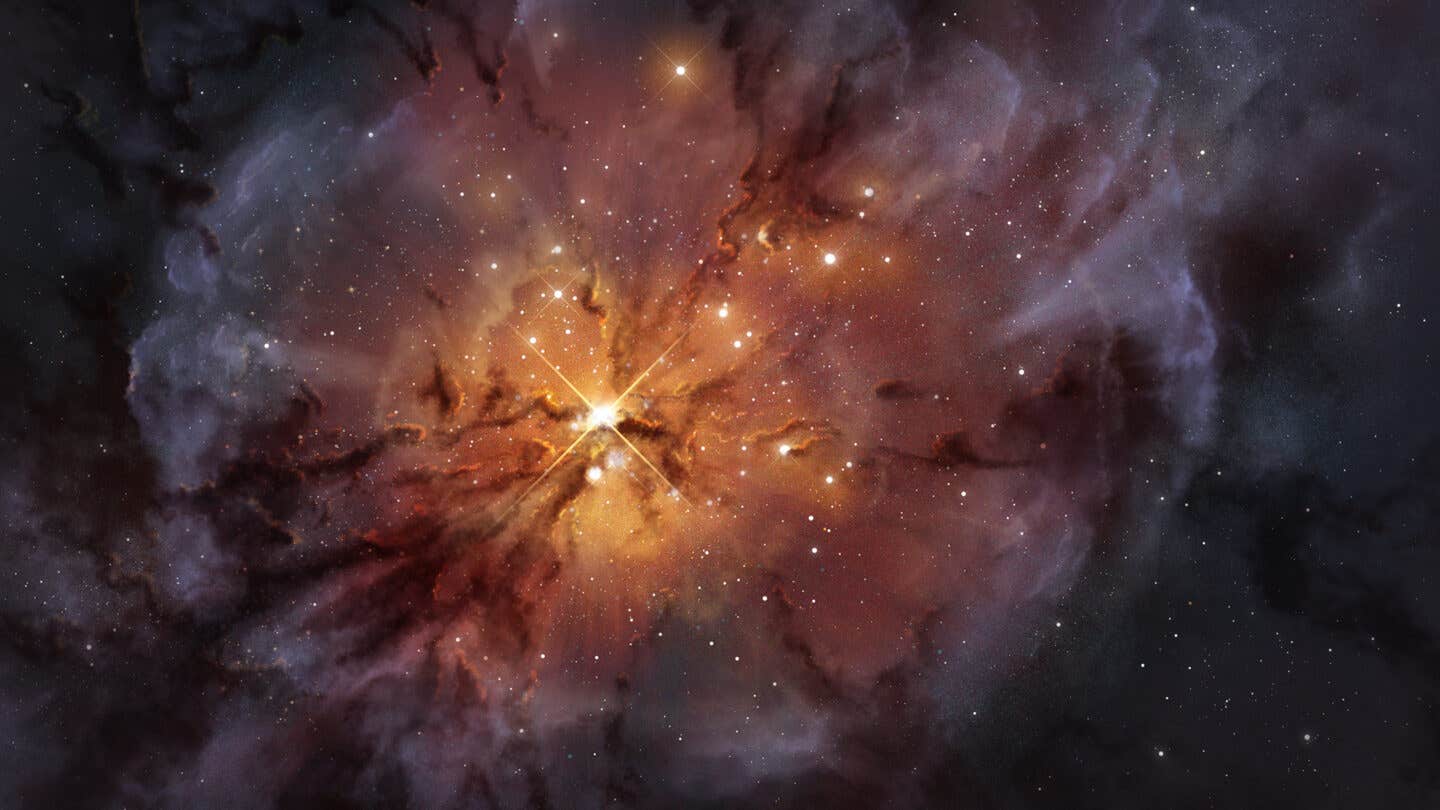
An artist’s illustration depicts gas being pushed away from a star-forming region in the early universe, showing how radiation from young stars can clear surrounding material. (CREDIT: Matt Twombly for Simons Foundation)
- Lyman-alpha light could help expose young galaxies by pushing away lower-density gas and dust around their stars.
- Calculations suggest dense gas can resist that pressure, allowing vigorous star formation while clearer sight lines develop.
- The findings depend strongly on dust and use saved simulation snapshots, so they do not yet settle Webb's bright-galaxy puzzle.
Some of the universe's earliest galaxies may look unusually bright because their stars help clear away the material hiding them. A particular kind of ultraviolet light could push loose gas and dust outward, exposing more starlight. The proposed mechanism offers a possible contribution to the bright-galaxy puzzle raised by the James Webb Space Telescope. It does not require that every unexpectedly luminous galaxy contain more stars than astronomers anticipated.
Webb has revealed more bright galaxies than many models predicted for the first few hundred million years after the Big Bang. Researchers at the Flatiron Institute and the University of Texas at Dallas investigated whether light could help explain their visibility. Their findings appear in The Astrophysical Journal. The calculations examine how radiation competes with gravity inside the compact stellar nurseries associated with early galaxies.
Light that delivers repeated pushes
The radiation involved is called Lyman-alpha, a distinctive ultraviolet emission from hydrogen. It can arise after an electron rejoins an ionized hydrogen atom or excites an existing atom through a collision. In either case, an electron subsequently falls to a lower energy level and releases light. Young stellar environments can produce substantial amounts of this radiation.
Light carries momentum, so interactions with matter can exert pressure. Lyman-alpha is particularly interesting because neutral hydrogen can absorb and re-emit it repeatedly. Each scattering exchanges momentum, allowing radiation trapped in a cloud to deliver many pushes before escaping. Dust absorption can interrupt that process and weaken the accumulated force.
“We've known for a very long time that Lyman-alpha radiation could be important because it carries a lot of force,” said lead author Shyam Menon. “But we've never actually been able to estimate how important it is in a realistic environment because of how challenging it is to model.” Menon is a research fellow at Flatiron's Center for Computational Astrophysics. The repeated interactions make tracing the radiation computationally expensive.
Why dense gas can keep forming stars
Strong radiation pressure raises an obvious question: Could it remove the gas needed to build stars? Earlier simplified calculations suggested Lyman-alpha might severely restrict star formation in some dense environments. The new analysis finds that the answer depends on where the gas sits and how it is arranged. A cloud's average properties can conceal important differences between its dense filaments and more diffuse surroundings.
In the simulations, turbulent gas gathers into narrow, dense structures that feed growing star clusters. Gravity remains stronger than Lyman-alpha's outward push in the densest material. Consequently, much of the gas supplying new stars can remain bound.
The calculations suggest that strong radiation need not prevent efficient cluster formation under the conditions examined. Their accompanying model estimated that at least half the initial gas could still become stars in cases containing dust. Even the dust-free limit allowed substantial star formation, although its efficiency was lower. These are model-dependent estimates, not measurements of how individual observed galaxies formed their stars.
Lower-density gas presents a different opportunity for radiation. Once much of the stellar mass has formed, a larger share of the remaining material becomes susceptible to outward acceleration. The result could combine vigorous star formation with rapid clearing around the stars. That combination matters because a productive stellar nursery can remain luminous while losing some of its obscuring material.
Testing the forces in three dimensions
Menon and collaborator Aaron Smith used snapshots from computer simulations of turbulent, collapsing gas clouds. Each initial cloud contained about a million times the Sun's mass within a radius of 10 parsecs, roughly 33 light-years. Those conditions represented dense cluster-forming environments relevant to cosmic dawn. They were not simulations of an entire galaxy or the whole early universe.
The researchers then followed Lyman-alpha radiation through the saved gas structures using a radiation-transfer code called COLT. They calculated how much momentum the light deposited and compared its acceleration with gravity. This captured the complicated three-dimensional arrangement of stars and gas. However, Lyman-alpha's force did not change the gas distribution as the original simulation evolved.
A simpler accompanying model estimated the consequences for star formation and clearing times. It suggested that Lyman-alpha could shorten the time needed to open low-obscuration sight lines by as much as a factor of two. In the modeled conditions, that clearing could occur within about 4 million years. These estimates provide guidance for more complete galaxy-formation simulations, rather than directly measuring winds in Webb's galaxies.
Dust determines how strong the effect becomes
Dust plays two roles in this explanation. It obscures starlight, but it can also absorb Lyman-alpha photons and stop their repeated scattering. How efficiently cosmic dust absorbs this ultraviolet radiation therefore helps determine how effectively the light pushes gas. Less dust can allow a stronger cumulative force.
The team tested dust abundances ranging from none to one-tenth of the local solar-neighborhood value. Lyman-alpha's effects were strongest in the dust-poor cases and more modest in the dustier ones. Its pressure could exceed other modeled radiation-pressure forces while still failing to overcome gravity in dense gas. Being the strongest radiative push does not automatically make it strong enough to eject everything.
The nature of dust in young galaxies remains an important uncertainty. Grain size and composition affect absorption, so the amount of dust alone does not settle its influence. The authors caution that some relatively massive galaxies accessible to Webb might be only weakly affected unless their dust absorbs less efficiently. The proposed mechanism's contribution may therefore vary substantially between galaxies.
Menon described the possible observational consequence in the foundation's account of the research. “Our results show Lyman-alpha radiation can push low-density gas and dust away really, really fast,” he said. “It can sort of clear the ‘fog,’ allowing us to see stars in the early universe much more clearly than we would otherwise.” Demonstrating how often that happens requires connecting the local calculations to a wider population of galaxies.
A possible explanation that needs a fuller test
Clearing material near clusters could make more stellar light visible and create routes for radiation to escape. That connects the calculation with broader questions about galactic winds and the radiation young galaxies release. But overcoming a cluster's gravity is not the same as escaping an entire galaxy. The study does not demonstrate that Lyman-alpha alone drives every proposed galaxy-scale outflow.
The snapshot approach also leaves feedback between radiation and moving gas unresolved. As gas disperses, photons may escape more easily, changing the force they exert. Other missing ingredients, including magnetic fields and stellar winds, could alter the balance. Numerical noise introduces further uncertainty in individual force estimates, reinforcing the need for calculations that evolve these processes together.
Ultimately, researchers need models that follow radiation, gas motions and star formation simultaneously. Such work could establish how much this mechanism changes galaxy brightness and the radiation escaping into surrounding space. It may also clarify differences between conspicuous objects and fainter early galaxies. For now, the result identifies a plausible way to expose bright young stars without shutting down the dense nurseries that produce them.
Dig deeper into radiation and early galaxies
These resources explore radiation pressure, early star clusters and other explanations for unexpectedly bright galaxies.
Lyman-alpha Pressure Strongly Enhances Pre-Supernova Feedback at Cosmic Dawn: The First Multi-Dimensional Lyman-alpha Radiation Hydrodynamics Simulations
This preprint presents two-dimensional calculations that evolve Lyman-alpha feedback alongside gas dynamics, providing a next step beyond snapshot analysis. (arXiv, June 2026)
Lyman α resonant-line radiative transfer in expanding media
Explains how expanding gas changes Lyman-alpha scattering, photon trapping and momentum transfer. (Monthly Notices of the Royal Astronomical Society, June 2025)
Bound star clusters observed in a lensed galaxy 460 Myr after the Big Bang
Reports observations of compact early star clusters, helping establish the environments that radiation-feedback calculations seek to explain. (Nature, June 2024)
Bursty Star Formation Naturally Explains the Abundance of Bright Galaxies at Cosmic Dawn
Investigates how short-lived bursts of star formation can increase the number of galaxies visible at high ultraviolet brightness. (The Astrophysical Journal Letters, October 2023)
Lyman-alpha radiation pressure: an analytical exploration
Develops analytical estimates of radiation-pressure amplification and the influence of dust, offering a foundation for more detailed simulations. (Monthly Notices of the Royal Astronomical Society, 2021)
Research findings are available online in The Astrophysical Journal.
The original story "A cosmic 'leaf blower' could expose the universe's earliest galaxies" is published in The Brighter Side of News.
Related Stories
- Galactic winds from exploding stars may block radiation that helped transform the early universe
- ALMA observatory maps a cosmic 'hamburger' that may be building a giant planet
- Cosmic ‘pearls’ emerge around the surviving star of an ancient supernova
Like these kind of feel good stories? Get The Brighter Side of News' newsletter.
Joseph Shavit
Writer, Editor-At-Large and Publisher
Joseph Shavit, based in Los Angeles, is a seasoned science journalist, editor and co-founder of The Brighter Side of News, where he transforms complex discoveries into clear, engaging stories for general readers. With vast experience at major media companies like The Los Angeles Times, Times Mirror and Tribune Publishing, he writes with both authority and curiosity. His writing focuses on space science, planetary science, quantum mechanics, geology. Known for linking breakthroughs to real-world markets, he highlights how research transitions into products and industries that shape daily life.