‘Cosmic Glitch’ could explain why gravity acts differently across the Universe
Planck data hint that gravity could weaken slightly on the universe’s largest scales, but stronger evidence is still needed.

 Edited By: Joshua Shavit

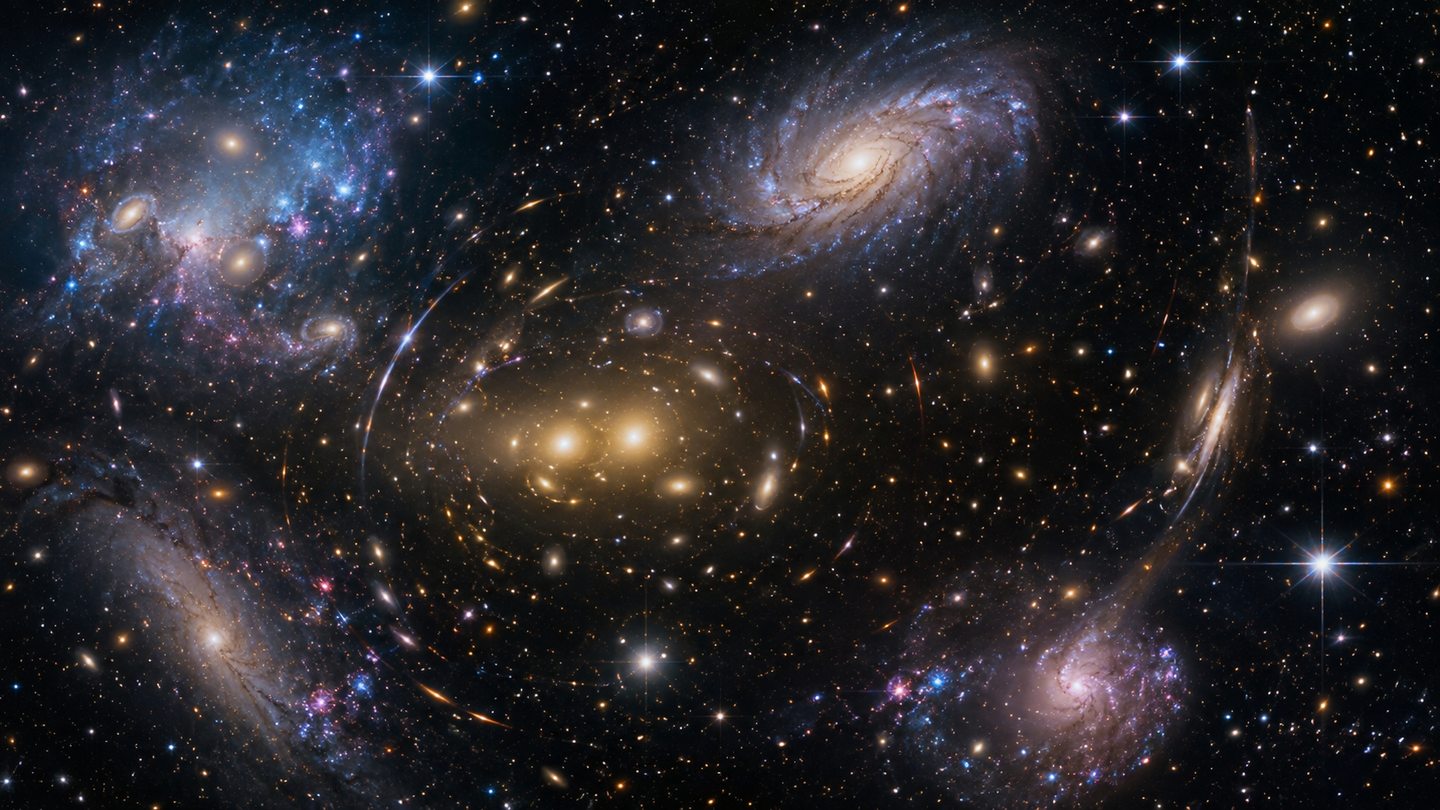
A cosmic glitch in gravity may make gravity about 1% weaker across billions of light-years, challenging Einstein’s theory at vast scales. (CREDIT: Shutterstock)
- Einstein’s theory of gravity may behave slightly differently across distances of billions of light-years, with gravity appearing about 1 percent weaker on cosmic scales.
- The proposed “cosmic glitch” modestly improves some cosmological measurements and eases the disagreement over how fast the universe is expanding, although it does not resolve the problem.
- Current evidence remains tentative, and future observations from projects such as DESI and Euclid could reveal whether the effect is real or disappears with better data.
Gravity has passed nearly every test physicists have thrown at it for a century. Yet on the largest scales in the universe, a small mismatch may be pointing toward a limit in Einstein’s theory.
A team from the University of Waterloo and the University of British Columbia has developed a model for what it calls a “cosmic glitch” in gravity. The idea suggests gravity could be about 1 percent weaker across distances of billions of light-years than general relativity predicts.
The work appears in the Journal of Cosmology and Astroparticle Physics. It does not discard Einstein’s theory. Instead, the model modifies its equations only at immense cosmological scales while preserving the theory’s successes elsewhere.
“This model of gravity has been essential for everything from theorizing the Big Bang to photographing black holes,” said Robin Wen, the study’s lead author and a recent Waterloo Mathematical Physics graduate.
“But when we try to understand gravity on a cosmic scale, at the scale of galaxy clusters and beyond, we encounter apparent inconsistencies with the predictions of general relativity. It’s almost as if gravity itself stops perfectly matching Einstein’s theory. We are calling this inconsistency a ‘cosmic glitch’: gravity becomes around one per cent weaker when dealing with distances in the billions of light years. “
A small change at enormous distances
General relativity replaced Newton’s picture of gravity with a description in which matter and energy shape spacetime. It has survived a century of observational and experimental tests.
The new model asks whether that success can remain intact while allowing a slight difference between gravity on smaller scales and gravity across the universe.
The researchers express that difference through a parameter called Ωg. A value of zero corresponds to standard cosmology based on general relativity. Negative values represent weaker effective gravity on cosmological scales.
Using 2018 Planck observations of the cosmic microwave background, the team found Ωg = -0.0087 ± 0.0046. That places the standard value of zero almost two standard deviations from the model’s mean estimate.
The cosmic-glitch model also produced a Hubble constant of 68.58 ± 0.86 kilometers per second per megaparsec. Standard ΛCDM using the same Planck data gave 67.36 ± 0.54.
A possible link to the Hubble tension
The Hubble tension describes the disagreement between expansion rates inferred from the early universe and those measured through the distance ladder.
The SH0ES project reported 73.2 ± 1.3 kilometers per second per megaparsec, while Planck data interpreted through ΛCDM gave 67.36 ± 0.54.
Allowing the cosmic-glitch parameter to go negative raised the Planck-based estimate. With Planck data alone, the model reduced the Hubble tension from 4.1 standard deviations to 3.0.
When the team combined Planck data with Dark Energy Survey measurements, the preferred expansion rate rose to 69.69 ± 0.66. That brought the result within 2.4 standard deviations of SH0ES.
But the improvement did not survive every data combination.
Adding baryon acoustic oscillation measurements lowered the estimate to 68.11 ± 0.46 and placed it 3.7 standard deviations from SH0ES. Supernova data produced only a small change.
“Almost a century ago, astronomers discovered that our universe is expanding,” said Niayesh Afshordi, a University of Waterloo astrophysics professor and Perimeter Institute researcher.
“The farther away galaxies are, the faster they are moving, to the point that they seem to be moving at nearly the speed of light, the maximum allowed by Einstein’s theory. Our finding suggests that, on those very scales, Einstein’s theory may also be insufficient.”
Planck data offer tentative support
A negative Ωg slightly improved how the model matched parts of the Planck cosmic microwave background data.
It lowered predicted power at large angular scales, producing a somewhat better fit to the observed low-multipole deficit. It also slightly improved the match to residual patterns in higher-multipole temperature and polarization measurements.
Still, the evidence remains limited.
With the original Planck 2018 likelihoods, the preference for a negative cosmic-glitch value ranged from 1.9 to 2.8 standard deviations, depending on which additional large-scale structure data were included.
A later analysis using Planck Public Release 4 weakened that preference. The researchers obtained Ωg = -0.0054 ± 0.0042, leaving the standard value only 1.3 standard deviations from the model’s mean.
The newer analysis still favored a negative value, but less strongly.
The model also did not resolve the tension involving S8, a parameter connected to matter clustering. However, some Planck and Dark Energy Survey constraints overlapped more when compared in two dimensions.
A footnote to Einstein, not a replacement
The proposed modification is deliberately minimal. Rather than adding a new physical scale or extra propagating degree of freedom, it allows gravity’s effective strength to differ between sub-horizon and super-horizon scales.
“Think of it as being like a footnote to Einstein’s theory,” Wen said. “Once you reach a cosmic scale, terms and conditions apply.”
The researchers also explored whether the glitch could change with cosmic time. Measurements tied to primordial helium abundances would require Ωg = -0.085 ± 0.027 during Big Bang nucleosynthesis.
That difference raises the possibility that the parameter might evolve across cosmic history, although the paper treats that idea as speculative.
“This new model might just be the first clue in a cosmic puzzle we are starting to solve across space and time,” Afshordi said.
Practical implications of the research
The immediate impact is a new way to test whether gravity behaves identically across every cosmic scale.
Future cosmic microwave background measurements and large-scale structure surveys could sharply narrow the uncertainty around Ωg. The researchers estimate that an ideal cosmic-variance-limited CMB experiment could reduce the uncertainty to about 0.0011. Adding Euclid-like baryon acoustic oscillation measurements could lower it to about 0.0008.
That would make it easier to determine whether the apparent negative value reflects a real feature of gravity or a statistical fluctuation.
Upcoming surveys, including DESI and Euclid, may therefore help decide whether the “cosmic glitch” points toward physics beyond general relativity or fades as measurements improve.
Einstein's General Theory of Relativity
Einstein’s theory of general relativity, introduced in 1915, fundamentally changed how scientists understand gravity. Here’s a simplified overview:
Spacetime Curvature: Rather than treating gravity as a force, as Newton did, Einstein described it as the bending of spacetime by massive objects such as stars and planets. Picture a heavy ball resting on a stretched sheet. The ball creates a dip, causing nearby objects to move toward it.
Mass-Energy Equivalence: Expanding on his famous equation, E=mc², Einstein showed that mass and energy are closely connected. Both contribute to the curvature of spacetime and therefore influence gravity.
Geodesic Motion: Objects in free fall, including planets orbiting stars, travel along the most direct paths available through curved spacetime. These paths are called geodesics. What appears to be gravitational acceleration is actually an object following the natural geometry of spacetime.
Gravitational Time Dilation: Gravity also affects the passage of time. Clocks run more slowly in stronger gravitational fields. This effect has been experimentally verified and must be accounted for to keep GPS satellite positioning accurate.
Predictions: General relativity predicts several remarkable phenomena, including gravitational lensing, where massive objects bend passing light, as well as black holes and gravitational waves.
Overall, general relativity explains gravity not as a conventional force, but as the distortion of spacetime produced by mass and energy.
Research findings are available online in the Journal of Cosmology and Astroparticle Physics.
The original story "‘Cosmic Glitch’ could explain why gravity acts differently across the Universe" is published in The Brighter Side of News.
Related Stories
- Faint black hole 'ringing' provides a sharper test of Einstein’s gravity
- Scientists reveal the hidden forces shaping how gravity works across the Universe
- Geophysicists solve the mystery of a 75-year-old ‘gravity hole’ in the Indian Ocean
Like these kind of feel good stories? Get The Brighter Side of News' newsletter.
Joseph Shavit
Writer, Editor-At-Large and Publisher
Joseph Shavit, based in Los Angeles, is a seasoned science journalist, editor and co-founder of The Brighter Side of News, where he transforms complex discoveries into clear, engaging stories for general readers. With vast experience at major media companies like The Los Angeles Times, Times Mirror and Tribune Publishing, he writes with both authority and curiosity. His writing focuses on space science, planetary science, quantum mechanics, geology. Known for linking breakthroughs to real-world markets, he highlights how research transitions into products and industries that shape daily life.