Could animal camouflage actually be a form of communication?
A researcher proposes that twig-like caterpillars can change a predator’s behavior by making their identity harder to recognize. The idea challenges how scientists define an animal signal.
 Writer: Go Totsukawa (y)

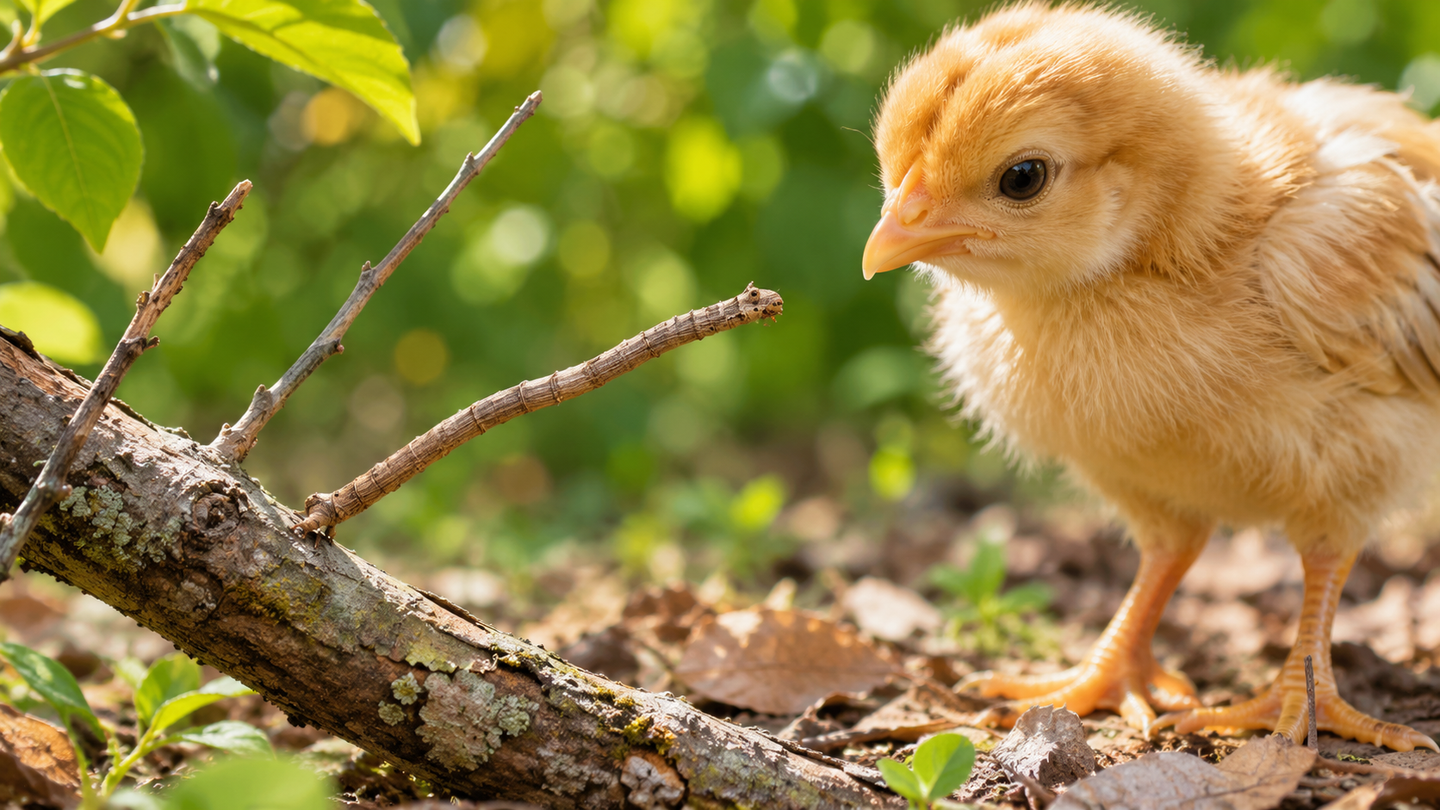
In this illustration, a caterpillar holds itself stiff like a twig as a chick stands nearby. In an earlier experiment, chicks familiar with twigs took longer to attack twig-like caterpillars, suggesting that the disguise can hide the insect’s identity in plain sight. (CREDIT: The Brighter Side of News)
- A Tokyo Metropolitan University researcher proposes that some animal camouflage works as a signal by masking an animal’s identity.
- In an earlier experiment, chicks familiar with twigs took longer to attack twig-like caterpillars, suggesting that experience shaped how they classified potential prey.
- The argument is strongest for masquerade, in which an animal resembles an object. Whether it applies to camouflage more broadly remains open.
A chick can look at a caterpillar and see something that appears to be a twig. To the caterpillar, the distinction may be a matter of survival. The chick has registered an object in front of it, but the object’s appearance gives it little reason to investigate further.
Minato Asari, an assistant professor at Tokyo Metropolitan University, argues that this kind of concealment deserves a place in the study of communication. In Philosophy of Science, he proposes that some animal camouflage functions as an information-masking signal. It changes what another animal can infer from the features it perceives.
Many familiar signals make useful information easier to pick up. Research on chimpanzee calls and whale clicks examines what listeners can learn from sounds. Asari turns the question around. If an animal’s appearance evolved to make its identity harder to work out, could that appearance also count as a signal?
When animal camouflage relies on recognition
Camouflage can interfere with vision at different stages. A pattern that matches the colors and textures of bark can make it hard to pick out an animal’s outline. Biologists call this general kind of concealment crypsis. Asari focuses on masquerade, in which an animal takes on the appearance of a recognizable object, such as a twig or a dead leaf.
Both strategies can keep a predator from attacking, but they create different problems for the viewer. A predator searching a patch of bark must first pick out an object. A predator looking at a dead-leaf butterfly may see its outline clearly and still pass it by. The butterfly’s resemblance to a leaf makes its identity harder to recognize.
The distinction matters when comparing background matching with other ways animals’ appearances affect a viewer. For example, experiments on shark deterrence have explored whether changing a silhouette can affect a predator’s response. Similar outcomes can arise at different points in the process, from first noticing a shape to deciding what that shape represents.
What chicks learned from twigs
Asari draws on an experiment published in 2010 by John Skelhorn and colleagues. The team changed what domestic chicks had seen before presenting them with caterpillars that resemble twigs. Some chicks had experience with ordinary twigs, while comparison groups had different prior exposure. The researchers then timed how long the chicks took to attack.
Chicks familiar with real twigs took longer to attack the caterpillars. Since the prey presented to the birds still looked like twigs, the difference depended on the birds’ earlier experience. It supports the idea that the chicks could register an object but classify it as something they had little reason to peck. The researchers inferred that classification from the birds’ behavior.
The important comparison was between chicks that encountered the same kind of prey after different experiences. A longer delay can matter in nature because it may give a caterpillar time to remain undisturbed or escape. The experiment recorded attack timing under controlled conditions, leaving survival in the wild as a separate question.
Other studies of animal perception ask what an animal makes of the sights it encounters. Work on caterpillar vibrations also shows that contacts between caterpillars and other species can depend on the particular features a receiver picks up. In the twig experiment, the critical feature was the prey’s resemblance to an object the birds had already encountered.
How a signal can conceal information
Animal signaling theories often ask whether a trait evolved because it affects another organism’s behavior. By that reasoning, some theorists have excluded camouflage on the grounds that a predator cannot respond to something it never detects. Masquerade gives Asari a reason to challenge that assumption. A predator can respond to an object by passing it over after classifying it as irrelevant.
Asari uses information theory to describe what changes for the receiver. In this setting, that means asking how a sight or sound changes the likelihood the viewer assigns to different explanations. If a shape moves like a caterpillar, a bird may be more likely to treat it as food. If that shape looks convincingly like a twig, the same bird may judge that prey is less likely to be present.
Work on insect communication documents the many ways animals make signals available to one another. Research into camouflage pigments illustrates how an animal’s visible appearance can also be altered. Asari’s framework places the emphasis on what the receiver can infer once it encounters that appearance.
The model treats these judgments as changes in probability. A hungry bird enters a patch with some expectation of finding food, then updates that expectation as it sees what is there. Asari uses this idea to describe the effect of the disguise without assuming that the bird consciously works out the odds.
Where masking and deception overlap
Consider an edible animal that resembles a toxic one. Its appearance can push a predator toward a specific mistaken conclusion: that eating it would be dangerous. This resembles the strategy of a mimicking flower, which can attract flies by giving off odors associated with their usual targets. The resemblance directs the receiver toward a particular interpretation.
A twig-like caterpillar can succeed by making prey seem unlikely to be present. In Asari’s model, the critical change is that the predator assigns less weight to the correct possibility. The distinction depends on which possibilities a receiver has available. A single resemblance can both conceal an animal’s identity and encourage a mistaken interpretation.
The context also matters. Something that resembles a twig in one setting may stand out in another, much as a change in visible color can help an object blend into one background while making it conspicuous against another. The predator’s previous encounters also help determine whether that resemblance is convincing enough to delay an attack. That makes the viewer’s experience part of the explanation, alongside the properties of the disguise itself.
Practical implications
The model gives researchers a way to ask where animal camouflage changes a predator’s response. Experiments could measure when a predator first looks at an object, whether it inspects the object and how quickly it attacks. Tracking those decisions separately could show which traits make an animal harder to spot and which make a visible animal harder to identify.
Other forms of signaling offer a way to test whether the concept travels. Research on vibrational signals and animal calls addresses how messages reach receivers. In treehoppers, for example, a male can produce vibrations that overlap a rival’s courtship signal. The rival’s message becomes harder to pick up, while the twig-like caterpillar masks information about itself.
The earlier chick experiment gives Asari’s analysis a concrete starting point. Extending it will require tests that show what a receiver perceived and which information became harder to use. For a chick facing a twig-like caterpillar, the next question is whether researchers can pinpoint the moment between seeing the shape and deciding to leave it alone.
Dig deeper into animal camouflage and communication
These studies cover the science of being seen, being misidentified and interfering with other animals’ signals.
Role of body size and shape in animal camouflage: The study examines how an animal’s dimensions can influence its ability to blend in or resemble objects. (Ecology and Evolution, 2024)
A framework for understanding post-detection deception in predator–prey interactions: The authors examine how prey can influence a predator’s decisions after the predator detects them. (Proceedings of the Royal Society B, 2023)
Hiding among colors: background color diversity impedes detection time: Researchers test how color variety in a background affects the time it takes to find a concealed target. (Behavioral Ecology, 2023)
Competitive masking of vibrational signals during mate searching in a treehopper: Experiments investigate how male treehoppers interfere with rivals’ courtship vibrations. (Animal Behaviour, 2012)
Masquerade: camouflage without crypsis: The original experiment tests how previous encounters with twigs affect how quickly chicks attack twig-like caterpillars. (Science, 2010)
Research findings are available online in the journal Philosophy of Science.
The original story "Could animal camouflage actually be a form of communication?" is published in The Brighter Side of News.
Related Stories
- Scientists engineer microbe that mass-produces camouflage pigment
- Incredible thermal camouflage makes soldiers nearly undetectable
- Squirrel colors spotlight local evolutionary changes in urban species
Like these kind of feel good stories? Get The Brighter Side of News' newsletter.
Hannah Shavit-Weiner
Medical & Health Writer
Hannah Shavit-Weiner is a Los Angeles–based medical and health journalist for The Brighter Side of News, an online publication focused on uplifting, transformative stories from around the globe. Having published articles on AOL.com, MSN and Yahoo News, Hannah covers a broad spectrum of topics—from medical breakthroughs and health information to animal science. With a talent for making complex science clear and compelling, she connects readers to the advancements shaping a brighter, more hopeful future.