The rise of ancient mountains may have changed the course of life on Earth
Rocks once buried beneath ancient ranges reveal two jumps in crustal thickness. Researchers propose that taller mountains sent more nutrients to the oceans, helping change conditions for early life.
 Writer: Alex Walls (UBC)

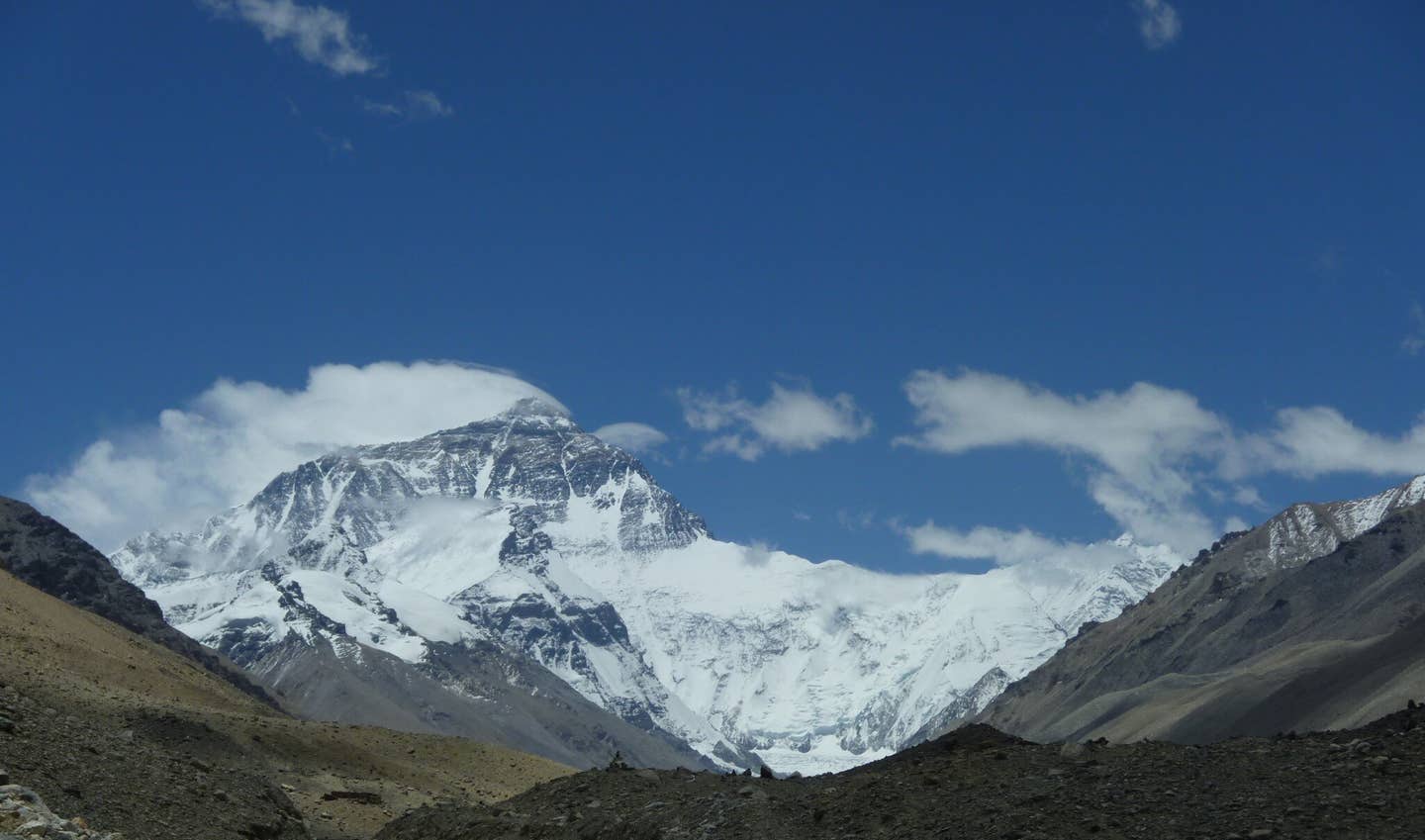
Mount Everest, the world’s tallest mountain above sea level, rises above the rugged Himalayan landscape as seen from the Tibetan side of the mountain in China. (CREDIT: Matthijs Smit)
- Ancient rocks record two periods when colliding tectonic plates began building thicker crust and likely supporting taller mountains.
- The researchers estimated that the maximum crustal thickness recorded in mountain belts rose from about 30 to 60 kilometers and later approached 90 kilometers.
- Both shifts broadly overlap with changes in Earth’s oxygen levels. The study proposes that erosion supplied nutrients to marine life, but the timing alone cannot establish what caused oxygen to rise.
The tallest mountains on early Earth may have stood little above sea level. Billions of years later, colliding plates could build ranges comparable to the Himalayas. A new study traces that change to two growth spurts and proposes that the rise of mountains helped reshape the oceans where early life evolved.
Matthijs Smit of the University of British Columbia and colleagues reconstructed how deeply rocks were buried in mountain belts over roughly three billion years. Their study, published in Science Advances, found two sustained increases in the maximum thickness of mountain-belt crust. Thicker crust generally supports higher terrain, although the relationship also depends on the density of the rock.
The history of plate motion goes back billions of years. Other studies trace the emergence of early continents, where rocks became exposed to rain, rivers and air. The new work asks when collisions began to build mountains tall enough to change how much material moved from those continents into the sea.
Ancient rocks record mountain growth
Mountains lose their peaks as rivers, glaciers and landslides wear them down. Rocks that once lay far below those peaks can survive. These metamorphic rocks changed under heat and pressure while buried, and some retain minerals that reveal the conditions they experienced. Over time, geological processes can bring the rocks back to the surface.
The team combined new results with published measurements from mountain belts around the world. The minerals provided estimates of the pressure the rocks had experienced, while dates helped establish when they reached those conditions. By comparing the highest pressures recorded in different periods, the authors estimated how deep the roots of mountain belts could extend.
Studies of Earth’s earliest rocks illustrate how much geologists can learn from surviving fragments of ancient crust. Research on how continents formed also shows how strongly conditions below the surface can shape what survives. If especially deep rocks sank into the mantle or never returned to the surface, the preserved record could miss some of the thickest early crust.
Two shifts raised the ceiling
The first period of mountain growth stretched from about 2.7 billion to 2.2 billion years ago. Across that interval, the estimated maximum thickness of mountain-belt crust rose from about 30 to about 60 kilometers. The authors’ conversion from thickness to elevation suggests some later ranges could have stood roughly half as high as the Himalayas do today.
The second shift came much later, between about 800 million and 700 million years ago. By then, the rock record points to crust reaching nearly 90 kilometers thick in some mountain belts. That approaches the thickness beneath parts of the modern Himalaya and adjacent regions. The figure describes the depth of the crust beneath a mountain belt, while the elevation estimate describes how high its surface may have stood.
The changes likely reflect how collisions evolved as Earth’s interior cooled. Smit and co-author Douwe van Hinsbergen and their colleagues propose that plate behavior increasingly allowed pieces of continental crust to stack and thicken. Research on lost continents and continental collisions shows how these processes can reorganize the surface. The precise heights of individual ancient ranges remain uncertain because their rock density and sea level may have differed from today’s.
From eroding rock to ocean nutrients
A taller range can expose more rock to weathering, the physical and chemical processes that break it down. On steep slopes, rivers can carry sediment away and expose fresh surfaces. Water also dissolves minerals and transports some of their ingredients downstream. Over long periods, that movement connects the growth of a mountain belt to the chemistry of distant coastal waters.
One ingredient is phosphorus, which living cells need to build DNA and transfer energy. The researchers propose that erosion supplied more phosphorus to seas where it could limit the growth of photosynthetic microbes. Studies of other possible phosphorus sources and ancient ocean chemistry highlight a related question. How much of the phosphorus delivered to the water remained available for life to use?
More photosynthesis could increase the production of oxygen. Whether oxygen accumulates also depends on how much gets used up when organisms decompose or react with minerals and dissolved substances. If some organic matter becomes buried before it breaks down, more oxygen can remain in the environment. The mountain-growth hypothesis therefore depends on what happened to nutrients and organic matter after they reached the sea.
The oxygen timeline puts the idea to a test
The first growth interval overlaps with the Great Oxidation Event, which began around 2.4 billion years ago. Chemical evidence indicates that atmospheric oxygen rose unevenly over an extended period. Some early microbes may already have used oxygen before it became a persistent part of the atmosphere.
The later interval broadly overlaps with changes in oxygen levels before the rise of early animals. Fossil evidence from an oxygenated seafloor helps show why local conditions mattered. Oxygen levels could vary across oceans, and different environments could become suitable for complex organisms at different times.
The study adds a geological explanation for why nutrients might have become more available during those broad transitions. Its pressure measurements constrain the history of mountain building. The proposed effects on marine nutrients, oxygen and biodiversity depend on additional evidence from sediments and fossils. Their timing leaves room for other processes, including changes in how the ocean recycled phosphorus and how much oxygen seawater and rocks consumed.
Practical implications
The study gives geologists two intervals to compare with independent signs of erosion and continental exposure. Marine geochemists can ask whether sediments from those intervals show an increase in nutrients from land. Researchers could start by comparing the rock record with other evidence about past conditions, from ancient salt to the distribution of early animal fossils.
The decisive test will be whether the order of events holds across different regions. The proposed chain starts with thicker crust and more exposed rock, followed by stronger nutrient delivery and changes in ocean chemistry. Finding those steps in that order would help establish when rising mountains began to change the conditions under which life could diversify.
Dig deeper into mountain building and early life
These resources trace the evidence for ancient mountain growth, changing nutrient supplies and Earth’s uneven rise in oxygen.
Mountain growth spurts may have sparked complex life on Earth: The university explains the reconstructed changes in crustal thickness and the proposed connection to ocean nutrients. (University of British Columbia, 2026)
Two-billion-year transitional oxygenation of the Earth’s surface: Researchers examine the long transition in oxygen levels across Earth’s surface environments. (Nature, 2025)
Onset of coupled atmosphere–ocean oxygenation 2.3 billion years ago: The study uses geological evidence to refine the timing of oxygen changes in the atmosphere and ocean. (Nature, 2024)
Earth’s Great Oxidation Event facilitated by the rise of sedimentary phosphorus recycling: Researchers investigate how phosphorus released from marine sediments could have supported oxygen-producing life. (Nature Geoscience, 2022)
The temporal distribution of Earth’s supermountains and their potential link to the rise of atmospheric oxygen and biological evolution: An earlier reconstruction uses mineral evidence to identify ancient phases of large-scale mountain building. (Earth and Planetary Science Letters, 2022)
Research findings are available online in the journal Science Advances.
The original story "The rise of ancient mountains may have changed the course of life on Earth" is published in The Brighter Side of News.
Related Stories
- Mountain soils store twice as much carbon as scientists thought
- Human activity found to literally move mountains
- Billion-year geological model explains the Great Unconformity seen in the Grand Canyon
Like these kind of feel good stories? Get The Brighter Side of News' newsletter.
Joshua Shavit
Writer and Editor
Joshua Shavit is a NorCal-based science and technology writer with a passion for exploring the breakthroughs shaping the future. As a co-founder of The Brighter Side of News, he focuses on positive and transformative advancements in technology, physics, engineering, robotics, and astronomy. Having published articles on AOL.com, MSN, Yahoo News, and Ground News, Joshua's work highlights the innovators behind the ideas, bringing readers closer to the people driving progress.