New kerosene gel fuel could improve propulsion control in rockets and satellites
A clear kerosene gel stayed visibly uniform in sealed containers for more than a year and flowed more readily under shear. Concordia researchers are exploring what that could mean for rockets and satellites.
 Writer: Patrick Lejtenyi (Concordia University)

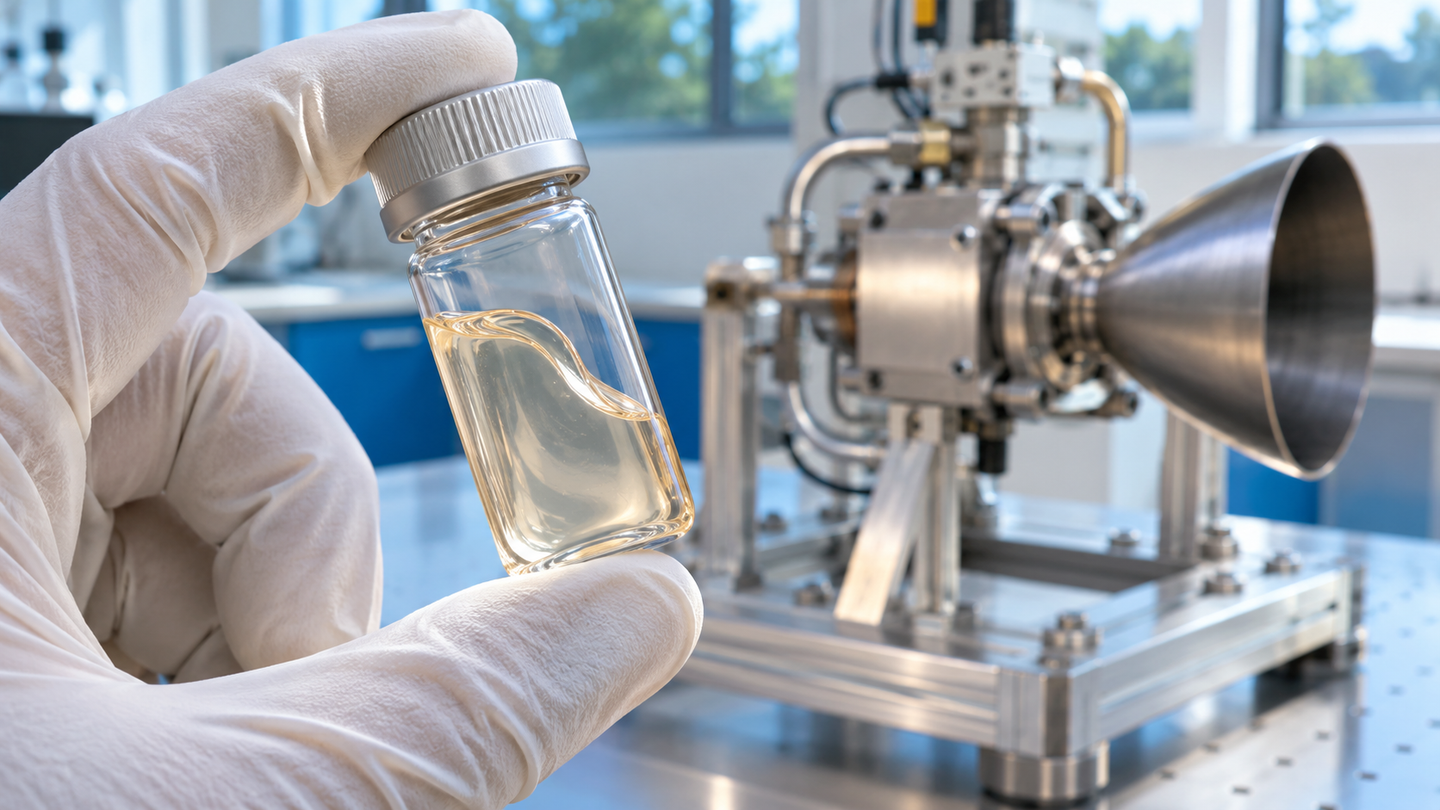
A lab illustration shows a vial of clear kerosene gel beside a spacecraft thruster. In Concordia University’s tests, the gel behaved like a soft solid at rest and flowed more easily under shear. (CREDIT: The Brighter Side of News)
- Concordia University researchers developed a clear kerosene gel that behaves like a soft solid at rest and flows more easily when disturbed.
- The gel’s viscosity fell roughly 100-fold as the rate of shear increased, and sealed samples showed no visible separation after more than a year.
- The material could help limit fuel slosh and make storage easier, but tests in a working propulsion system are still needed.
A rocket engine needs fuel to move on command. Inside the tank, that same freedom to move can become a problem. Fuel can surge from one side to the other as a vehicle accelerates or turns, pushing against the tank walls and complicating the work of keeping the spacecraft on course.
Researchers Pranay Mudaliar and Jerin John at Concordia University are exploring a way to give kerosene two useful behaviors. Their transparent gel holds together like a soft solid while sitting still. When layers of the material slide past one another faster, it becomes much easier to move. The team reported its findings in Langmuir.
Why moving fuel can steer a spacecraft
A half-full water bottle makes the problem easy to see. Move the bottle sharply, then stop, and the water keeps moving for a moment. As it hits the walls and rolls back, it pushes on the bottle. In a spacecraft, where propellant can account for a large share of the vehicle’s mass, similar motion can affect the flight path.
The issue matters across space transportation, from a launcher climbing away from Earth to a vehicle making adjustments after reaching orbit. Those adjustments can be especially important for missions that rely on carefully timed orbital maneuvers. Even after a maneuver ends, the fuel can keep moving. The tank and the guidance system must deal with the forces that motion creates.
One familiar solution is to put baffles inside the tank. These barriers interrupt waves and help damp their motion. A gel tackles the problem through the fuel itself. If the material resists motion when little force acts on it, engineers may have another way to limit how far it shifts. How much the Concordia gel would reduce slosh in a spacecraft tank remains an open question.
What holds the kerosene in place
The gel gets its structure from lecithin, a naturally derived substance that can form tiny groups of molecules. Calcium chloride helps those groups grow into long, flexible strands called wormlike micelles. The strands form a mesh that restricts the kerosene’s movement. The mesh can deform, which helps explain why the gel can yield even though it behaves like a soft solid at rest.
A familiar parallel is a hydrogel, where a network holds water. The liquids and chemistry differ, but both materials show how a liquid can acquire some of the properties of a solid. Research on stretchy materials uses the same broad principle. A network inside a material can govern how it gives way, stretches or holds its shape.
The Concordia team found that the material could range from mostly liquid-like to more solid-like as the amount of gelling agent changed. That range matters because a gel that holds its shape well can also be harder to move. The researchers needed to measure how readily their material would flow after something disturbed the network.
Why the gel flows more easily under shear
Viscosity describes how strongly a substance resists flow. Honey, for example, runs more slowly than water because it has a higher viscosity. Shear occurs when adjacent layers of a material move past one another, as they do when a fluid travels down a pipe. A material that offers less resistance as those layers slide faster is called shear-thinning.
The Concordia gel’s viscosity dropped by about a factor of 100 as shear increased in laboratory tests. That behavior could help with a challenge familiar to researchers developing alternative rocket fuels. An engine needs a steady supply of fuel, and that fuel must break into droplets when sprayed. How a material moves through a feed line and how it sprays are separate questions for any rocket engine that might use it.
The viscosity figure describes how the gel responded across the laboratory test. A pump, feed line and injector would each subject it to different conditions during operation. The useful question for an engine designer is whether the material can move through that entire system consistently, including when the engine starts again after a long pause.
What a year in sealed containers showed
After more than a year in sealed containers, the samples still showed no visible separation. That observation addresses a basic storage question. If the kerosene and the material holding it in place separated into layers, the fuel reaching an engine could change as the tank emptied. The sealed samples gave the team an initial indication that the gel could stay together over time.
For orbiting spacecraft, fuel can sit through long stretches between maneuvers. A spacecraft launch brings a different set of conditions, including vibration and acceleration. The sealed-container observation covers one part of that picture. The next question is how the gel’s properties hold up when storage and vehicle movement are part of the same test.
The researchers also examined how the material responded to temperature and chemical changes. Those tests showed that mechanical force was one of several ways its behavior could change. That sensitivity matters when assessing stored fuel, since a sample that looks uniform over time may still flow differently when conditions change.
A clear view of what happens next
Transparency gives the team a way to see details that an opaque fuel would hide. With suitable optical equipment, researchers could watch the gel move through a test section or see how a spray breaks into droplets. The ability to see those changes has value in its own right, much as visual tests help researchers understand how responsive materials react when conditions change.
As with other experimental spacecraft thrusters, the material’s value will depend on what happens when individual components have to work together. Tank tests could show how much the gel moves during a maneuver. Engine tests could show how consistently it reaches the injector, forms a spray and burns across repeated firings.
The laboratory results give researchers concrete properties to carry into those tests. The gel stayed visibly uniform in sealed containers for more than a year and became much easier to move under increasing shear. A propulsion test would bring those two findings together by showing how reliably stored fuel can go from sitting in a tank to feeding an engine on command.
Dig deeper into gel rocket fuel
These five resources cover the Concordia study and the challenge of controlling fuel in spacecraft tanks.
New gel fuel could make rocket and satellite propulsion easier to control: Concordia summarizes the flow and storage results and identifies what remains to be tested in a propulsion system. (Concordia University, October 2026)
Rheology and Thermal Characterization of Lecithin-Based Kerosene Gels for In-Space Propulsion: The original study describes the gel’s molecular structure and its response to changes in shear and temperature. (Langmuir, July 2026)
Rheological Properties of Organic Kerosene Gel Fuel: An earlier study examines why kerosene gels resist flow at rest and how their response to shear affects fuel delivery. (Gels, August 2022)
Keeping Spacecraft on Course with Propellant Management Technologies: NASA explains how moving propellant can affect spacecraft trajectories and complicate measurements of the fuel left in a tank. (NASA, November 2020)
How much does liquid wobble when moving in space?: ESA describes how an experiment aboard the International Space Station helped researchers study liquid motion in microgravity. (European Space Agency, August 2020)
Research findings are available online in the journal Langmuir.
The original story "New kerosene gel fuel could improve propulsion control in rockets and satellites" is published in The Brighter Side of News.
Related Stories
- Scientists develop a greener, catalyst-free, rocket thruster to power the next generation of spacecraft
- Can rockets ride on a microwave beam? A radical launch idea is moving beyond the lab
- Pulsar Fusion’s Sunbird fusion rocket could get us to Mars in half the time
Like these kind of feel good stories? Get The Brighter Side of News' newsletter.
Joseph Shavit
Writer, Editor-At-Large and Publisher
Joseph Shavit, based in Los Angeles, is a seasoned science journalist, editor and co-founder of The Brighter Side of News, where he transforms complex discoveries into clear, engaging stories for general readers. With vast experience at major media companies like The Los Angeles Times, Times Mirror and Tribune Publishing, he writes with both authority and curiosity. His writing focuses on space science, planetary science, quantum mechanics, geology. Known for linking breakthroughs to real-world markets, he highlights how research transitions into products and industries that shape daily life.