
Digital brain twins link aging and dementia with environmental conditions
Digital brain twins of 6,986 people link simulated activity with aging, dementia and living conditions, without proving causation.
 Trinity College Dublin Writer: Ruth McAvinia

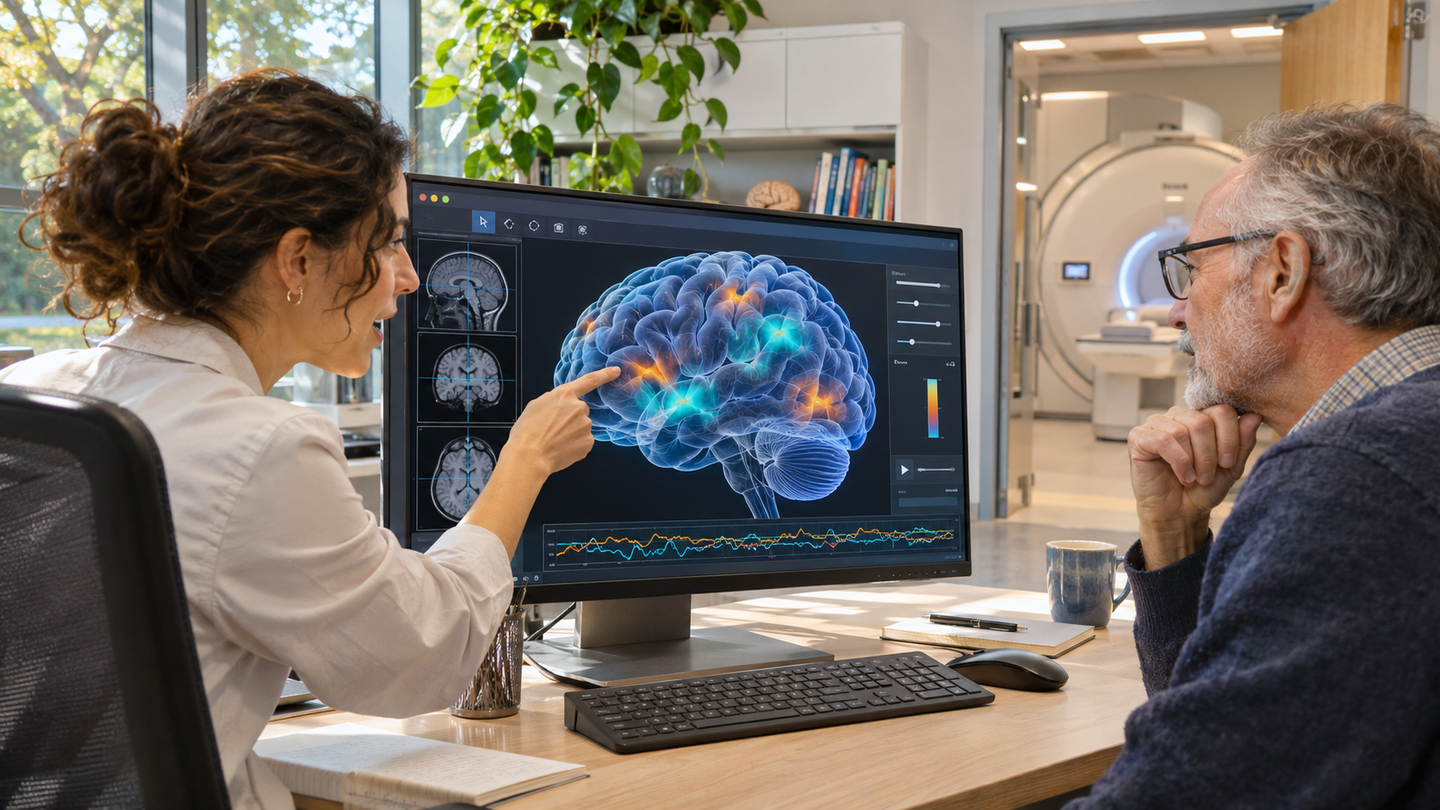
Personalized brain simulations reveal associations with aging and the environment, but their predictive value still needs testing. (CREDIT: The Brighter Side of News)
Nearly 7,000 people now have computer models of their brain activity, giving scientists a way to investigate differences hidden beneath conventional scans. These personalized simulations connect recorded signals with possible biological mechanisms. They also place brain aging within the social and environmental conditions of people's lives.
The international study appears in Nature Biomedical Engineering. Its authors include researchers from BrainLat at Universidad Adolfo Ibáñez. Their digital models represent selected brain processes, rather than complete copies of thoughts, memories or consciousness.
Participants ranged from 18 to 100 years old across 16 countries. The sample included 5,063 healthy individuals, 732 people with Alzheimer's disease, 459 with mild cognitive impairment and 732 with frontotemporal lobar degeneration. Together, they offered a broad view of differences across age and diagnosis.
Turning brain scans into biological simulations
The team began with resting-state functional magnetic resonance imaging, or fMRI. These scans track indirect signals associated with neural activity while participants rest. Unlike a structural image, brain imaging of this kind helps reveal patterns of activity shared between regions.
Each twin contained 90 connected brain regions, with interacting populations representing excitatory and inhibitory neurons. Excitatory signals encourage neurons to fire, while inhibitory signals restrain them. Researchers adjusted the models until their simulated MRI signals closely matched each person's recordings.
That process produced estimates of average activity, its irregularity and the balance between excitation and inhibition. These features offer possible explanations for recorded patterns, rather than direct measurements of individual neurons. A model can reproduce a signal without uniquely identifying every biological process behind it.
Such distinctions matter when interpreting digital twins. “MRI records indirect measures of neural activity,” said first author Rubén Herzog, a BrainLat researcher. The simulations extend those observations by asking which combinations of interacting processes might generate them.
The distinction between a scan and a mechanism is central to the approach. Two people can show different imaging patterns, but a scan alone does not explain why. A biological model offers a controlled setting for investigating how changes in its components could produce those differences.
Testing whether personalization adds value
To evaluate personalization, researchers compared individual and group-based models across 34 groups containing 2,018 participants. Personalized models improved agreement with observed activity by an average of 12%. Only 19 participants showed no improvement, indicating that individual adjustments usually captured information lost in group averages.
That result concerns how well simulations fit recorded brain activity. It does not mean diagnostic accuracy improved by 12%, or that the twins can forecast dementia. Predicting an outcome that has not happened requires a different test.
The team also checked a separate measure: gray matter volume. Among 6,017 participants with available measurements, more than 90% showed positive relationships between regional volume and model parameters governing excitability. The average correlation was 0.266.
Gray matter measurements did not enter the original fitting process. Their relationship with model parameters therefore supports biological relevance beyond matching scans alone. Still, this check does not establish that brain models capture every cellular mechanism correctly.
Another comparison retained the original structural connections without further optimization. Personalized models still improved the fit by approximately 9.4%. This additional analysis supported the value of individual modeling under a different setup, although agreement with existing recordings remains separate from successful prediction.
Aging and dementia leave different patterns
Age related most strongly to how regularly or unpredictably simulated neural activity fluctuated over time. The findings suggest that understanding aging brains requires examining the changing rhythm of activity, alongside its average level.
The twins also revealed regional differences associated with sex. These patterns involved excitation and inhibition, emphasizing that a single whole-brain average can conceal variation. A region showing relatively greater excitation can coexist with another showing stronger inhibition.
Disease comparisons required several features together: activity levels, variability and the balance between signals encouraging or restraining firing. Frontotemporal lobar degeneration showed the largest overall departure from healthy patterns. Alzheimer's disease and mild cognitive impairment showed intermediate changes.
The results do not reduce dementia to a universally overactive or underactive brain. Instead, they describe combinations of changes across regions and measurements. This approach gives researchers a more detailed framework for investigating neurodegenerative disease, without establishing a new clinical diagnostic test.
The breadth of the sample also matters for interpretation. Comparing healthy adults with several diagnostic groups helps distinguish age-associated patterns from those associated with disease. Nevertheless, comparisons between different people cannot reveal exactly how any one person's brain changed over their lifetime.
Connecting brain dynamics with lived conditions
The researchers examined 68 environmental and social indicators across 10 domains. Seven domains showed associations with simulated brain dynamics. Democratic conditions, soil and water quality, and air pollution produced the strongest overall relationships.
The democracy indicators covered conditions including participation, political representation, free choices and rule of law. These findings concern relationships across combined indicators. They do not establish that a particular political arrangement directly changes a person's neurons.
The main results remained consistent after accounting for age, sex, diagnosis, country, scanners and data quality. However, most environmental measurements represented national conditions rather than each participant's actual exposure. Country averages cannot describe every neighborhood, household or lifetime experience.
A complementary analysis examined eight individual social factors among 952 participants. Healthcare access, childhood experiences and financial circumstances showed associations with simulated activity. This added personal information to the broader investigation of environmental influences, while remaining observational.
The study captured participants at a single period rather than following their brains through changing conditions. Consequently, it cannot determine whether an environmental difference preceded a neural difference. Statistical adjustments reduce some alternative explanations, but they cannot eliminate every unmeasured influence or establish the direction of a relationship.
What virtual experiments must prove next
The models provide a way to change selected parameters and observe the simulated consequences. Researchers could explore how altering communication between neural populations affects whole-brain patterns. This turns brain simulation into a tool for developing and comparing possible explanations.
Future studies could incorporate maps of neurotransmitter receptors and simulate changes involving glutamate and GABA. These chemical messengers generally increase and reduce neural activity, respectively. Researchers could then investigate whether simulated changes move activity toward patterns found in healthy people of similar ages.
Those experiments would help prioritize hypotheses, rather than demonstrate that a treatment works. Likewise, modeling better healthcare access or cleaner air would require suitable intervention data. The present study cannot show that changing an exposure reverses disease.
A useful simulation must eventually face evidence beyond the observations used to build it. If an intervention changes a participant's measured brain activity, researchers can compare that outcome with the twin's prediction. Agreement would provide stronger support for its proposed mechanisms and possible research uses.
The team is sharing code and model parameters so others can reproduce and extend the analyses. The next decisive test is whether these personalized models anticipate changes measured in people over time or after an intervention. That evidence will determine how far virtual experiments can guide real-world brain research.
Dig deeper into digital brain models
These studies explain the foundations of personalized simulations and their relationship with brain health.
- Digital twin brain simulator for real-time consciousness monitoring and virtual intervention using primate electrocorticogram data: Explores a primate brain-model prototype that tracks recorded activity and simulates interventions during anesthesia. (npj Digital Medicine, February 2025)
- Dementia prevention, intervention, and care: 2024 report of the Lancet standing Commission: Reviews evidence on modifiable dementia risks, providing context for investigating environmental and social conditions. (The Lancet, August 2024)
- Brain simulation as a cloud service: The Virtual Brain on EBRAINS: Describes shared tools for constructing, fitting and analyzing brain-network simulations. (NeuroImage, May 2022)
- The Virtual Epileptic Patient: Individualized whole-brain models of epilepsy spread: Shows how patient-specific information can support simulations of seizure propagation, an earlier application of individualized brain modeling. (NeuroImage, January 2017)
- The Virtual Brain: a simulator of primate brain network dynamics: Introduces a foundational platform connecting brain anatomy with simulated large-scale activity. (Frontiers in Neuroinformatics, June 2013)
Research findings are available online in the journal Nature Biomedical Engineering.
The original story "Digital brain twins link aging and dementia with environmental conditions" is published in The Brighter Side of News.
Related Stories
- Creating a digital copy of the human brain faces a bigger problem than simulating 86 billion neurons
- Digital ‘super-brain’ with a physics education speeds up technology development
- Why does the right side of our brain control the left side of our body? New research may have the answer
Like these kind of feel good stories? Get The Brighter Side of News' newsletter.
Joshua Shavit
Writer and Editor
Joshua Shavit is a NorCal-based science and technology writer with a passion for exploring the breakthroughs shaping the future. As a co-founder of The Brighter Side of News, he focuses on positive and transformative advancements in technology, physics, engineering, robotics, and astronomy. Having published articles on AOL.com, MSN, Yahoo News, and Ground News, Joshua's work highlights the innovators behind the ideas, bringing readers closer to the people driving progress.